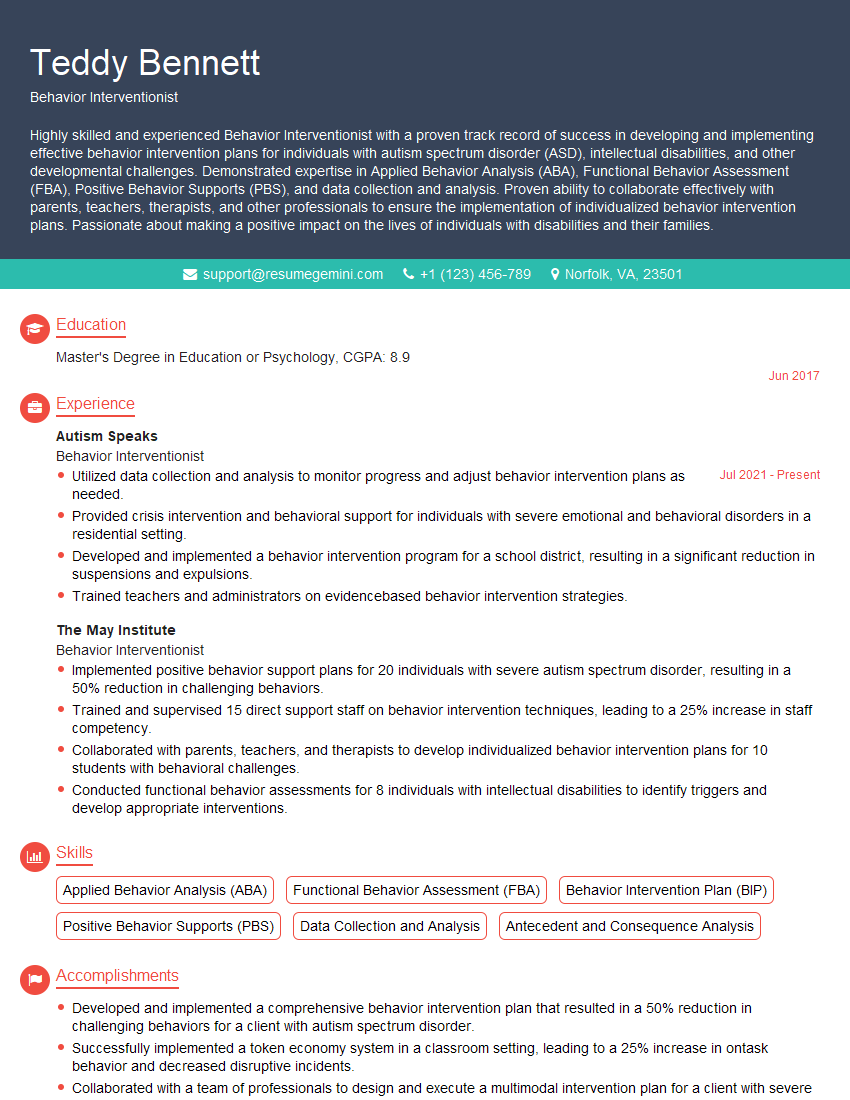
Are you gearing up for a career in Behavior Interventionist? Feeling nervous about the interview questions that might come your way? Don’t worry, you’re in the right place. In this blog post, we’ll dive deep into the most common interview questions for Behavior Interventionist and provide you with expert-backed answers. We’ll also explore the key responsibilities of this role so you can tailor your responses to showcase your perfect fit.
Acing the interview is crucial, but landing one requires a compelling resume that gets you noticed. Crafting a professional document that highlights your skills and experience is the first step toward interview success. ResumeGemini can help you build a standout resume that gets you called in for that dream job.






Essential Interview Questions For Behavior Interventionist
1. Define the principles of Applied Behavior Analysis (ABA)
ABA is a scientific discipline that uses the principles of reinforcement to change behavior. It is based on the idea that all behavior is learned and can be changed through reinforcement and punishment.
- Positive reinforcement: This is when a positive consequence is added to increase the likelihood of a behavior being repeated.
- Negative reinforcement: This is when a negative consequence is removed or withheld to increase the likelihood of a behavior being repeated.
- Punishment: This is when a negative consequence is added to decrease the likelihood of a behavior being repeated.
- Time-out: This is when a person is removed from a situation for a period of time as a consequence.
2. Explain the different methods of data collection used in ABA.
Observation
- Anecdotal notes: These are written descriptions of specific behaviors that are observed.
- Frequency counts: These are tallies of how often a behavior occurs over a period of time.
- Duration measures: These are measurements of how long a behavior lasts.
- Interval recording: This is a method of recording how many times a behavior occurs within a specified time interval.
Self-report
- Interviews: These are conversations with the individual about their behavior.
- Questionnaires: These are written surveys that ask questions about the individual’s behavior.
- Diaries: These are written records of the individual’s behavior that are kept over a period of time.
3. Describe the process of developing a behavior intervention plan.
- Assessment: Collect data on the individual’s behavior to identify the target behavior and the factors that influence it.
- Goal setting: Develop specific, measurable, achievable, relevant, and time-bound goals for the intervention.
- Intervention selection: Choose the most appropriate interventions based on the assessment data and the individual’s needs.
- Implementation: Carry out the interventions as planned.
- Evaluation: Collect data on the individual’s behavior to assess the effectiveness of the interventions and make adjustments as needed.
4. Discuss the ethical considerations in working as a behavior interventionist.
- Confidentiality: Maintain the privacy of the individuals you work with and keep their information confidential.
- Informed consent: Obtain informed consent from the individuals you work with before implementing any interventions.
- Respect for diversity: Respect the cultural and individual differences of the individuals you work with.
- Avoidance of harm: Do not use any interventions that could harm the individuals you work with.
5. Explain the importance of collaboration with other professionals in providing behavior intervention services.
Collaboration with other professionals is important to ensure that the individual receives the most appropriate and effective services.
- Medical professionals: Can provide medical evaluations and treatment for underlying medical conditions that may be contributing to the individual’s behavior.
- Mental health professionals: Can provide therapy and counseling to address the emotional and psychological factors that may be contributing to the individual’s behavior.
- Educational professionals: Can provide educational and behavioral support to the individual in school settings.
- Social service professionals: Can provide support and resources to the individual and their family.
6. Describe the role of supervision in the behavior intervention process.
Supervision is an essential component of the behavior intervention process. It provides the opportunity for behavior interventionists to receive support, guidance, and feedback from more experienced professionals.
- Case consultation: Supervisors can provide guidance on specific cases and help behavior interventionists develop effective intervention plans.
- Skill development: Supervisors can provide training and support to help behavior interventionists develop their skills.
- Quality assurance: Supervisors can review the work of behavior interventionists to ensure that it meets ethical and professional standards.
7. Discuss the challenges and rewards of working as a behavior interventionist.
Challenges
- Difficult clients: Working with individuals who have challenging behaviors can be emotionally and physically demanding.
- Limited resources: Behavior interventionists often work with limited resources, which can make it difficult to provide the best possible care.
- Burnout: Working with individuals who have challenging behaviors can lead to burnout.
Rewards
- Making a difference: Behavior interventionists can make a real difference in the lives of the individuals they work with.
- Intellectual stimulation: The work of a behavior interventionist is intellectually stimulating and constantly changing.
- Personal growth: Working as a behavior interventionist can lead to personal growth and development.
8. Explain the importance of continuing education and professional development for behavior interventionists.
Continuing education and professional development are important for behavior interventionists to stay up-to-date on the latest research and best practices in the field.
- Conferences and workshops: Attending conferences and workshops can provide behavior interventionists with the opportunity to learn about new research and best practices.
- Online courses: There are many online courses available that can help behavior interventionists learn about new topics and earn continuing education credits.
- Books and journals: Reading books and journals can help behavior interventionists stay up-to-date on the latest research and best practices.
9. Describe your experience in working with individuals with challenging behaviors.
I have worked with individuals with a variety of challenging behaviors, including aggression, self-injury, and tantrums. I have experience using a variety of interventions to address these behaviors, including positive reinforcement, negative reinforcement, time-out, and functional analysis.
In one case, I worked with a child who was engaging in aggressive behavior towards other children. I conducted a functional analysis of the child’s behavior and determined that the child was engaging in aggressive behavior to get attention from the other children.
I developed an intervention plan that included positive reinforcement for appropriate behavior and a time-out for aggressive behavior. I also worked with the child’s parents to teach them how to implement the intervention plan at home.
After implementing the intervention plan, the child’s aggressive behavior decreased significantly. The child was able to interact with other children in a more appropriate manner and was able to make friends.
10. What are your strengths and weaknesses as a behavior interventionist?
Strengths
- Passionate: I am passionate about helping individuals with challenging behaviors learn and grow.
- Patient: I am patient and understanding, even when working with individuals who are engaging in challenging behaviors.
- Creative: I am creative and able to think outside the box to develop individualized intervention plans.
- Collaborative: I am able to collaborate effectively with other professionals, including teachers, parents, and therapists.
Weaknesses
- Limited experience: I have limited experience working with individuals with severe challenging behaviors.
- Time management: I sometimes struggle to manage my time effectively when working with multiple clients.
Interviewers often ask about specific skills and experiences. With ResumeGemini‘s customizable templates, you can tailor your resume to showcase the skills most relevant to the position, making a powerful first impression. Also check out Resume Template specially tailored for Behavior Interventionist.
Career Expert Tips:
- Ace those interviews! Prepare effectively by reviewing the Top 50 Most Common Interview Questions on ResumeGemini.
- Navigate your job search with confidence! Explore a wide range of Career Tips on ResumeGemini. Learn about common challenges and recommendations to overcome them.
- Craft the perfect resume! Master the Art of Resume Writing with ResumeGemini’s guide. Showcase your unique qualifications and achievements effectively.
- Great Savings With New Year Deals and Discounts! In 2025, boost your job search and build your dream resume with ResumeGemini’s ATS optimized templates.
Researching the company and tailoring your answers is essential. Once you have a clear understanding of the Behavior Interventionist‘s requirements, you can use ResumeGemini to adjust your resume to perfectly match the job description.
Key Job Responsibilities
Behavior Interventionists are responsible for working with individuals who have behavioral challenges, such as those with autism spectrum disorder (ASD), developmental disabilities, or mental health conditions. They develop and implement behavior intervention plans to help these individuals improve their social, emotional, and behavioral skills.
1. Assessment and Evaluation
Assess individuals to identify behavioral challenges and develop appropriate intervention plans.
- Conduct functional behavior assessments to determine the underlying causes of challenging behaviors.
- Review medical and educational records, and consult with other professionals to gather relevant information.
2. Intervention Plan Development
Develop individualized behavior intervention plans based on assessment findings and evidence-based practices.
- Set specific and measurable goals for behavior change.
- Identify positive reinforcement strategies and consequences to encourage desired behaviors.
3. Intervention Implementation
Implement and monitor behavior intervention plans, providing direct instruction and support to individuals.
- Use positive reinforcement, such as praise, rewards, and social recognition, to encourage desired behaviors.
- Teach and model appropriate social and behavioral skills.
4. Data Collection and Analysis
Monitor and track progress, collecting data to evaluate the effectiveness of interventions.
- Use observation, checklists, and other data collection methods to track behavior changes.
- Analyze data to identify areas where adjustments to the intervention plan may be needed.
5. Collaboration and Communication
Collaborate with families, teachers, therapists, and other professionals to provide a comprehensive approach to behavior intervention.
- Keep families informed about their child’s progress and provide support and guidance.
- Attend meetings and participate in team discussions to share information and develop coordinated strategies.
Interview Tips
Preparing for an interview for a Behavior Interventionist position requires understanding the essential responsibilities of the role and demonstrating your qualifications. Here are some tips to help you ace your interview:
1. Research the Organization and Position
Familiarize yourself with the company’s mission, values, and services. Research the specific position and its responsibilities.
- Visit the company’s website and social media pages.
- Read job descriptions and company reviews.
2. Highlight Relevant Experience and Skills
Tailor your resume and cover letter to emphasize your experience working with individuals with behavioral challenges.
- Quantify your accomplishments using specific metrics whenever possible.
- Showcase your knowledge of behavior intervention techniques and evidence-based practices.
3. Prepare Examples of Your Work
Be ready to provide specific examples of your work, such as successful behavior intervention plans or case studies.
- Explain the challenges you encountered and how you addressed them.
- Highlight your problem-solving skills and ability to adapt your approach based on individual needs.
4. Demonstrate Your Passion for the Field
Convey your passion for working with individuals with behavioral challenges and your commitment to making a difference in their lives.
- Share personal stories or experiences that illustrate your dedication.
- Explain how your values align with the organization’s mission.
5. Ask Thoughtful Questions
At the end of the interview, ask thoughtful questions that demonstrate your interest in the position and the organization.
- Inquire about the organization’s approach to behavior intervention.
- Ask about opportunities for professional development and growth.
Next Step:
Now that you’re armed with the knowledge of Behavior Interventionist interview questions and responsibilities, it’s time to take the next step. Build or refine your resume to highlight your skills and experiences that align with this role. Don’t be afraid to tailor your resume to each specific job application. Finally, start applying for Behavior Interventionist positions with confidence. Remember, preparation is key, and with the right approach, you’ll be well on your way to landing your dream job. Build an amazing resume with ResumeGemini