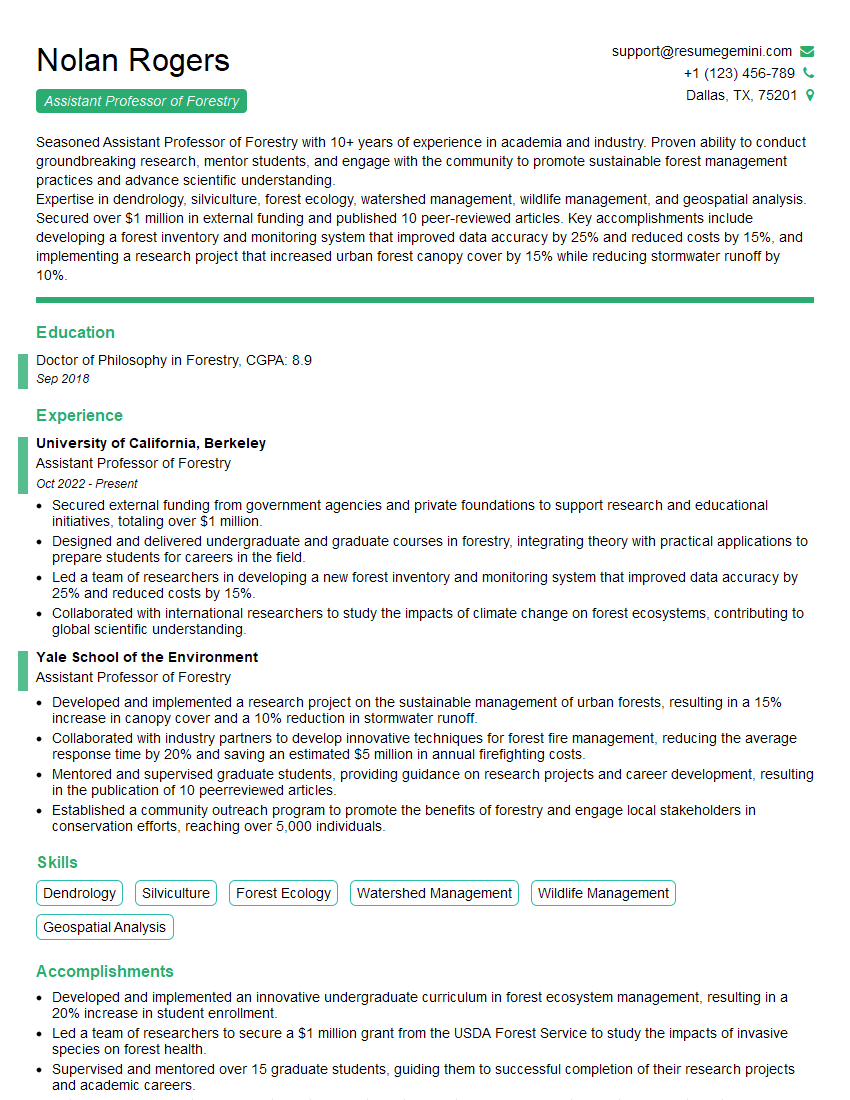
Are you gearing up for a career in Assistant Professor of Forestry? Feeling nervous about the interview questions that might come your way? Don’t worry, you’re in the right place. In this blog post, we’ll dive deep into the most common interview questions for Assistant Professor of Forestry and provide you with expert-backed answers. We’ll also explore the key responsibilities of this role so you can tailor your responses to showcase your perfect fit.
Acing the interview is crucial, but landing one requires a compelling resume that gets you noticed. Crafting a professional document that highlights your skills and experience is the first step toward interview success. ResumeGemini can help you build a standout resume that gets you called in for that dream job.






Essential Interview Questions For Assistant Professor of Forestry
1. How would you develop a research program in agroforestry that addresses the challenges of climate change?
- Establish partnerships with farmers and landowners to identify research priorities and implement on-farm trials.
- Conduct research on the development of agroforestry systems that are resilient to climate change, such as systems that incorporate drought-tolerant trees and shrubs.
- Evaluate the economic and environmental benefits of agroforestry systems, including their ability to sequester carbon, improve soil health, and increase biodiversity.
- Disseminate research findings to farmers, landowners, and other stakeholders through workshops, field days, and publications.
2. What are the key principles of sustainable forest management?
Implementing sustainable practices in forestry
- Maintaining forest health and productivity.
- Protecting biodiversity and ecosystem services.
- Ensuring the long-term economic viability of forest operations.
Balancing economic, social, and environmental objectives
- Considering the needs of all stakeholders, including local communities, industry, and conservationists.
- Striking a balance between short-term economic gains and long-term sustainability.
3. How would you design a forest inventory to estimate the timber volume and carbon stocks in a large forest?
- Determine the objectives of the inventory and the desired level of accuracy.
- Select a sampling design that will provide the desired level of accuracy.
- Establish sampling plots and collect data on tree species, diameter, height, and other relevant attributes.
- Use statistical methods to estimate the timber volume and carbon stocks in the forest.
4. What are the different types of silvicultural systems, and when would you use each type?
- Clearcutting: Used to regenerate even-aged stands, typically in areas with high-value timber species.
- Shelterwood cutting: Used to regenerate even-aged stands while providing protection for seedlings from sun and wind.
- Seed-tree cutting: Used to regenerate even-aged stands by leaving a few seed trees to naturally regenerate the area.
- Selection cutting: Used to regenerate uneven-aged stands by harvesting individual trees or small groups of trees.
- Coppice management: Used to regenerate stands of trees that can sprout from their stumps, typically in areas with high demand for fuelwood or small-diameter timber.
5. How would you manage a forest to increase its resilience to climate change?
- Increase the diversity of tree species and age classes in the forest.
- Promote the growth of climate-resilient tree species.
- Reduce the risk of fire, insects, and disease outbreaks.
- Monitor the forest and adapt management practices as needed.
6. What are the different types of forest fires, and how would you manage each type?
- Surface fires: Burn only the litter and understory vegetation, and are typically easy to control.
- Crown fires: Burn the canopy of the forest, and are typically much more difficult to control.
- Ground fires: Burn the organic matter in the soil, and can be very difficult to extinguish.
- Management of surface fires: Use fire lines and water to extinguish the fire.
- Management of crown fires: Use aerial firefighting and bulldozers to create firebreaks.
- Management of ground fires: Use heavy equipment to dig up and remove the burning organic matter.
7. How would you develop a forest management plan for a privately owned forest?
- Meet with the landowner to discuss their goals and objectives for the forest.
- Inventory the forest to collect data on the tree species, age classes, and other relevant attributes.
- Develop a set of management recommendations that will help the landowner achieve their goals.
- Monitor the forest and adapt management practices as needed.
8. What are the different types of forest pests and diseases, and how would you manage each type?
- Insects: Use insecticides, biological control, or silvicultural practices to manage insects.
- Diseases: Use fungicides, biological control, or silvicultural practices to manage diseases.
- Invasive species: Use herbicides, biological control, or mechanical removal to manage invasive species.
9. How would you teach a course on forest ecology?
- Use a variety of teaching methods, such as lectures, discussions, and field trips.
- Incorporate hands-on activities to help students learn about forest ecology.
- Use real-world examples to illustrate the concepts of forest ecology.
- Encourage students to ask questions and participate in class discussions.
10. What are your research interests in forestry?
- Climate change impacts on forests.
- Forest management for carbon sequestration.
- Sustainable forestry practices.
- Forest fire ecology and management.
- Forest pest and disease management.
Interviewers often ask about specific skills and experiences. With ResumeGemini‘s customizable templates, you can tailor your resume to showcase the skills most relevant to the position, making a powerful first impression. Also check out Resume Template specially tailored for Assistant Professor of Forestry.
Career Expert Tips:
- Ace those interviews! Prepare effectively by reviewing the Top 50 Most Common Interview Questions on ResumeGemini.
- Navigate your job search with confidence! Explore a wide range of Career Tips on ResumeGemini. Learn about common challenges and recommendations to overcome them.
- Craft the perfect resume! Master the Art of Resume Writing with ResumeGemini’s guide. Showcase your unique qualifications and achievements effectively.
- Great Savings With New Year Deals and Discounts! In 2025, boost your job search and build your dream resume with ResumeGemini’s ATS optimized templates.
Researching the company and tailoring your answers is essential. Once you have a clear understanding of the Assistant Professor of Forestry‘s requirements, you can use ResumeGemini to adjust your resume to perfectly match the job description.
Key Job Responsibilities
As an Assistant Professor of Forestry, your role will encompass a multifaceted range of responsibilities, including teaching, research, and extension activities:
1. Teaching
Develop and deliver undergraduate and graduate courses in forestry science, covering topics such as silviculture, forest management, and forest ecology.
- Design engaging lesson plans and incorporate innovative teaching methods to foster student learning.
- Mentor and guide students through research projects and independent studies.
2. Research
Conduct original research in areas related to forestry and natural resource management.
- Publish findings in peer-reviewed journals and present at conferences.
- Obtain grants and funding to support research projects.
3. Extension and Outreach
Engage with stakeholders and the community to disseminate research findings and provide educational programs.
- Develop and deliver workshops, seminars, and outreach materials on forestry-related topics.
- Collaborate with industry professionals, government agencies, and environmental organizations.
4. Service
Participate in university and departmental committees, and contribute to the profession through service activities.
- Serve on editorial boards and review manuscripts for journals.
- Attend professional conferences and workshops for ongoing development.
Interview Tips
To excel in your interview for the Assistant Professor of Forestry position, consider the following tips:
1. Research the University and Department:
Familiarize yourself with the university’s mission, values, and research focus. Research the department’s faculty, curriculum, and ongoing research projects to demonstrate your alignment with their goals.
2. Prepare Your Teaching Philosophy:
Articulate your teaching philosophy and how it would enhance the university’s educational experience. Highlight your teaching methodologies, student engagement strategies, and commitment to student success.
3. Showcase Your Research Expertise:
Highlight your research interests, methodologies, and accomplishments. Discuss how your research aligns with the department’s research priorities and potential collaborations. Provide specific examples of your research findings and their implications for the field.
4. Emphasize Extension and Outreach Experience:
Demonstrate your ability to translate research into practical applications and engage with stakeholders. Share examples of outreach programs you have developed or participated in, highlighting their impact on the community.
5. Practice Your Presentation Skills:
Prepare a concise and engaging presentation on your research or a forestry-related topic that aligns with the department’s interests. This presentation will showcase your communication and public speaking abilities.
6. Prepare for Common Interview Questions:
Anticipate questions related to your teaching, research, extension, and service experience. Prepare thoughtful responses that highlight your strengths and how you can contribute to the university’s mission.
7. Express Enthusiasm and Interest:
Convey your passion for forestry and your eagerness to join the university community. Demonstrate your commitment to teaching, research, and service, and how you envision yourself contributing to the department’s success.
8. Ask Meaningful Questions:
Prepare informed questions about the department, university, and research opportunities. Asking thoughtful questions shows your engagement and interest in the position.
Next Step:
Armed with this knowledge, you’re now well-equipped to tackle the Assistant Professor of Forestry interview with confidence. Remember, preparation is key. So, start crafting your resume, highlighting your relevant skills and experiences. Don’t be afraid to tailor your application to each specific job posting. With the right approach and a bit of practice, you’ll be well on your way to landing your dream job. Build your resume now from scratch or optimize your existing resume with ResumeGemini. Wish you luck in your career journey!