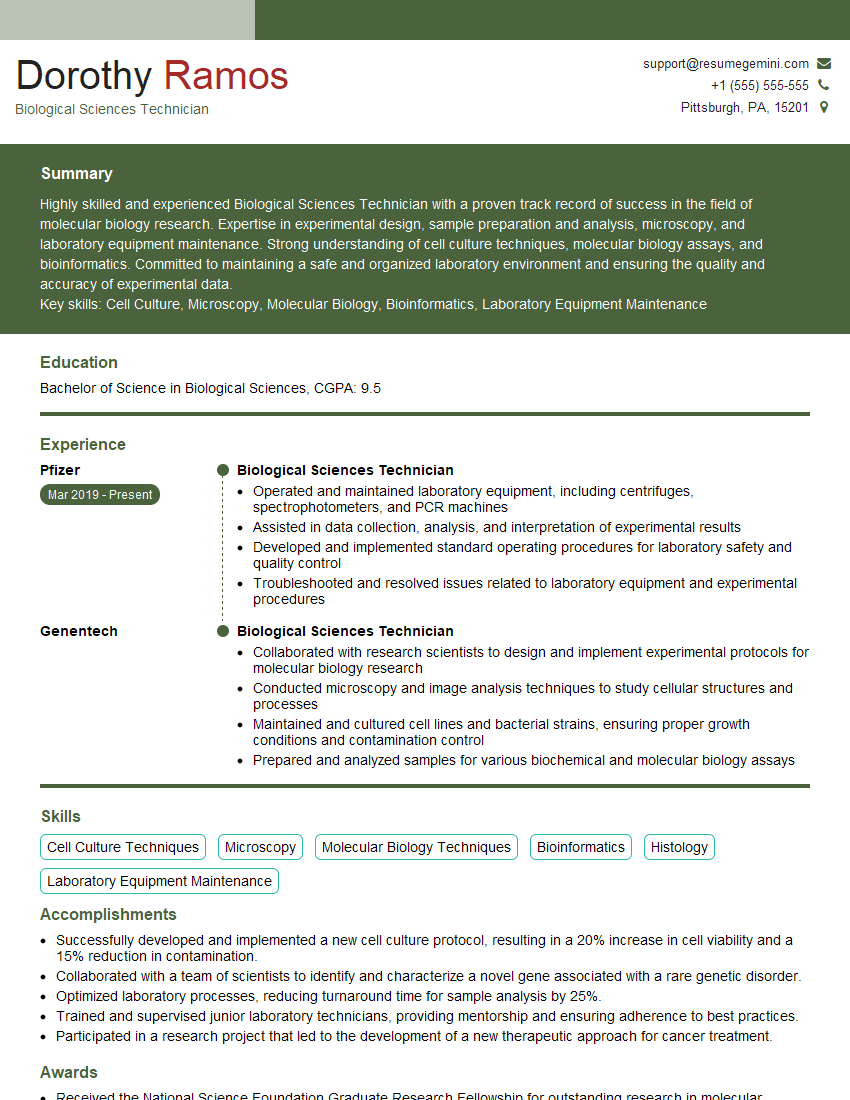
Are you gearing up for a career in Biological Sciences Technician? Feeling nervous about the interview questions that might come your way? Don’t worry, you’re in the right place. In this blog post, we’ll dive deep into the most common interview questions for Biological Sciences Technician and provide you with expert-backed answers. We’ll also explore the key responsibilities of this role so you can tailor your responses to showcase your perfect fit.
Acing the interview is crucial, but landing one requires a compelling resume that gets you noticed. Crafting a professional document that highlights your skills and experience is the first step toward interview success. ResumeGemini can help you build a standout resume that gets you called in for that dream job.






Essential Interview Questions For Biological Sciences Technician
1. What are the key responsibilities of a Biological Sciences Technician?
The key responsibilities of a Biological Sciences Technician include:
- Preparing and maintaining laboratory equipment, materials, and supplies.
- Conducting experiments and collecting data under the supervision of a scientist or researcher.
- Maintaining accurate records of experimental procedures and results.
- Assisting with the training of new laboratory personnel.
- Ensuring that laboratory safety protocols are followed.
2. What are your strengths and weaknesses as a Biological Sciences Technician?
My strengths as a Biological Sciences Technician include:
- I am highly organized and detail-oriented.
- I have strong problem-solving skills.
- I am proficient in a variety of laboratory techniques.
- I am a team player and I am always willing to help others.
My weaknesses include:
- I am not always the most confident public speaker.
- I can sometimes be a bit too perfectionistic.
3. What is your experience with using laboratory equipment, such as microscopes, pipettes, and spectrophotometers?
I have experience using a wide variety of laboratory equipment, including microscopes, pipettes, and spectrophotometers. I am proficient in using these instruments to conduct experiments and collect data.
For example, I have used microscopes to examine cells and tissues, pipettes to measure and dispense liquids, and spectrophotometers to measure the concentration of chemicals in solutions.
4. What is your experience with maintaining laboratory equipment?
I have experience with maintaining a variety of laboratory equipment, including microscopes, pipettes, and spectrophotometers. I am familiar with the manufacturer’s recommended maintenance procedures for these instruments.
For example, I know how to clean and calibrate microscopes, pipettes, and spectrophotometers. I also know how to troubleshoot common problems with these instruments.
5. What is your experience with conducting experiments and collecting data?
I have experience with conducting a variety of experiments, including cell culture experiments, molecular biology experiments, and biochemical experiments. I am familiar with the scientific method and I know how to design and conduct experiments to test hypotheses.
I am also proficient in collecting and analyzing data. I am familiar with a variety of statistical software packages and I can use these packages to analyze data and generate graphs and charts.
6. What is your experience with maintaining accurate records of experimental procedures and results?
I am experienced with maintaining accurate records of experimental procedures and results. I keep a detailed laboratory notebook in which I record all of my experimental procedures and results.
I also use a variety of electronic data management systems to store and organize my data. I am familiar with the principles of data integrity and I take steps to ensure that my data is accurate and reliable.
7. What is your experience with assisting with the training of new laboratory personnel?
I have experience with assisting with the training of new laboratory personnel. I have helped to train new laboratory technicians on a variety of topics, including laboratory safety, laboratory techniques, and data analysis.
I am patient and I am able to explain complex concepts in a clear and concise manner. I am also able to provide hands-on training and I am always willing to answer questions.
8. What is your experience with ensuring that laboratory safety protocols are followed?
I am experienced with ensuring that laboratory safety protocols are followed. I am familiar with the Occupational Safety and Health Administration (OSHA) regulations and I take steps to ensure that my work environment is safe.
For example, I always wear appropriate personal protective equipment (PPE), such as gloves, safety glasses, and a lab coat. I also make sure that my work area is clean and organized.
9. What are your career goals?
My career goals are to become a research scientist. I am interested in studying the molecular basis of human diseases. I believe that my skills and experience as a Biological Sciences Technician will provide me with a strong foundation for a career in research.
10. Do you have any questions for me?
I do not have any questions for you at this time.
Interviewers often ask about specific skills and experiences. With ResumeGemini‘s customizable templates, you can tailor your resume to showcase the skills most relevant to the position, making a powerful first impression. Also check out Resume Template specially tailored for Biological Sciences Technician.
Career Expert Tips:
- Ace those interviews! Prepare effectively by reviewing the Top 50 Most Common Interview Questions on ResumeGemini.
- Navigate your job search with confidence! Explore a wide range of Career Tips on ResumeGemini. Learn about common challenges and recommendations to overcome them.
- Craft the perfect resume! Master the Art of Resume Writing with ResumeGemini’s guide. Showcase your unique qualifications and achievements effectively.
- Great Savings With New Year Deals and Discounts! In 2025, boost your job search and build your dream resume with ResumeGemini’s ATS optimized templates.
Researching the company and tailoring your answers is essential. Once you have a clear understanding of the Biological Sciences Technician‘s requirements, you can use ResumeGemini to adjust your resume to perfectly match the job description.
Key Job Responsibilities
Biological Sciences Technicians play a vital role in the field of biological sciences, conducting various technical tasks to support research and development activities. Their responsibilities encompass a wide range of duties, including:
1. Laboratory Operations
Performing laboratory procedures and experiments following established protocols.
- Preparing and maintaining laboratory equipment, glassware, and reagents.
- Handling biological samples, including collection, preservation, and analysis.
2. Data Management
Documenting and recording experimental data accurately and efficiently.
- Analyzing and interpreting experimental results using statistical techniques.
- Preparing reports and presentations summarizing findings.
3. Equipment Maintenance
Maintaining and calibrating laboratory equipment to ensure accuracy and reliability.
- Troubleshooting and resolving equipment malfunctions.
- Performing routine maintenance tasks to prevent equipment failures.
4. Safety and Compliance
Adhering to laboratory safety protocols and regulations.
- Handling hazardous materials and waste properly.
- Maintaining a clean and organized work environment.
Interview Tips
Preparing for a job interview can be daunting, but with proper planning and practice, you can increase your chances of making a positive impression. Here are some key tips to help you ace your Biological Sciences Technician interview:
1. Research the Company and Position
Take the time to learn about the company’s mission, values, and recent developments. Research the specific role you are applying for and understand its responsibilities and requirements.
2. Practice Your Answers
Anticipate common interview questions and prepare your answers thoroughly. Practice delivering your responses confidently and concisely.
3. Highlight Your Skills and Experience
Tailor your resume and cover letter to the job description, emphasizing your relevant skills and experience. Quantify your accomplishments whenever possible.
4. Be Enthusiastic and Professional
Show genuine interest in the position and the company. Maintain a professional demeanor throughout the interview, demonstrating your enthusiasm for the field of biological sciences.
5. Ask Thoughtful Questions
At the end of the interview, prepare insightful questions to demonstrate your interest and knowledge. This shows that you are engaged in the conversation and actively seeking more information.
Next Step:
Armed with this knowledge, you’re now well-equipped to tackle the Biological Sciences Technician interview with confidence. Remember, preparation is key. So, start crafting your resume, highlighting your relevant skills and experiences. Don’t be afraid to tailor your application to each specific job posting. With the right approach and a bit of practice, you’ll be well on your way to landing your dream job. Build your resume now from scratch or optimize your existing resume with ResumeGemini. Wish you luck in your career journey!