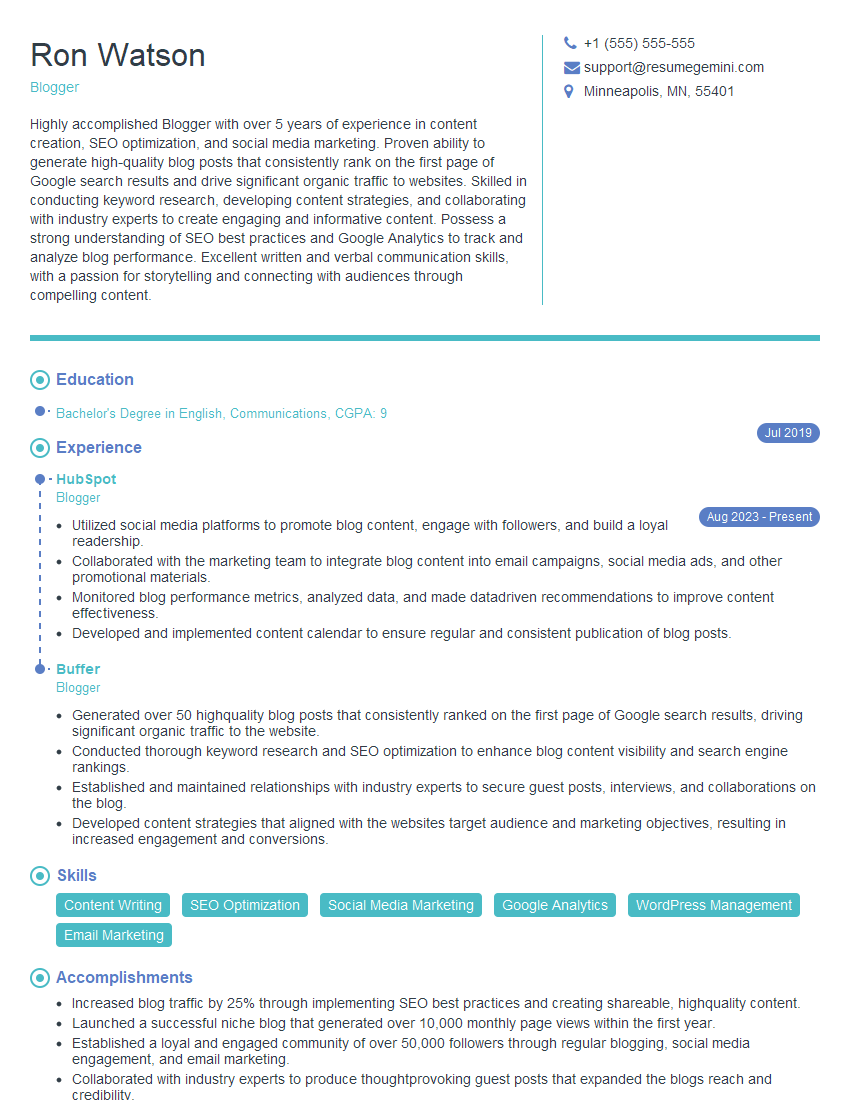
Are you gearing up for a career shift or aiming to ace your next interview? Look no further! We’ve curated a comprehensive guide to help you crack the interview for the coveted Blogger position. From understanding the key responsibilities to mastering the most commonly asked questions, this blog has you covered. So, buckle up and let’s embark on this journey together
Acing the interview is crucial, but landing one requires a compelling resume that gets you noticed. Crafting a professional document that highlights your skills and experience is the first step toward interview success. ResumeGemini can help you build a standout resume that gets you called in for that dream job.






Essential Interview Questions For Blogger
1. Explain the process of optimizing a blog post for search engines, including keyword research and on-page optimization?
- Keyword research: Identifying relevant keywords and phrases that target specific search queries.
- On-page optimization: Optimizing elements within the blog post for search engines, including:
- Page title and meta description
- Heading structure (H1, H2, etc.)
- Content relevance and keyword usage
- Image optimization and alt tags
- Website speed and mobile responsiveness
2. How do you track and measure the success of a blog post using analytics?
Tracking metrics
- Website traffic
- Time on page
- Bounce rate
- Conversion rate
Analytics tools
- Google Analytics
- Google Search Console
- Social media analytics platforms
3. Describe your approach to creating engaging and high-quality blog content?
Research and planning: Understanding the target audience, conducting topic research, and outlining the post.
Writing: Using clear and concise language, storytelling techniques, and relevant examples to engage readers.
Editing and formatting: Proofreading for grammatical and spelling errors, optimizing for readability, and formatting for visual appeal.
4. How do you promote a blog post on social media and other platforms?
- Social media: Sharing the post on relevant social media channels, using appropriate hashtags and engaging with followers.
- Email marketing: Sending newsletters to subscribers and including links to the post.
- Paid advertising: Using social media or search engine ads to reach a wider audience.
- Collaborations: Partnering with other bloggers or influencers to promote the post.
5. How do you build a loyal following of readers and encourage them to return to your blog?
- Consistency: Regularly publishing high-quality content.
- Engagement: Responding to comments, answering questions, and fostering a sense of community.
- Value: Providing valuable information, insights, or entertainment that resonates with readers.
- Exclusivity: Offering exclusive content or perks to loyal followers.
6. What are some ethical considerations to keep in mind when blogging?
- Accuracy and fact-checking: Verifying information before publishing and citing sources.
- Privacy and anonymity: Respecting the confidentiality of sources and protecting personal information.
- Bias and opinion: Clearly distinguishing between facts and opinions, and avoiding offensive or discriminatory language.
- Copyright and intellectual property: Acknowledging and giving credit to the original creators of content.
7. How do you stay up-to-date with the latest trends and best practices in blogging?
- Industry blogs and publications: Reading articles from reputable sources to stay informed about new techniques and strategies.
- Social media: Following industry leaders and participating in online discussions.
- Conferences and workshops: Attending events to learn from experienced bloggers and network with others.
- Online courses and certifications: Enrolling in programs to enhance knowledge and skills.
8. How do you handle negative comments or criticism?
Stay professional and respectful: Respond in a polite and non-confrontational manner.
Address the specific concerns: Provide evidence to support your position or acknowledge valid points.
Avoid personal attacks: Focus on the issue rather than the person making the criticism.
Consider removing offensive or abusive comments: If necessary, take action to maintain a positive and respectful environment.
9. How do you manage your time and prioritize tasks as a blogger?
- Create a schedule: Plan out tasks for the week or month, allocating time for writing, editing, promoting, and administrative work.
- Use a task management system: Track progress and deadlines using tools like Trello or Asana.
- Delegate tasks: If possible, outsource or collaborate with others to free up time for higher-priority tasks.
- Take breaks: Avoid burnout by scheduling time for rest and relaxation.
10. How do you define success as a blogger?
Audience engagement: Building a loyal following and receiving positive feedback.
Content quality: Creating and publishing high-quality content that resonates with readers.
Website traffic and growth: Increasing website traffic and expanding the reach of the blog.
Personal satisfaction and growth: Enjoying the writing process and developing as a content creator.
Interviewers often ask about specific skills and experiences. With ResumeGemini‘s customizable templates, you can tailor your resume to showcase the skills most relevant to the position, making a powerful first impression. Also check out Resume Template specially tailored for Blogger.
Career Expert Tips:
- Ace those interviews! Prepare effectively by reviewing the Top 50 Most Common Interview Questions on ResumeGemini.
- Navigate your job search with confidence! Explore a wide range of Career Tips on ResumeGemini. Learn about common challenges and recommendations to overcome them.
- Craft the perfect resume! Master the Art of Resume Writing with ResumeGemini’s guide. Showcase your unique qualifications and achievements effectively.
- Great Savings With New Year Deals and Discounts! In 2025, boost your job search and build your dream resume with ResumeGemini’s ATS optimized templates.
Researching the company and tailoring your answers is essential. Once you have a clear understanding of the Blogger‘s requirements, you can use ResumeGemini to adjust your resume to perfectly match the job description.
Key Job Responsibilities
Bloggers play a key role in creating and managing content for websites, social media, and other online platforms. They are responsible for researching, writing, editing, and publishing high-quality articles, blog posts, and other forms of content. Bloggers may also work with other content creators, such as graphic designers and videographers, to develop engaging and informative content.
1. Content Creation
Bloggers are responsible for creating original and engaging content that is relevant to their target audience. This may include writing blog posts, articles, videos, or other forms of content. Bloggers must have a strong understanding of their topic and be able to write clearly and concisely.
- Researching and identifying topics that are relevant to their target audience
- Writing and editing blog posts, articles, and other forms of content
- Proofreading and editing their work, as well as the work of others
2. Content Optimization
Bloggers must optimize their content for search engines (SEO) so that it can be easily found by potential readers. This involves using relevant keywords and phrases in their content and promoting their blog on social media and other online platforms.
- Using relevant keywords and phrases in their content
- Promoting their blog on social media and other online platforms
- Tracking the results of their SEO efforts and making adjustments as needed
3. Community Engagement
Bloggers must engage with their audience and build a community around their blog. This involves responding to comments, answering questions, and participating in discussions on social media and other online platforms.
- Responding to comments and questions on their blog and social media
- Participating in discussions on social media and other online platforms
- Hosting contests and giveaways to engage their audience
4. Analytics and Reporting
Bloggers must track the results of their efforts and report on their progress to their clients or supervisors. This may involve using Google Analytics or other tools to track traffic to their blog and measure the effectiveness of their content.
- Using Google Analytics or other tools to track traffic to their blog
- Measuring the effectiveness of their content
- Reporting on their progress to their clients or supervisors
Interview Tips
Preparing for a job interview can be a daunting task, but it is important to do your research and practice your answers to common interview questions. Here are a few tips to help you ace your next interview for a blogging position:
1. Research the Company
Before your interview, take some time to research the company you are applying to. This will help you understand their culture, values, and goals. You should also research the specific position you are applying for and the company’s blogging strategy.
- Go to the company’s website and read about their history, mission, and products or services
- Read the job description carefully and identify the key skills and qualifications required
- Use LinkedIn to research the company’s employees and learn more about their culture
2. Showcase Your Skills
In your interview, be sure to highlight your skills and experience that are relevant to the blogging position. This may include your writing ability, your knowledge of SEO, and your experience with social media. You should also be prepared to discuss your ideas for how you can contribute to the company’s blogging strategy.
- Bring samples of your work to the interview, such as blog posts, articles, or videos
- Discuss your SEO skills and experience
- Talk about your experience with social media and how you can use it to promote the company’s blog
3. Be Prepared for Common Interview Questions
There are a few common interview questions that you are likely to be asked in a blogging interview. These questions may include:
- Tell me about your experience with blogging
- What are your strengths and weaknesses as a blogger?
- How do you stay up-to-date on the latest blogging trends?
- What are your goals for this position?
4. Be Enthusiastic and Professional
It is important to be enthusiastic and professional throughout your interview. This will show the interviewer that you are passionate about blogging and that you are serious about the position. Be sure to make eye contact, smile, and dress appropriately.
- Make eye contact with the interviewer and smile
- Dress appropriately for the interview
- Be polite and respectful to the interviewer
Next Step:
Now that you’re armed with a solid understanding of what it takes to succeed as a Blogger, it’s time to turn that knowledge into action. Take a moment to revisit your resume, ensuring it highlights your relevant skills and experiences. Tailor it to reflect the insights you’ve gained from this blog and make it shine with your unique qualifications. Don’t wait for opportunities to come to you—start applying for Blogger positions today and take the first step towards your next career milestone. Your dream job is within reach, and with a polished resume and targeted applications, you’ll be well on your way to achieving your career goals! Build your resume now with ResumeGemini.