Are you gearing up for a career shift or aiming to ace your next interview? Look no further! We’ve curated a comprehensive guide to help you crack the interview for the coveted Brake Engineer position. From understanding the key responsibilities to mastering the most commonly asked questions, this blog has you covered. So, buckle up and let’s embark on this journey together.
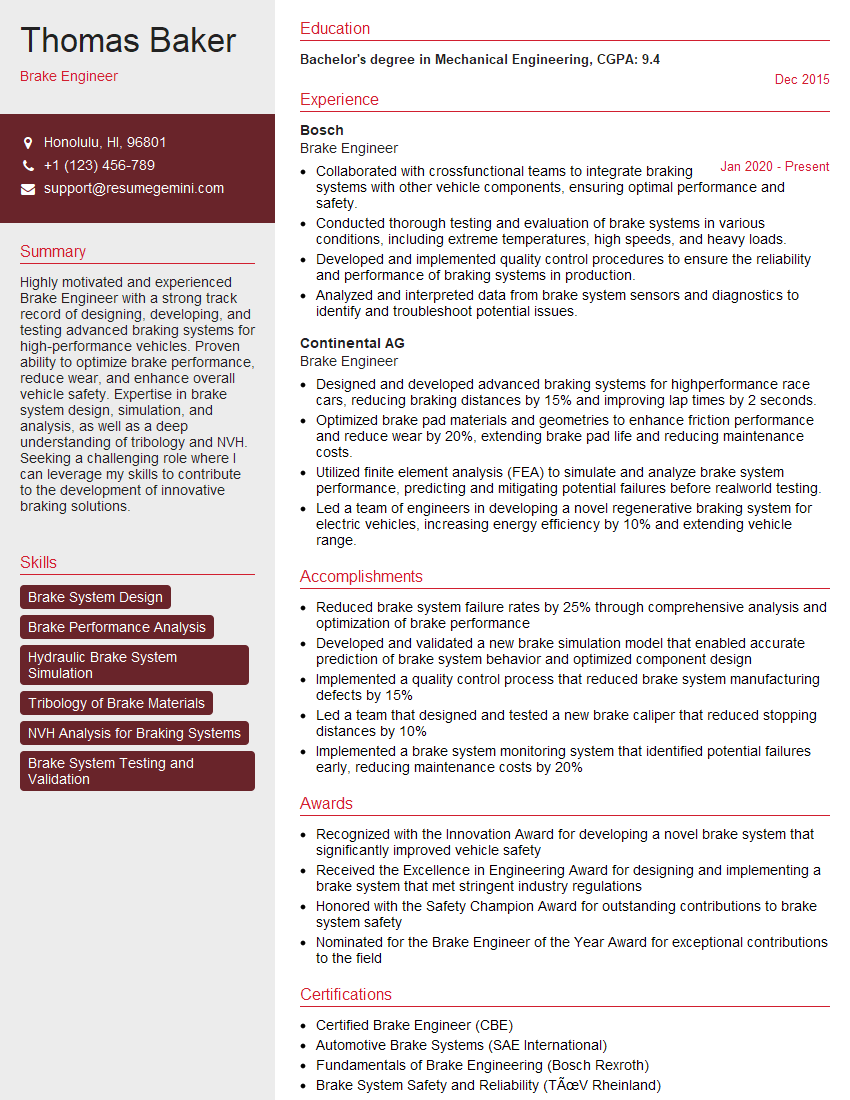
Acing the interview is crucial, but landing one requires a compelling resume that gets you noticed. Crafting a professional document that highlights your skills and experience is the first step toward interview success. ResumeGemini can help you build a standout resume that gets you called in for that dream job.






Essential Interview Questions For Brake Engineer
1. What are the different types of brake systems used in vehicles?
- Hydraulic Brake System: Uses hydraulic fluid to transmit force from the master cylinder to the wheel cylinders, which activate the brake pads.
- Air Brake System: Employs compressed air to actuate the brake chambers, which in turn engage the brake shoes or pads.
- Mechanical Brake System: Utilizes cables, levers, and linkages to transfer mechanical force from the brake pedal to the brake shoes or pads.
2. Explain the function and operation of an anti-lock braking system (ABS).
- Function: Prevents wheel lock-up during braking, allowing for better vehicle control and stability.
- Operation: Uses wheel speed sensors to detect impending lock-up. When a wheel is about to lock, the ABS system modulates brake pressure to the wheel, allowing it to continue rolling while maintaining braking force.
3. What are the factors that influence the effectiveness of a brake system?
- Coefficient of friction between brake pads and rotors
- Brake caliper design and efficiency
- Brake fluid quality and condition
- Tire condition and tread depth
- Vehicle weight and distribution
- Environmental factors (e.g., temperature, humidity)
4. Describe the process of troubleshooting a brake system failure.
- Identify the symptoms of the failure (e.g., excessive pedal travel, spongy pedal, pulling to one side)
- Perform a visual inspection of the brake components for leaks, wear, or damage
- Check brake fluid level and condition
- Use diagnostic tools to test sensors, actuators, and other electrical components
- Identify and replace any faulty parts
5. What are the safety precautions that should be taken when working on a brake system?
- Park the vehicle on a level surface and engage the parking brake
- Wear appropriate safety gear (e.g., gloves, eye protection)
- Inspect the brake system thoroughly before starting any work
- Use the correct tools and techniques
- Never bleed the brake system without proper ventilation
6. Explain the design considerations for a brake system in a high-performance vehicle.
- Increased heat dissipation due to higher braking forces
- Improved fade resistance and linearity
- Weight reduction for better acceleration and handling
- Integration with electronic stability control systems
- Upgraded pads and rotors for enhanced performance
7. What are the latest advancements in brake technology?
- Electric brake systems for improved efficiency and responsiveness
- Carbon-ceramic brakes for exceptional heat resistance and stopping power
- Regenerative braking systems to recover energy during deceleration
- Autonomous emergency braking systems to prevent collisions
- Connected brake systems for remote monitoring and diagnostics
8. What are your thoughts on the future of brake system design?
The future of brake system design is likely to focus on the following areas:
- Further integration with advanced driver assistance systems (ADAS)
- Increased use of lightweight materials and innovative designs
- Development of self-adjusting and self-monitoring brake systems
- Exploration of alternative braking technologies (e.g., magnetic brakes)
- Emphasis on safety, efficiency, and reduced environmental impact
9. Describe a challenging brake system project that you have worked on and how you overcame the obstacles.
Explain a specific project where you encountered a complex brake system issue and discuss:
- Identification: How you diagnosed the problem and determined its root cause
- Troubleshooting: The steps you took to resolve the issue
- Overcoming Obstacles: Any challenges you encountered and how you addressed them
- Solutions: The specific solutions you implemented to solve the problem
- Outcomes: The results achieved and the impact on the vehicle’s performance
10. What industry standards and best practices do you follow in your approach to brake system design and engineering?
- SAE International Standards
- Federal Motor Vehicle Safety Standards (FMVSS)
- ISO 26115 for functional safety of automotive systems
- Best practices from industry leaders and research institutions
- Continuous professional development and training to stay current with advancements
Interviewers often ask about specific skills and experiences. With ResumeGemini‘s customizable templates, you can tailor your resume to showcase the skills most relevant to the position, making a powerful first impression. Also check out Resume Template specially tailored for Brake Engineer.
Career Expert Tips:
- Ace those interviews! Prepare effectively by reviewing the Top 50 Most Common Interview Questions on ResumeGemini.
- Navigate your job search with confidence! Explore a wide range of Career Tips on ResumeGemini. Learn about common challenges and recommendations to overcome them.
- Craft the perfect resume! Master the Art of Resume Writing with ResumeGemini’s guide. Showcase your unique qualifications and achievements effectively.
- Great Savings With New Year Deals and Discounts! In 2025, boost your job search and build your dream resume with ResumeGemini’s ATS optimized templates.
Researching the company and tailoring your answers is essential. Once you have a clear understanding of the Brake Engineer‘s requirements, you can use ResumeGemini to adjust your resume to perfectly match the job description.
Key Job Responsibilities
Brake Engineers play a critical role in ensuring the safety and performance of vehicles. They are responsible for designing, developing, testing, and evaluating braking systems to meet industry standards and customer requirements.
1. Design and Development
Collaborate with design and engineering teams to develop and optimize brake systems for various types of vehicles, including cars, trucks, and motorcycles.
- Analyze braking system requirements and conduct research to identify optimal solutions.
- Create concept designs and use computer-aided design (CAD) software to develop detailed drawings and specifications.
2. Testing and Evaluation
Conduct rigorous testing and evaluation of brake systems in laboratory and real-world conditions to ensure their performance and durability.
- Develop and implement test protocols to measure braking efficiency, stopping distances, and other key performance indicators.
- Use specialized equipment and data analysis techniques to identify potential issues and optimize braking system design.
3. Compliance and Standards
Ensure that brake systems meet industry regulations and safety standards, such as those established by the National Highway Traffic Safety Administration (NHTSA) and the Federal Motor Vehicle Safety Standards (FMVSS).
- Stay up-to-date with industry best practices and advancements in brake technology.
- Conduct research on emerging regulations and standards to anticipate and proactively address new requirements.
4. Collaboration and Communication
Collaborate closely with other engineers, technicians, and stakeholders to optimize brake system designs and ensure smooth project execution.
- Work with manufacturing teams to ensure feasibility of designs and identify production challenges.
- Present technical information and findings to clients, managers, and regulatory agencies.
Interview Tips
A successful interview for a Brake Engineer position requires a combination of technical proficiency, communication skills, and industry knowledge. Here are some tips to help you ace your interview:
1. Research the Company and Position
Thoroughly research the company, its product line, and the specific job requirements. This demonstrates your interest and preparation.
- Visit the company’s website to learn about their mission, values, and recent projects.
- Read industry publications and news articles to stay informed about the latest trends and advancements in brake technology.
2. Highlight Your Technical Skills
Brake Engineering is a highly technical field, so be sure to emphasize your strong understanding of brake system design, testing, and regulatory compliance.
- Quantify your experience with specific engineering tools and software, such as CAD, Finite Element Analysis (FEA), and simulation software.
- Provide examples of projects where you have successfully solved complex brake system problems.
3. Showcase Your Communication Skills
Brake Engineers often collaborate with cross-functional teams and need to communicate effectively with clients and stakeholders. Demonstrate your ability to articulate technical concepts clearly and persuasively.
- Prepare examples of presentations you have given or technical reports you have written.
- Practice explaining complex engineering concepts in a simplified and engaging manner.
4. Emphasize Your Industry Knowledge
Keeping up-to-date with industry regulations and advancements is essential for a Brake Engineer. Show that you are knowledgeable about the latest trends and technologies.
- Discuss your involvement in industry organizations or professional development activities.
- Mention any research or publications you have contributed to that demonstrate your expertise.
5. Be Prepared for Technical Questions
Interviewers will likely ask technical questions to assess your understanding of brake system design and testing. Prepare for questions about:
- Brake system components and their functions.
- Braking force calculation and optimization.
- Testing methods for evaluating brake performance.
- Industry regulations and compliance requirements.
Next Step:
Armed with this knowledge, you’re now well-equipped to tackle the Brake Engineer interview with confidence. Remember, a well-crafted resume is your first impression. Take the time to tailor your resume to highlight your relevant skills and experiences. And don’t forget to practice your answers to common interview questions. With a little preparation, you’ll be on your way to landing your dream job. So what are you waiting for? Start building your resume and start applying! Build an amazing resume with ResumeGemini.