Are you gearing up for a career shift or aiming to ace your next interview? Look no further! We’ve curated a comprehensive guide to help you crack the interview for the coveted Bridge Builder position. From understanding the key responsibilities to mastering the most commonly asked questions, this blog has you covered. So, buckle up and let’s embark on this journey together.
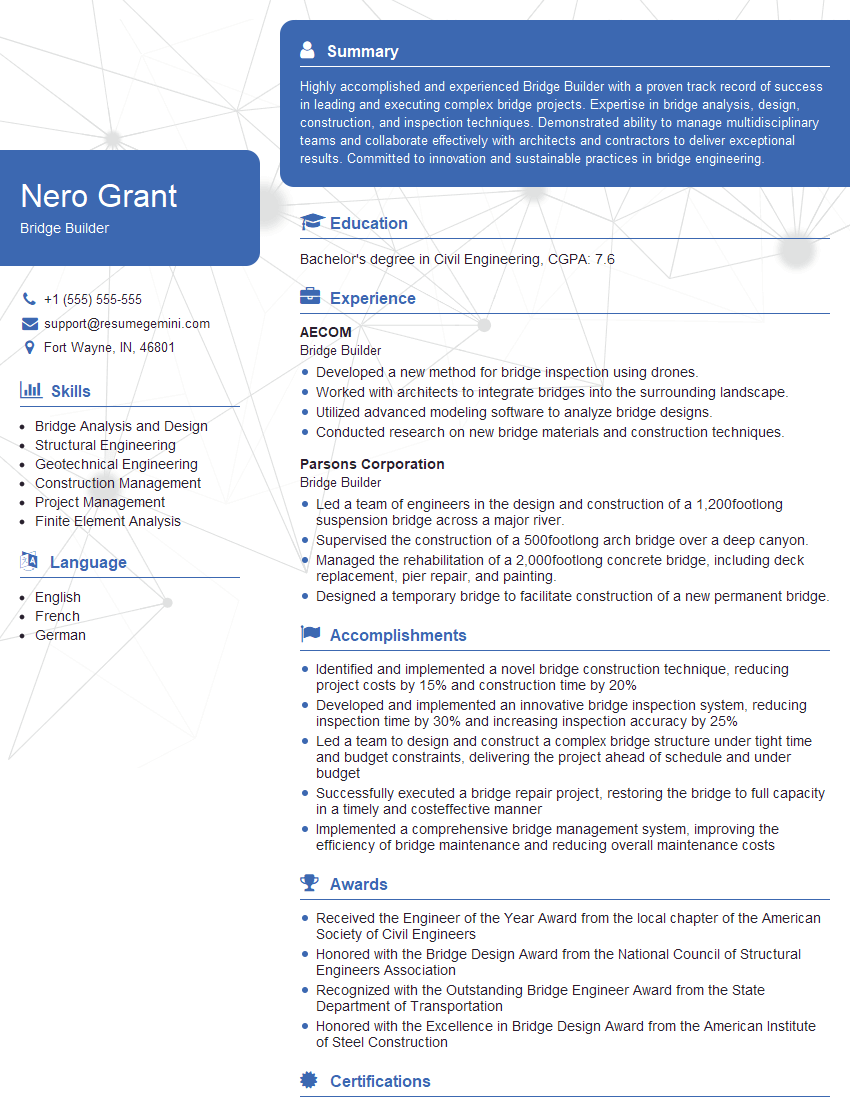
Acing the interview is crucial, but landing one requires a compelling resume that gets you noticed. Crafting a professional document that highlights your skills and experience is the first step toward interview success. ResumeGemini can help you build a standout resume that gets you called in for that dream job.






Essential Interview Questions For Bridge Builder
1. What are the key considerations when designing a bridge?
- Type of bridge: Suspension, cable-stayed, arch, etc.
- Span length and width
- Loads: Live loads (traffic), dead loads (structure weight), environmental loads (wind, seismic, etc.)
- Materials: Concrete, steel, composite materials
- Construction methods
- Environmental factors: Climate, soil conditions, water currents
- Aesthetics and community impact
- Cost
2. Describe the different types of bridge construction methods.
Conventional methods
- Cast-in-place concrete
- Precast concrete
- Steel
Innovative methods
- Cable-stayed
- Suspension
- Extradosed
- Incremental launching
3. How do you determine the optimal design for a particular bridge project?
- Consider the specific requirements of the project
- Conduct a feasibility study to assess the site conditions and constraints
- Develop multiple design options and evaluate their pros and cons
- Consider the life-cycle cost of each option
- Consult with stakeholders including engineers, architects, contractors, and community members
- Select the design that best meets the project objectives
4. What software do you use for bridge design and analysis?
- Bridge design: AutoCAD, STAAD.Pro, SAP2000, Midas Civil
- Structural analysis: ANSYS, Abaqus, LS-DYNA
- Finite element analysis (FEA)
- Computer-aided design (CAD)
5. How do you ensure the quality and safety of your bridge designs?
- Follow established design codes and standards
- Use rigorous analytical methods and computer modeling
- Conduct thorough testing and inspection
- Involve multiple engineers in the review process
- Obtain independent certification
6. What are the latest advancements in bridge design and construction?
- Use of new materials such as fiber-reinforced polymers (FRPs) and high-performance steel
- Advanced construction techniques such as self-compacting concrete and prefabrication
- Innovative bridge designs such as cable-stayed bridges with long spans and curved bridges
- Monitoring systems to assess bridge health and safety
- Sustainability considerations such as reducing carbon emissions and using recycled materials
7. Describe a challenging bridge project you worked on and how you overcame the challenges.
- Provide a brief overview of the project
- Describe the specific challenges encountered
- Explain how you approached and overcame these challenges
- Highlight the lessons learned from the experience
8. How do you stay updated with the latest developments in bridge engineering?
- Attend conferences and workshops
- Read technical journals and publications
- Participate in continuing education programs
- Network with other professionals in the field
9. What are your thoughts on the future of bridge design and construction?
- Greater use of technology
- Increased focus on sustainability
- New materials and construction methods
- Collaboration between engineers, architects, and other professionals
10. What sets you apart from other candidates for this position?
- Your unique skills and experience
- Your passion for bridge engineering
- Your commitment to quality and safety
- Your ability to work independently and as part of a team
- Your willingness to learn and grow
Interviewers often ask about specific skills and experiences. With ResumeGemini‘s customizable templates, you can tailor your resume to showcase the skills most relevant to the position, making a powerful first impression. Also check out Resume Template specially tailored for Bridge Builder.
Career Expert Tips:
- Ace those interviews! Prepare effectively by reviewing the Top 50 Most Common Interview Questions on ResumeGemini.
- Navigate your job search with confidence! Explore a wide range of Career Tips on ResumeGemini. Learn about common challenges and recommendations to overcome them.
- Craft the perfect resume! Master the Art of Resume Writing with ResumeGemini’s guide. Showcase your unique qualifications and achievements effectively.
- Great Savings With New Year Deals and Discounts! In 2025, boost your job search and build your dream resume with ResumeGemini’s ATS optimized templates.
Researching the company and tailoring your answers is essential. Once you have a clear understanding of the Bridge Builder‘s requirements, you can use ResumeGemini to adjust your resume to perfectly match the job description.
Key Job Responsibilities
Bridge Builders are responsible for leading complex construction projects, specializing in building bridges and other infrastructure. They oversee all aspects of the construction process, from planning and design to execution and completion.
1. Project Management
Bridge Builders are responsible for planning, organizing, and directing the construction of bridges and other infrastructure. This includes developing project plans, setting schedules, and coordinating with contractors and subcontractors.
- Develop and implement project plans and schedules.
- Coordinate with contractors and subcontractors to ensure the timely and efficient completion of projects.
- Manage project budgets and ensure compliance with all applicable laws and regulations.
2. Design and Engineering
Bridge Builders are responsible for designing and engineering bridges and other infrastructure. This includes working with architects and engineers to develop plans and specifications, and overseeing the construction of the structure.
- Design and engineer bridges and other infrastructure in accordance with applicable codes and standards.
- Work with architects and engineers to develop plans and specifications.
- Oversee the construction of bridges and other infrastructure to ensure that it meets the design specifications.
3. Construction Management
Bridge Builders are responsible for managing the construction of bridges and other infrastructure. This includes overseeing the work of contractors and subcontractors, and ensuring that the project is completed on time and within budget.
- Oversee the work of contractors and subcontractors to ensure that the project is completed on time and within budget.
- Monitor the progress of construction and make adjustments as necessary.
- Inspect completed projects to ensure that they meet the design specifications and all applicable codes and standards.
4. Maintenance and Inspection
Bridge Builders are responsible for maintaining and inspecting bridges and other infrastructure to ensure that they are safe and in good repair. This includes conducting regular inspections, and performing maintenance and repairs as necessary.
- Conduct regular inspections of bridges and other infrastructure to identify any potential problems.
- Perform maintenance and repairs on bridges and other infrastructure to ensure that they are safe and in good repair.
- Work with other engineers and inspectors to develop and implement maintenance and repair plans.
Interview Tips
Here are a few interview tips to help you ace your interview for a Bridge Builder position:
1. Research the Company
Take the time to learn about the company you’re interviewing with. This will give you a better understanding of their culture, values, and what they’re looking for in a Bridge Builder.
- Visit the company’s website.
- Read articles about the company in the news.
- Talk to people who work at the company.
2. Practice Your Answers
It’s helpful to practice answering common interview questions so that you can feel confident and prepared during your interview. Some common questions that you might be asked include:
- Tell me about your experience in bridge building.
- What are your strengths and weaknesses as a Bridge Builder?
- Why are you interested in working for this company?
3. Prepare Questions to Ask
Asking thoughtful questions at the end of your interview shows that you’re engaged and interested in the position. It also gives you an opportunity to learn more about the company and the position.
- What are the biggest challenges facing the company right now?
- What are the company’s growth plans for the future?
- What is the company culture like?
4. Follow Up
After your interview, it’s important to follow up with the interviewer. This shows that you’re still interested in the position and that you appreciate their time.
- Send a thank-you note to the interviewer within 24 hours of the interview.
- Follow up with the interviewer a week or two after the interview to reiterate your interest in the position.
Next Step:
Now that you’re armed with interview-winning answers and a deeper understanding of the Bridge Builder role, it’s time to take action! Does your resume accurately reflect your skills and experience for this position? If not, head over to ResumeGemini. Here, you’ll find all the tools and tips to craft a resume that gets noticed. Don’t let a weak resume hold you back from landing your dream job. Polish your resume, hit the “Build Your Resume” button, and watch your career take off! Remember, preparation is key, and ResumeGemini is your partner in interview success.