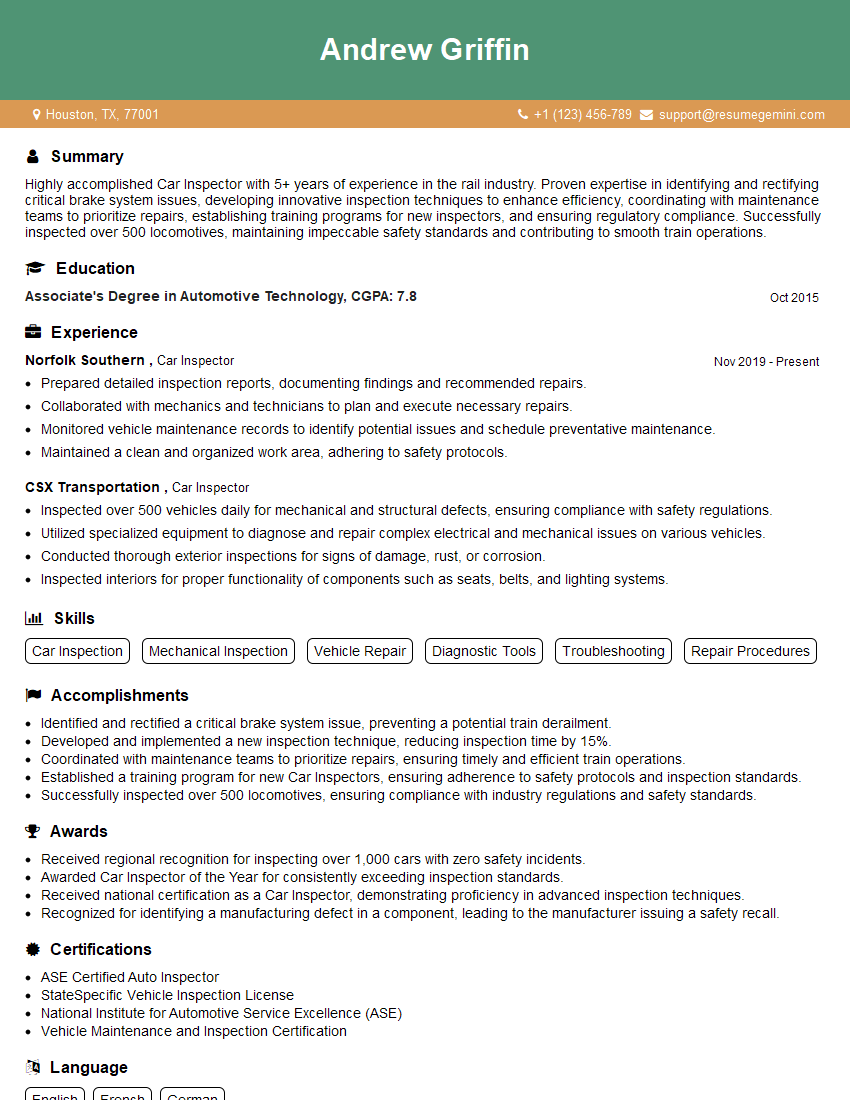
Ever felt underprepared for that crucial job interview? Or perhaps you’ve landed the interview but struggled to articulate your skills and experiences effectively? Fear not! We’ve got you covered. In this blog post, we’re diving deep into the Car Inspector interview questions that you’re most likely to encounter. But that’s not all. We’ll also provide expert insights into the key responsibilities of a Car Inspector so you can tailor your answers to impress potential employers.
Acing the interview is crucial, but landing one requires a compelling resume that gets you noticed. Crafting a professional document that highlights your skills and experience is the first step toward interview success. ResumeGemini can help you build a standout resume that gets you called in for that dream job.






Essential Interview Questions For Car Inspector
1. What are the key components of a vehicle’s suspension system and their functions?
The suspension system comprises several key components, each with specific functions:
- Springs: Absorb and release energy from road irregularities, providing a smooth ride.
- Shock absorbers and struts: Control spring movement, dampening vibrations and preventing excessive bounce.
- Control arms: Connect the suspension to the vehicle’s frame and allow for wheel movement.
- Ball joints: Allow the wheels to move independently while maintaining alignment.
- Stabilizer bar: Reduces body roll during cornering.
2. Describe the different types of brake systems used in modern vehicles.
Hydraulic Brake System:
- Uses brake fluid to transfer force from the master cylinder to the calipers and wheel cylinders.
- Provides precise control and quick response.
Air Brake System:
- Employs compressed air to actuate the brake calipers.
- Found in heavy-duty vehicles like trucks and buses.
3. What are the key components of an engine’s fuel system and their functions?
The fuel system delivers fuel to the engine’s cylinders for combustion:
- Fuel tank: Stores the fuel.
- Fuel pump: Delivers fuel to the fuel injector.
- Fuel filter: Removes impurities from the fuel.
- Fuel injector: Sprays fuel into the engine’s cylinders.
- Fuel rail: Distributes fuel to the injectors.
4. Explain the function and operation of an electronic stability control (ESC) system.
ESC is a safety feature that prevents skidding and loss of control:
- Monitors wheel speed, steering angle, and yaw rate.
- Detects potential instability and applies brakes to individual wheels.
- Helps the driver maintain control and avoid accidents.
5. Describe the process of performing a vehicle safety inspection.
A comprehensive safety inspection involves the following steps:
- Visual inspection: Checking the vehicle’s exterior, interior, and undercarriage for any damage or leaks.
- Fluid checks: Verifying the levels and condition of brake fluid, engine oil, transmission fluid, and coolant.
- Brake inspection: Examining the brake pads, rotors, and calipers for wear and damage.
- Suspension inspection: Testing shocks, struts, and ball joints for proper function.
- Tire inspection: Assessing tire pressure, tread depth, and alignment.
6. What are the common engine problems and how can you diagnose them?
Common engine problems include:
- Misfiring: Rough engine operation, loss of power.
- Stalling: Engine shuts off unexpectedly.
- Overheating: Coolant temperature gauge reads high.
- Oil leaks: Visible oil stains under the vehicle.
- Knocking or rattling noises: Internal engine component issues.
7. How would you use an OBD-II scanner to troubleshoot vehicle issues?
Using an OBD-II scanner involves the following steps:
- Connect the scanner to the vehicle’s diagnostic port.
- Turn the ignition to the “ON” position (without starting the engine).
- Select the appropriate tests from the scanner’s menu.
- Read and interpret the diagnostic codes and data displayed on the scanner.
- Use the information to identify the potential issue and recommend repairs.
8. Discuss the importance of proper wheel alignment and its impact on vehicle performance.
Proper wheel alignment ensures:
- Optimal tire wear: Reduces uneven tire wear, extending their lifespan.
- Fuel efficiency: Minimizes rolling resistance, improving fuel economy.
- Handling and stability: Improves vehicle handling, cornering ability, and stability.
- Reduced suspension wear: Prevents excessive stress on suspension components.
9. What are the different types of engine cooling systems and their advantages and disadvantages?
Liquid Cooling System:
- Uses coolant to absorb heat and dissipate it through the radiator.
- Advantages: Efficient heat removal, precise temperature control.
- Disadvantages: Complex system, potential for leaks.
Air Cooling System:
- Uses air to cool the engine directly.
- Advantages: Simple design, lightweight.
- Disadvantages: Less efficient cooling, higher operating temperatures.
10. Explain the role of the transmission in a vehicle’s powertrain.
The transmission’s role in the powertrain:
- Connects the engine to the wheels: Transfers power from the engine to the wheels.
- Changes gear ratios: Adjusts the speed and torque delivered to the wheels.
- Provides reverse gear: Allows the vehicle to move in reverse.
- Dampens vibrations: Reduces vibrations transferred from the engine to the rest of the vehicle.
Interviewers often ask about specific skills and experiences. With ResumeGemini‘s customizable templates, you can tailor your resume to showcase the skills most relevant to the position, making a powerful first impression. Also check out Resume Template specially tailored for Car Inspector.
Career Expert Tips:
- Ace those interviews! Prepare effectively by reviewing the Top 50 Most Common Interview Questions on ResumeGemini.
- Navigate your job search with confidence! Explore a wide range of Career Tips on ResumeGemini. Learn about common challenges and recommendations to overcome them.
- Craft the perfect resume! Master the Art of Resume Writing with ResumeGemini’s guide. Showcase your unique qualifications and achievements effectively.
- Great Savings With New Year Deals and Discounts! In 2025, boost your job search and build your dream resume with ResumeGemini’s ATS optimized templates.
Researching the company and tailoring your answers is essential. Once you have a clear understanding of the Car Inspector‘s requirements, you can use ResumeGemini to adjust your resume to perfectly match the job description.
Key Job Responsibilities
Car Inspectors are responsible for ensuring that vehicles meet safety and quality standards. They perform a variety of tasks, including:
1. Inspecting vehicles for damage and defects
Car Inspectors must be able to identify any damage or defects that could compromise the safety of a vehicle. This includes inspecting the body of the vehicle for dents, scratches, and rust, as well as the engine, brakes, and other mechanical components.
2. Writing reports on their findings
Car Inspectors must be able to write clear and concise reports on their findings. These reports should include a detailed description of any damage or defects that were found, as well as recommendations for repairs.
3. Maintaining records of their inspections
Car Inspectors must maintain accurate records of all the inspections they perform. These records can be used to track the condition of vehicles over time, as well as to identify any trends in vehicle damage or defects.
4. Testifying in court about their findings
Car Inspectors may be required to testify in court about their findings. They must be able to articulate their findings clearly and concisely, and they must be able to withstand cross-examination.
Interview Tips
Preparing for an interview can be daunting, but there are a few things you can do to increase your chances of success.
1. Research the company and the position
Take some time to learn about the company you’re applying to and the position you’re applying for. This will help you answer questions about your qualifications and why you’re interested in the job.
2. Practice answering common interview questions
There are a few common interview questions that you can expect to be asked, such as “Tell me about yourself” and “Why are you interested in this job?” Practice answering these questions in advance so that you can deliver confident and polished responses.
3. Dress professionally
First impressions matter, so make sure you dress professionally for your interview. This means wearing a suit or dress pants and a button-down shirt or blouse. You should also make sure your clothes are clean and pressed.
4. Be on time
Punctuality is important, so make sure you arrive for your interview on time. If you’re running late, call or email the interviewer to let them know.
5. Be yourself
The most important thing is to be yourself. Don’t try to be someone you’re not, because the interviewer will be able to tell. Just be confident in your abilities and let your personality shine through.
Next Step:
Now that you’re armed with a solid understanding of what it takes to succeed as a Car Inspector, it’s time to turn that knowledge into action. Take a moment to revisit your resume, ensuring it highlights your relevant skills and experiences. Tailor it to reflect the insights you’ve gained from this blog and make it shine with your unique qualifications. Don’t wait for opportunities to come to you—start applying for Car Inspector positions today and take the first step towards your next career milestone. Your dream job is within reach, and with a polished resume and targeted applications, you’ll be well on your way to achieving your career goals! Build your resume now with ResumeGemini.