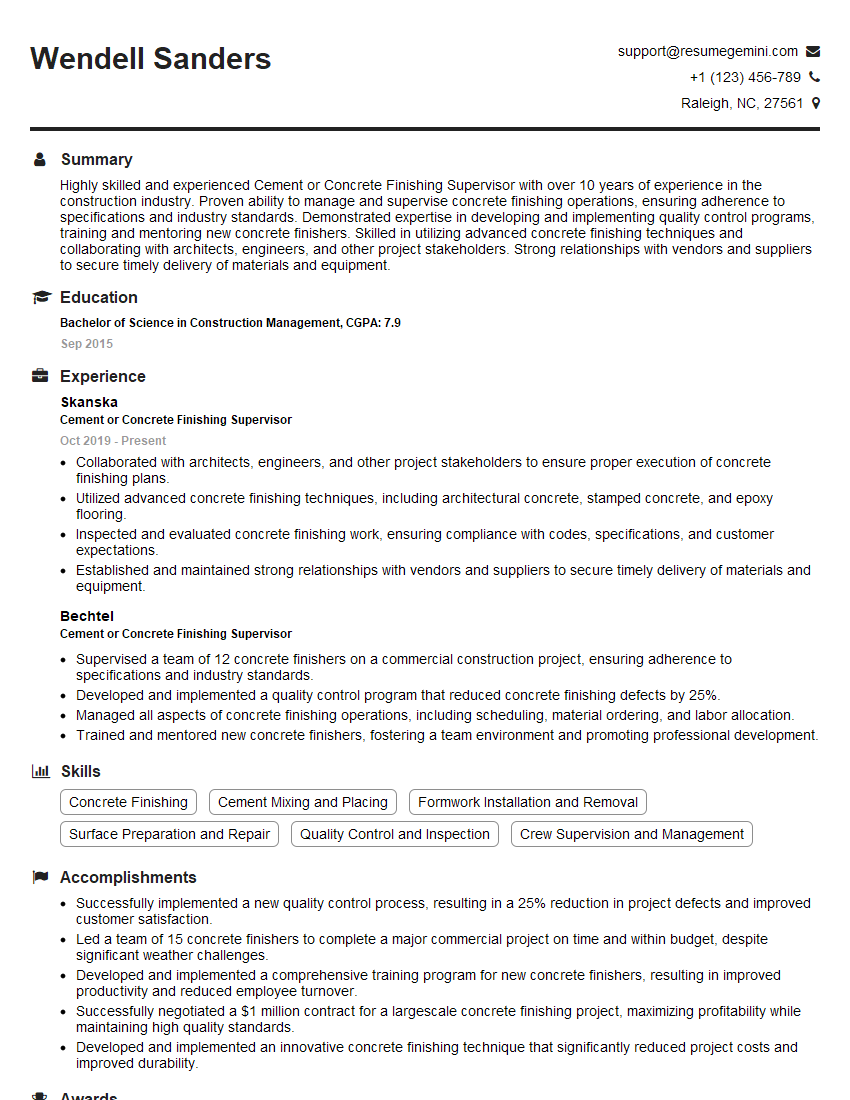
Are you gearing up for a career shift or aiming to ace your next interview? Look no further! We’ve curated a comprehensive guide to help you crack the interview for the coveted Cement or Concrete Finishing Supervisor position. From understanding the key responsibilities to mastering the most commonly asked questions, this blog has you covered. So, buckle up and let’s embark on this journey together
Acing the interview is crucial, but landing one requires a compelling resume that gets you noticed. Crafting a professional document that highlights your skills and experience is the first step toward interview success. ResumeGemini can help you build a standout resume that gets you called in for that dream job.






Essential Interview Questions For Cement or Concrete Finishing Supervisor
1. What are the different types of concrete finishes and how do you achieve each of them?
The different types of concrete finishes include:
- Float finish: A smooth, level finish achieved by using a steel trowel to smooth the surface of the concrete.
- Trowel finish: A smooth, hard finish achieved by using a power trowel to press and compact the surface of the concrete.
- Brushed finish: A textured finish achieved by using a wire brush to create a rougher surface.
- Stamped finish: A decorative finish achieved by using a stamp or mold to create a pattern or design in the concrete.
- Exposed aggregate finish: A finish that exposes the aggregate in the concrete by removing the top layer of the concrete.
I achieve these finishes by following the manufacturer’s recommendations for the specific type of finish and using the appropriate tools and techniques.
2. How do you control the placement and compaction of concrete?
I control the placement and compaction of concrete by following the engineer’s specifications and using the appropriate equipment and techniques.
: Placement
- I use a concrete pump or chute to place the concrete in the forms or on the subgrade.
- I ensure that the concrete is placed evenly and that there are no voids or gaps.
Subheading: Compaction
- I use a vibrator to compact the concrete and remove any air bubbles.
- I ensure that the concrete is compacted thoroughly and that there are no soft spots or honeycombs.
3. How do you cure concrete and why is it important?
I cure concrete by keeping it moist and at a constant temperature for a period of time.
- I use methods such as spraying the concrete with water, covering it with plastic sheeting, or using a curing compound.
- I maintain the proper curing temperature by using heaters or blankets if necessary.
Curing is important because it allows the concrete to gain strength and durability. Without proper curing, the concrete will be weaker and more susceptible to cracking and other damage.
4. What are the different types of concrete joints and how do you install them?
The different types of concrete joints include:
- Expansion joints: Joints that allow the concrete to expand and contract with changes in temperature.
- Control joints: Joints that are placed in the concrete to control cracking.
- Construction joints: Joints that are placed in the concrete where two pours meet.
I install concrete joints by following the manufacturer’s recommendations and using the appropriate tools and techniques.
- I use a saw to cut the joints into the concrete.
- I install joint filler material into the joints to prevent water and debris from entering.
- I seal the joints with a sealant to prevent water and debris from entering.
5. How do you perform quality control on concrete work?
I perform quality control on concrete work by following the engineer’s specifications and using the appropriate equipment and techniques.
- I test the concrete for strength, durability, and other properties.
- I inspect the concrete for defects, such as cracks, voids, and honeycombs.
- I document my findings and take corrective action as necessary.
6. What are the safety hazards associated with concrete work and how do you mitigate them?
The safety hazards associated with concrete work include:
- Exposure to dust and chemicals
- Slips, trips, and falls
- Heavy lifting
- Electrical hazards
- Concrete burns
I mitigate these hazards by following safety protocols and using the appropriate personal protective equipment (PPE).
- I wear a respirator to protect myself from dust and chemicals.
- I wear non-slip shoes and use caution when walking on wet or uneven surfaces.
- I use proper lifting techniques and get help when lifting heavy objects.
- I am aware of electrical hazards and take precautions to avoid them.
- I wear gloves to protect myself from concrete burns.
7. What are the latest trends in concrete technology?
The latest trends in concrete technology include:
- The use of self-consolidating concrete (SCC)
- The use of high-performance concrete (HPC)
- The use of sustainable concrete
- The use of 3D printing to create concrete structures
I am familiar with these trends and am always looking for ways to incorporate them into my work.
8. How do you stay up-to-date on the latest developments in concrete technology?
I stay up-to-date on the latest developments in concrete technology by:
- Reading trade publications
- Attending industry conferences
- Participating in online forums
- Talking to other concrete professionals
I am also a member of the American Concrete Institute (ACI) and the National Ready Mixed Concrete Association (NRMCA), which provide me with access to the latest information on concrete technology.
9. What are your strengths and weaknesses as a Concrete Finishing Supervisor?
My strengths as a Concrete Finishing Supervisor include:
- I have over 10 years of experience in the concrete industry.
- I am familiar with all aspects of concrete finishing, from placement to curing.
- I am a skilled craftsman and take pride in my work.
- I am a good communicator and can work well with others.
- I am a safety-conscious worker and always follow safety protocols.
My weaknesses include:
- I am not a licensed engineer.
- I do not have experience with all types of concrete finishes.
10. Why do you want to work for our company?
I want to work for your company because I am impressed with your commitment to quality and innovation.
- I believe that my skills and experience would be a valuable asset to your team.
- I am eager to learn more about your company and the industry.
- I am confident that I can make a significant contribution to your company.
Interviewers often ask about specific skills and experiences. With ResumeGemini‘s customizable templates, you can tailor your resume to showcase the skills most relevant to the position, making a powerful first impression. Also check out Resume Template specially tailored for Cement or Concrete Finishing Supervisor.
Career Expert Tips:
- Ace those interviews! Prepare effectively by reviewing the Top 50 Most Common Interview Questions on ResumeGemini.
- Navigate your job search with confidence! Explore a wide range of Career Tips on ResumeGemini. Learn about common challenges and recommendations to overcome them.
- Craft the perfect resume! Master the Art of Resume Writing with ResumeGemini’s guide. Showcase your unique qualifications and achievements effectively.
- Great Savings With New Year Deals and Discounts! In 2025, boost your job search and build your dream resume with ResumeGemini’s ATS optimized templates.
Researching the company and tailoring your answers is essential. Once you have a clear understanding of the Cement or Concrete Finishing Supervisor‘s requirements, you can use ResumeGemini to adjust your resume to perfectly match the job description.
Key Job Responsibilities
Cement or Concrete Finishing Supervisors oversee the work of concrete finishers and are responsible for ensuring that concrete is placed, finished, and cured according to specifications. They may also be responsible for estimating materials, ordering supplies, and maintaining equipment.
1. Plan and Schedule Work
Supervisors plan and schedule the work of concrete finishers, including assigning tasks, setting deadlines, and providing instructions.
- Develop work schedules and timelines for concrete finishing projects
- Coordinate with other trades to ensure timely completion of projects
2. Supervise and Train Crew
Supervisors supervise and train concrete finishers, providing guidance and instruction on proper techniques and safety procedures.
- Provide on-the-job training and mentorship to concrete finishers
- Monitor and evaluate the performance of crew members
3. Inspect and Test Concrete
Supervisors inspect and test concrete to ensure that it meets specifications, including strength, durability, and finish.
- Conduct quality control tests on concrete samples
- Inspect finished concrete surfaces for defects and ensure compliance with project specifications
4. Manage Materials and Equipment
Supervisors manage materials and equipment used in concrete finishing, including ordering supplies, maintaining equipment, and ensuring that materials are used efficiently.
- Estimate material needs and order supplies as required
- Maintain and inspect equipment to ensure proper functioning
Interview Tips
Preparing for an interview for a Cement or Concrete Finishing Supervisor position requires a combination of technical knowledge and soft skills. Here are some tips to help you ace your interview:
1. Research the Company and Position
Before your interview, thoroughly research the company and the specific position you are applying for. This will give you a good understanding of the company’s culture, values, and goals, as well as the specific responsibilities and expectations of the role.
- Visit the company’s website to learn about their history, mission, and recent projects.
- Review the job description carefully to identify the key qualifications and responsibilities of the position.
2. Practice Your Answers
Take some time to prepare and practice your answers to common interview questions, such as:
- Tell me about your experience in concrete finishing.
- What are your strengths and weaknesses as a supervisor?
- How do you handle conflict resolution within your team?
3. Showcase Your Knowledge and Skills
During the interview, highlight your technical knowledge and skills in concrete finishing, including your expertise in different finishing techniques, materials, and equipment.
- Share examples of successful projects you have worked on and the techniques you used to achieve high-quality results.
- Discuss your understanding of industry standards and best practices for concrete finishing.
4. Emphasize Your Leadership and Communication Skills
As a supervisor, strong leadership and communication skills are essential. Showcase your ability to motivate and lead a team, as well as your ability to effectively communicate with clients, contractors, and other stakeholders.
- Provide examples of how you have successfully managed and motivated construction crews.
- Describe your experience in communicating technical information to both technical and non-technical audiences.
5. Be Enthusiastic and Professional
Throughout the interview, maintain a positive and enthusiastic attitude. Demonstrate your passion for concrete finishing and your desire to contribute to the company’s success. Dress professionally and arrive on time for your interview, showing respect for the interviewer and the company.
Next Step:
Now that you’re armed with the knowledge of Cement or Concrete Finishing Supervisor interview questions and responsibilities, it’s time to take the next step. Build or refine your resume to highlight your skills and experiences that align with this role. Don’t be afraid to tailor your resume to each specific job application. Finally, start applying for Cement or Concrete Finishing Supervisor positions with confidence. Remember, preparation is key, and with the right approach, you’ll be well on your way to landing your dream job. Build an amazing resume with ResumeGemini