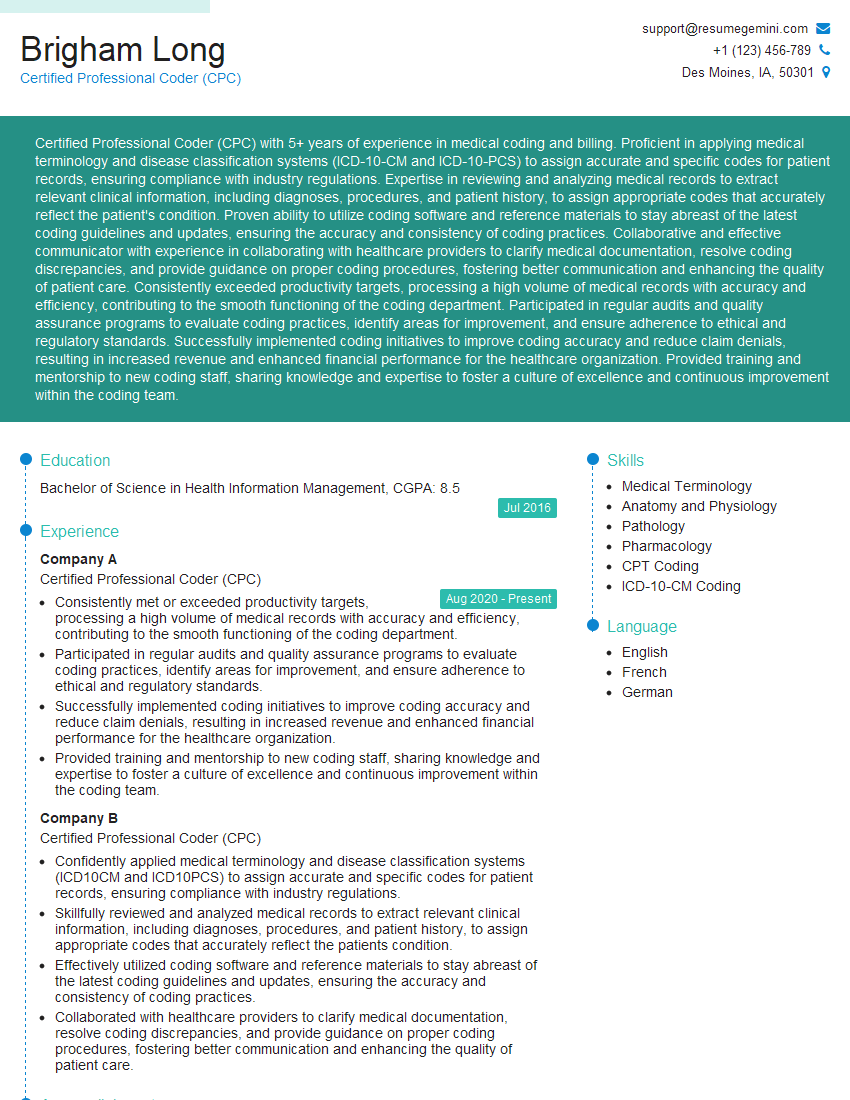
Are you gearing up for a career in Certified Professional Coder (CPC)? Feeling nervous about the interview questions that might come your way? Don’t worry, you’re in the right place. In this blog post, we’ll dive deep into the most common interview questions for Certified Professional Coder (CPC) and provide you with expert-backed answers. We’ll also explore the key responsibilities of this role so you can tailor your responses to showcase your perfect fit.
Acing the interview is crucial, but landing one requires a compelling resume that gets you noticed. Crafting a professional document that highlights your skills and experience is the first step toward interview success. ResumeGemini can help you build a standout resume that gets you called in for that dream job.






Essential Interview Questions For Certified Professional Coder (CPC)
1. Describe the correct coding process for a patient encounter, from registration to the final submission of claims.
- Gather patient information and verify insurance coverage.
- Assign the correct medical code(s) to describe the patient’s diagnosis and procedures.
- Review the codes for accuracy and completeness.
- Submit the claims to the insurance carrier.
- Follow up on claims to ensure payment.
2. What are the key principles of medical coding?
Accuracy
- Medical codes must be assigned accurately to ensure that patients receive the correct level of reimbursement.
- Inaccurate coding can lead to delays in payment, denials of claims, and even fraud.
Specificity
- Medical codes must be specific enough to identify the exact diagnosis or procedure that was performed.
- General or vague codes are not acceptable and can lead to incorrect payment.
Consistency
- Medical codes must be used consistently across all healthcare settings.
- This ensures that all patients are treated fairly and that the data collected is accurate and reliable.
Timeliness
- Medical codes must be submitted to the insurance carrier in a timely manner.
- Delays in submitting claims can lead to denials of payment.
3. What are the most common medical coding systems?
- International Classification of Diseases, 10th Revision, Clinical Modification (ICD-10-CM)
- Current Procedural Terminology (CPT)
- Healthcare Common Procedure Coding System (HCPCS)
4. What are the different types of medical coders?
- Inpatient coders
- Outpatient coders
- Emergency department coders
- Surgical coders
- Anesthesia coders
- Pathology coders
- Radiology coders
5. What are the career opportunities for medical coders?
- Medical coding manager
- Coding auditor
- Coding educator
- Coding consultant
- Health information manager
6. What are the challenges facing medical coders?
- The increasing complexity of medical coding systems
- The need to stay up-to-date on changes to coding guidelines
- The pressure to code quickly and accurately
- The risk of errors and fraud
7. What are the qualities of a successful medical coder?
- Attention to detail
- Strong analytical skills
- Excellent communication skills
- Up-to-date knowledge of coding guidelines
- Ability to work independently and as part of a team
8. What is the future of medical coding?
- The increasing use of electronic health records (EHRs)
- The development of new coding systems
- The growing demand for medical coders
9. What is your experience with medical coding software?
- I have experience with a variety of medical coding software, including Encoder Pro, CodeLink, and 3M Code Manager.
- I am proficient in using these software programs to assign medical codes to patient encounters.
- I am also familiar with the use of medical coding software to generate claims and track patient data.
10. What is your understanding of the HIPAA privacy and security regulations?
- The HIPAA privacy and security regulations are a set of federal laws that protect the privacy of patient health information.
- These regulations require healthcare providers to take steps to protect the confidentiality, integrity, and availability of patient health information.
- I am familiar with the HIPAA privacy and security regulations and I am committed to protecting the privacy of patient health information.
Interviewers often ask about specific skills and experiences. With ResumeGemini‘s customizable templates, you can tailor your resume to showcase the skills most relevant to the position, making a powerful first impression. Also check out Resume Template specially tailored for Certified Professional Coder (CPC).
Career Expert Tips:
- Ace those interviews! Prepare effectively by reviewing the Top 50 Most Common Interview Questions on ResumeGemini.
- Navigate your job search with confidence! Explore a wide range of Career Tips on ResumeGemini. Learn about common challenges and recommendations to overcome them.
- Craft the perfect resume! Master the Art of Resume Writing with ResumeGemini’s guide. Showcase your unique qualifications and achievements effectively.
- Great Savings With New Year Deals and Discounts! In 2025, boost your job search and build your dream resume with ResumeGemini’s ATS optimized templates.
Researching the company and tailoring your answers is essential. Once you have a clear understanding of the Certified Professional Coder (CPC)‘s requirements, you can use ResumeGemini to adjust your resume to perfectly match the job description.
Key Job Responsibilities
Certified Professional Coders (CPCs) play a crucial role in the healthcare industry, ensuring the accuracy and compliance of medical coding. Their key job responsibilities include:
1. Medical Coding and Classification
CPCs assign the correct medical codes to patient records based on the International Classification of Diseases (ICD-10-CM), Current Procedural Terminology (CPT), and Healthcare Common Procedure Coding System (HCPCS) guidelines.
2. Data Analysis and Interpretation
CPCs analyze medical records and identify patterns and trends to optimize coding practices. They also interpret medical terminology and ensure the accuracy of coded data.
3. Quality Assurance
CPCs conduct audits and reviews to ensure that coding practices comply with industry standards and regulations. They identify errors and inaccuracies and implement corrective measures.
4. Regulatory Compliance
CPCs stay up-to-date with regulatory changes and ensure that coding practices adhere to HIPAA, ICD-10-CM, and other applicable guidelines.
Interview Tips
Preparing thoroughly for a CPC interview can increase your chances of success. Here are some tips:
1. Research the Company and Position
Learn about the organization’s healthcare industry focus, coding standards, and team structure. Review the job description carefully to understand the specific requirements.
2. Quantify Your Experience
When discussing your experience, provide specific examples and quantify your achievements. For instance, instead of saying “I reviewed patient records,” you could say “I reviewed over 1,000 patient records, identifying coding errors that resulted in a 5% reduction in claims denials.”
3. Highlight Your Skills and Certifications
Emphasize your proficiency in coding systems, data analysis tools, and quality assurance processes. Mention any relevant certifications, such as the CPC certification from the American Health Information Management Association (AHIMA).
4. Demonstrate Your Knowledge of Industry Standards
Show the interviewer that you are up-to-date on industry trends and regulatory changes. Discuss your understanding of ICD-10-CM, CPT, HCPCS, and HIPAA guidelines.
5. Prepare for Behavioral Questions
Be prepared to answer behavioral questions using the STAR method (Situation, Task, Action, Result). For example, for the question “Tell me about a time you faced a challenge in medical coding,” you could outline the situation, describe the task you had to perform, explain the actions you took, and highlight the positive results.
6. Practice Your Answers
Anticipate common interview questions and practice your answers beforehand. This will help you deliver confident and articulate responses during the actual interview.
7. Dress Professionally and Arrive on Time
First impressions matter, so dress professionally and arrive for the interview on time. Show that you respect the interviewer’s time and the opportunity.
Next Step:
Armed with this knowledge, you’re now well-equipped to tackle the Certified Professional Coder (CPC) interview with confidence. Remember, a well-crafted resume is your first impression. Take the time to tailor your resume to highlight your relevant skills and experiences. And don’t forget to practice your answers to common interview questions. With a little preparation, you’ll be on your way to landing your dream job. So what are you waiting for? Start building your resume and start applying! Build an amazing resume with ResumeGemini.