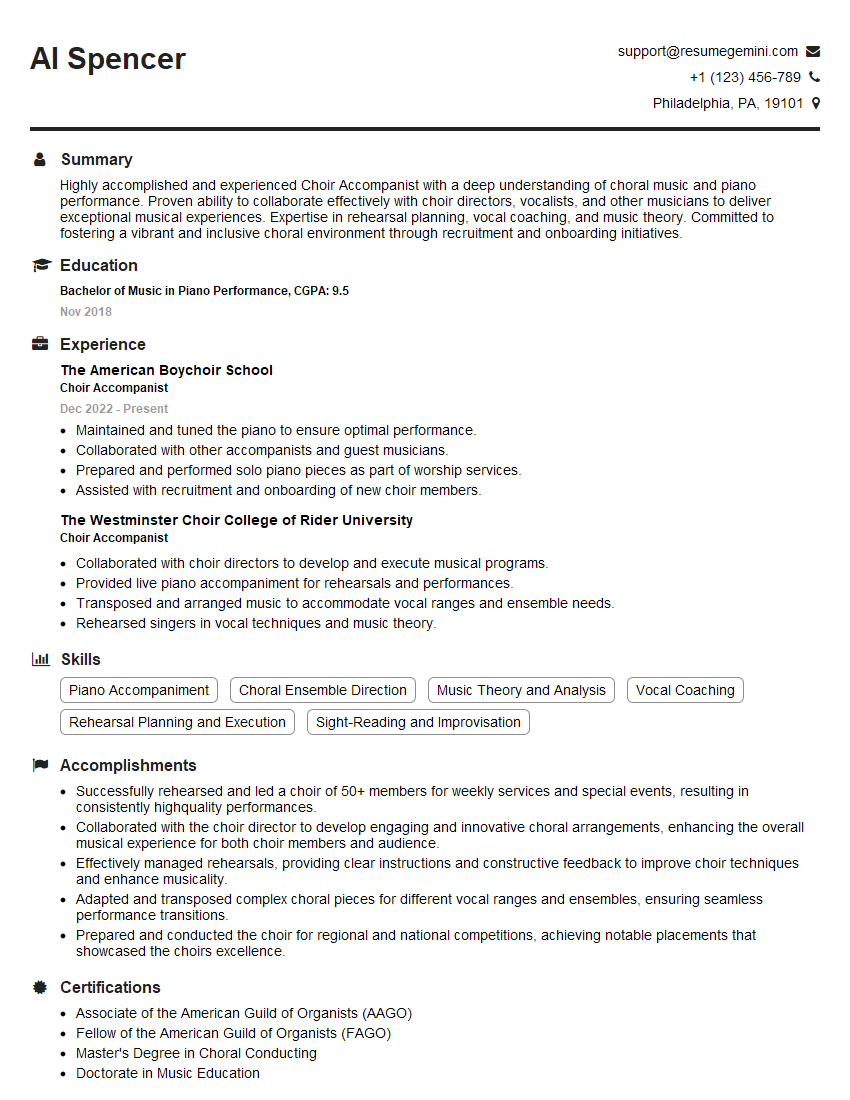
Are you gearing up for an interview for a Choir Accompanist position? Whether you’re a seasoned professional or just stepping into the role, understanding what’s expected can make all the difference. In this blog, we dive deep into the essential interview questions for Choir Accompanist and break down the key responsibilities of the role. By exploring these insights, you’ll gain a clearer picture of what employers are looking for and how you can stand out. Read on to equip yourself with the knowledge and confidence needed to ace your next interview and land your dream job!
Acing the interview is crucial, but landing one requires a compelling resume that gets you noticed. Crafting a professional document that highlights your skills and experience is the first step toward interview success. ResumeGemini can help you build a standout resume that gets you called in for that dream job.






Essential Interview Questions For Choir Accompanist
1. What are the essential qualities of a successful Choir Accompanist?
- Strong musicianship skills, including a high level of proficiency in piano playing and music theory.
- Excellent sight-reading and transposing skills.
- Ability to follow and interpret musical cues from the choir director.
- Excellent communication and interpersonal skills.
- A passion for music and a commitment to supporting the choir in achieving its goals.
2. How do you prepare for a rehearsal or performance with a choir?
Before the rehearsal
- Thoroughly study the music to be performed.
- Identify any tricky passages or sections that may require extra practice.
- Transposing music to the appropriate key if necessary.
- Practice playing the music on the piano to get a feel for the rhythm and phrasing.
During the rehearsal
- Arrive on time and be prepared to play.
- Follow the instructions of the choir director carefully.
- Be flexible and adaptable, as changes may need to be made to the music or performance.
- Provide support to the choir by playing the music accurately and expressively.
3. What are some of the challenges you have faced as a Choir Accompanist and how did you overcome them?
* Challenge 1: Accompanying a choir with a wide range of vocal abilities.
* Solution: I worked closely with the choir director to identify the strengths and weaknesses of individual singers. I then adjusted my playing accordingly, providing more support for those who needed it and giving more freedom to those who were more confident.
* Challenge 2: Dealing with unexpected changes during a performance.
* Solution: I remained calm and focused, and made quick adjustments to my playing to accommodate the changes. I also communicated with the choir director and the singers to ensure that we were all on the same page.
4. How do you work with the choir director to ensure that the musical vision of the choir is realized?
- Establish a strong working relationship with the choir director.
- Attend rehearsals regularly and participate actively in the musical decision-making process.
- Be open to feedback and suggestions from the choir director.
- Be willing to experiment with different musical interpretations.
- Ultimately, the goal is to support the choir director’s vision for the music and help the choir achieve its full potential.
5. What are your thoughts on using technology in the role of Choir Accompanist?
- Technology can be a valuable tool for Choir Accompanists.
- I use a digital piano that allows me to access a wide range of sounds and effects.
- I also use a tablet to store and organize my music.
- I believe that technology can enhance the musical experience for both the choir and the audience.
6. How do you stay up-to-date on the latest developments in choral music?
- I attend workshops and conferences on choral music.
- I read books and articles about choral music.
- I listen to recordings of choral music.
- I collaborate with other Choir Accompanists.
7. What are your goals for this position and how do you plan to achieve them?
- My goal is to provide the choir with the highest quality of musical support.
- I plan to achieve this by working closely with the choir director, preparing thoroughly for rehearsals and performances, and using my musical skills and experience to support the choir’s musical vision.
8. What qualities do you think make you the best candidate for this position?
- My strong musicianship skills and experience as a Choir Accompanist.
- My ability to follow and interpret musical cues from the choir director.
- My excellent communication and interpersonal skills.
- My passion for music and my commitment to supporting the choir in achieving its goals.
9. What is your experience in working with different choir sizes and levels?
* I have experience working with choirs of all sizes, from small chamber choirs to large choral societies.
* I have also worked with choirs of varying levels of experience, from beginner choirs to advanced choirs.
* I am comfortable working with choirs of all abilities and I am always willing to tailor my approach to meet the needs of the choir.
10. What are your strengths and weaknesses as a Choir Accompanist?
Strengths:
- Strong musicianship skills.
- Excellent sight-reading and transposing skills.
- Ability to follow and interpret musical cues from the choir director.
- Excellent communication and interpersonal skills.
- Passion for music and commitment to supporting the choir in achieving its goals.
Weaknesses:
- I can be a bit of a perfectionist, and I sometimes have to remind myself to relax and enjoy the music.
- I am still relatively new to the role of Choir Accompanist, and I am always looking for ways to improve my skills.
Interviewers often ask about specific skills and experiences. With ResumeGemini‘s customizable templates, you can tailor your resume to showcase the skills most relevant to the position, making a powerful first impression. Also check out Resume Template specially tailored for Choir Accompanist.
Career Expert Tips:
- Ace those interviews! Prepare effectively by reviewing the Top 50 Most Common Interview Questions on ResumeGemini.
- Navigate your job search with confidence! Explore a wide range of Career Tips on ResumeGemini. Learn about common challenges and recommendations to overcome them.
- Craft the perfect resume! Master the Art of Resume Writing with ResumeGemini’s guide. Showcase your unique qualifications and achievements effectively.
- Great Savings With New Year Deals and Discounts! In 2025, boost your job search and build your dream resume with ResumeGemini’s ATS optimized templates.
Researching the company and tailoring your answers is essential. Once you have a clear understanding of the Choir Accompanist‘s requirements, you can use ResumeGemini to adjust your resume to perfectly match the job description.
Key Job Responsibilities
The choir accompanist is a critical member of the church music team. Partnering with the choir director and music director, the accompanist leads and supports the choir’s vocal performances. To succeed in this role, candidates should possess strong musical and interpersonal skills.
1. Music Direction and Collaboration
Accompanists collaborate closely with choir directors and music directors to interpret and execute musical arrangements.
- Rehearse and perform musical scores accurately and expressively.
- Communicate musical interpretations to the choir.
- Provide constructive feedback to the choir and director.
2. Pianistic Skills
The position requires a high level of pianistic expertise.
- Demonstrate proficiency in various musical styles, including classical, sacred, and contemporary.
- Transcribe and interpret musical scores effectively.
- Accompany choral performances with sensitivity and responsiveness.
3. Choir Support and Collaboration
Accompanists support the choir’s vocal development and performance.
- Provide vocal warm-ups and exercises.
- Assist choir members with vocal technique and repertoire.
- Foster a positive and supportive learning environment.
4. Administrative Responsibilities
Accompanists may assist with administrative tasks related to choir rehearsals and performances.
- Maintain rehearsal and performance schedules.
- Order and manage sheet music and materials.
- Communicate with choir members and external stakeholders.
Interview Preparation Tips
To ace your interview for a Choir Accompanist position, follow these tips:
1. Research the Church and Choir
Learn about the church’s mission and music program, as well as the choir’s repertoire and performance history.
2. Prepare Musical Examples
Choose several musical pieces that showcase your accompaniment skills. Consider including a mix of styles and tempos.
3. Highlight Your Collaborative Abilities
Emphasize your experience and passion for working with singers and musical directors.
4. Demonstrate Your Commitment to the Choir
Explain your understanding of the role of the choir in the church and express your enthusiasm for supporting their musical journey.
5. Ask Thoughtful Questions
Prepare insightful questions that demonstrate your interest in the position and the church community.
6. Practice Your Sight-Reading Skills
The interviewer may ask you to sight-read a piece of music during the interview.
7. Be Enthusiastic and Professional
Show your passion for music and your professionalism throughout the interview.
Next Step:
Armed with this knowledge, you’re now well-equipped to tackle the Choir Accompanist interview with confidence. Remember, preparation is key. So, start crafting your resume, highlighting your relevant skills and experiences. Don’t be afraid to tailor your application to each specific job posting. With the right approach and a bit of practice, you’ll be well on your way to landing your dream job. Build your resume now from scratch or optimize your existing resume with ResumeGemini. Wish you luck in your career journey!