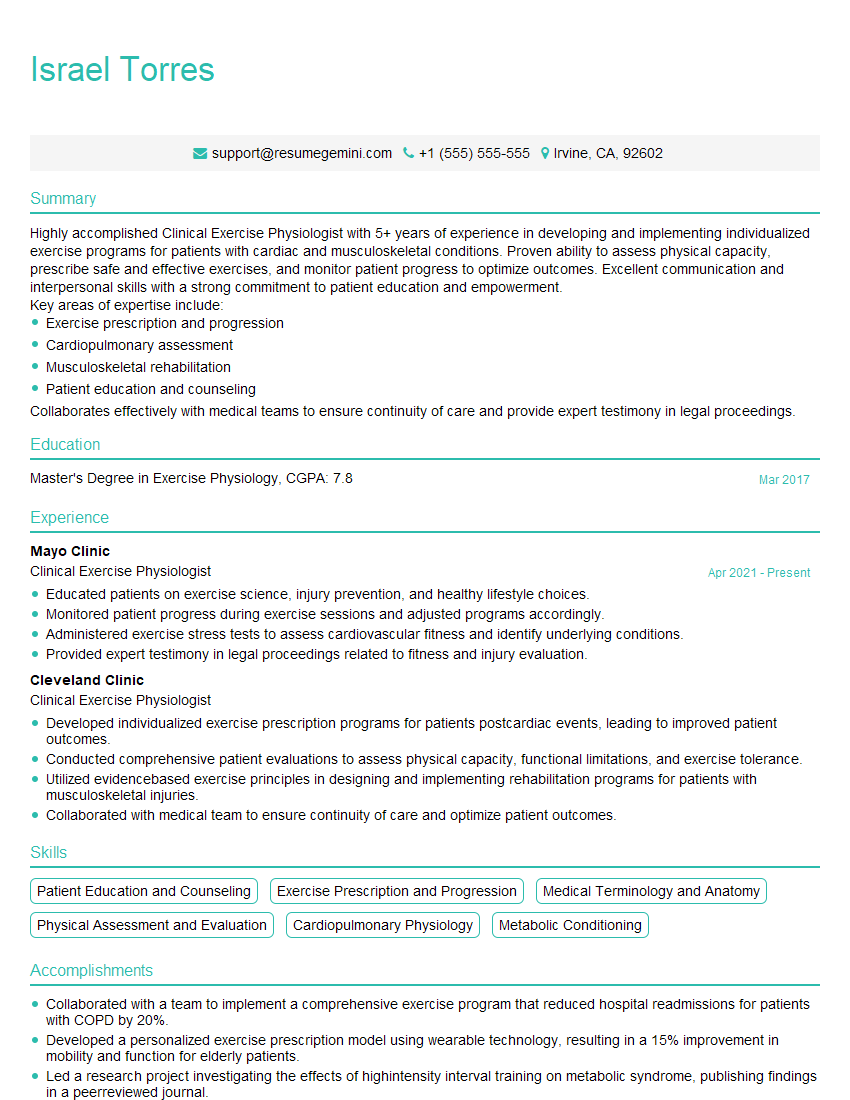
Are you gearing up for a career shift or aiming to ace your next interview? Look no further! We’ve curated a comprehensive guide to help you crack the interview for the coveted Clinical Exercise Physiologist position. From understanding the key responsibilities to mastering the most commonly asked questions, this blog has you covered. So, buckle up and let’s embark on this journey together.
Acing the interview is crucial, but landing one requires a compelling resume that gets you noticed. Crafting a professional document that highlights your skills and experience is the first step toward interview success. ResumeGemini can help you build a standout resume that gets you called in for that dream job.






Essential Interview Questions For Clinical Exercise Physiologist
1. Describe the key components of a comprehensive exercise prescription for a patient with cardiovascular disease?
- Assessment of the patient’s cardiovascular status, including risk factors, symptoms, and functional capacity
- Development of individualized exercise goals based on the patient’s needs and abilities
- Prescription of specific exercise modalities, intensity, duration, and frequency
- Monitoring of the patient’s progress and response to the exercise program
- Education on the benefits of exercise, risks of exercise, and lifestyle modifications
2. Explain the principles of exercise testing and interpretation of results for a patient with pulmonary disease.
Pulmonary function tests
- Spirometry: measures lung volumes and airflow rates
- Plethysmography: measures lung volumes and airway resistance
- Diffusion capacity: measures the rate of gas exchange in the lungs
Exercise testing
- Cardiopulmonary exercise testing (CPET): measures oxygen consumption, carbon dioxide production, and ventilation
- Incremental exercise test: gradually increases exercise intensity to assess functional capacity
- Constant work rate test: maintains a fixed exercise intensity to assess endurance
Interpretation of results
- Peak oxygen consumption (VO2 peak): measures maximal oxygen uptake
- Ventilatory threshold: indicates the point at which ventilation increases disproportionately to oxygen consumption
- Anaerobic threshold: indicates the point at which lactate production increases
- Respiratory exchange ratio: measures the ratio of carbon dioxide production to oxygen consumption
3. How would you approach the exercise prescription for a patient with diabetes?
- Assess the patient’s glycemic control, cardiovascular status, and other comorbidities
- Set realistic exercise goals based on the patient’s abilities and limitations
- Prescribe moderate-intensity aerobic activity for at least 150 minutes per week
- Encourage resistance training 2-3 times per week
- Educate the patient on the importance of exercise for managing blood glucose levels and improving cardiovascular health
4. Discuss the role of exercise in the management of obesity.
- Exercise increases energy expenditure and promotes weight loss
- Aerobic exercise helps to improve cardiovascular health and reduce the risk of obesity-related complications
- Resistance training helps to preserve muscle mass and improve metabolic rate
- Exercise can help to improve body composition and reduce body fat percentage
5. How would you assess the effectiveness of an exercise program for a patient with musculoskeletal pain?
- Use patient-reported outcome measures, such as pain scales and functional status questionnaires
- Measure changes in range of motion, strength, and flexibility
- Assess the patient’s ability to perform activities of daily living
- Monitor the patient’s adherence to the exercise program
6. Describe the ethical considerations in exercise prescription for special populations.
- Obtaining informed consent from patients
- Ensuring that the exercise program is safe and appropriate for the patient’s condition
- Respecting the patient’s values and preferences
- Maintaining confidentiality
7. How would you collaborate with other healthcare professionals in the management of patients with chronic conditions?
- Communicate with physicians, nurses, and other healthcare professionals to develop a comprehensive care plan for the patient
- Provide education on exercise and lifestyle modifications to other healthcare professionals.
- Participate in interdisciplinary team meetings to discuss patient progress and make recommendations
8. Describe the role of exercise in the prevention and management of falls in older adults.
- Exercise can improve balance, strength, and coordination
- Tai chi and yoga have been shown to reduce the risk of falls
- Resistance training can help to maintain muscle mass and strength
- Aerobic exercise can improve cardiovascular health and reduce the risk of falls
9. How would you use technology to enhance your practice as a Clinical Exercise Physiologist?
- Use wearable devices to track patient activity and progress
- Use mobile apps to provide patients with exercise programs and resources
- Use telehealth to provide remote exercise consultations
- Use data analytics to identify trends and patterns in patient data
10. What are the emerging trends in Clinical Exercise Physiology?
- Precision medicine: using genetic and other data to tailor exercise programs to individual patients
- Virtual reality: using virtual reality to create immersive and engaging exercise experiences
- Artificial intelligence: using artificial intelligence to develop personalized exercise recommendations and monitor patient progress
- Wearable technology: using wearable technology to track patient activity and progress
- Telehealth: using telehealth to provide remote exercise consultations
Interviewers often ask about specific skills and experiences. With ResumeGemini‘s customizable templates, you can tailor your resume to showcase the skills most relevant to the position, making a powerful first impression. Also check out Resume Template specially tailored for Clinical Exercise Physiologist.
Career Expert Tips:
- Ace those interviews! Prepare effectively by reviewing the Top 50 Most Common Interview Questions on ResumeGemini.
- Navigate your job search with confidence! Explore a wide range of Career Tips on ResumeGemini. Learn about common challenges and recommendations to overcome them.
- Craft the perfect resume! Master the Art of Resume Writing with ResumeGemini’s guide. Showcase your unique qualifications and achievements effectively.
- Great Savings With New Year Deals and Discounts! In 2025, boost your job search and build your dream resume with ResumeGemini’s ATS optimized templates.
Researching the company and tailoring your answers is essential. Once you have a clear understanding of the Clinical Exercise Physiologist‘s requirements, you can use ResumeGemini to adjust your resume to perfectly match the job description.
Key Job Responsibilities
Clinical Exercise Physiologists are allied health professionals who work with patients to improve their physical function and overall health through exercise. They use their knowledge of exercise science and physiology to design and implement individualized exercise programs for patients with a variety of conditions, including cardiovascular disease, pulmonary disease, diabetes, and obesity.
1. Assess patients
Clinical Exercise Physiologists typically begin by assessing patients’ overall health and fitness levels. This may involve conducting a physical exam, reviewing their medical history, and administering a variety of tests, such as:
- Body composition analysis
- Cardiopulmonary exercise testing
- Flexibility testing
- Muscular strength and endurance testing
2. Develop and implement exercise programs
Once they have assessed a patient’s needs, Clinical Exercise Physiologists develop and implement individualized exercise programs. These programs are designed to meet the patient’s specific goals, such as improving cardiovascular fitness, increasing muscular strength and endurance, or losing weight.
Clinical Exercise Physiologists may also provide education and counseling to patients on topics such as healthy eating, stress management, and smoking cessation.
3. Monitor and evaluate patients’ progress
Clinical Exercise Physiologists monitor and evaluate patients’ progress on a regular basis. This may involve conducting repeat assessments, such as body composition analysis or cardiopulmonary exercise testing. They may also use other methods to track patients’ progress, such as:
- Exercise logs
- Patient feedback
- Progress photos
Based on the results of their monitoring and evaluation, Clinical Exercise Physiologists may adjust patients’ exercise programs as needed.
4. Collaborate with other healthcare professionals
Clinical Exercise Physiologists often collaborate with other healthcare professionals, such as physicians, nurses, and dietitians, to provide comprehensive care to patients. They may also work with personal trainers and fitness coaches to help patients achieve their exercise goals.
Interview Tips
To ace an interview for a Clinical Exercise Physiology position, it is important to be well-prepared. Here are a few tips:
1. Research the organization and position
Before your interview, take some time to research the organization you are applying to, as well as the specific position you are interviewing for. This will help you understand the organization’s mission, values, and goals, as well as the specific responsibilities of the position.
You can research the organization’s website, annual report, and social media pages to learn more about their work. You can also reach out to the hiring manager or recruiter to ask specific questions about the position.
2. Practice your answers to common interview questions
There are a number of common interview questions that you are likely to be asked, such as “Tell me about yourself” and “Why are you interested in this position?”. It is helpful to practice your answers to these questions ahead of time so that you can deliver them confidently and concisely.
When answering interview questions, be sure to highlight your skills and experience that are relevant to the position you are interviewing for. Use specific examples to demonstrate your abilities and how you have used them to achieve success in previous roles.
3. Be prepared to discuss your research and clinical experience
As a Clinical Exercise Physiologist, you will be expected to have a strong understanding of exercise science and physiology. You should also be able to demonstrate your clinical experience in working with patients with a variety of conditions.
During your interview, be prepared to discuss your research and clinical experience in detail. Be able to articulate your research interests and how they relate to the field of Clinical Exercise Physiology. You should also be able to provide examples of how you have used your clinical skills to help patients improve their health and well-being.
4. Be professional and enthusiastic
First impressions matter, so it is important to be professional and enthusiastic during your interview. Dress appropriately, arrive on time, and be respectful of the interviewer’s time.
Throughout the interview, maintain eye contact, speak clearly and confidently, and ask thoughtful questions. Be sure to thank the interviewer for their time at the end of the interview.
5. Follow up after the interview
After the interview, be sure to follow up with the interviewer within 24-48 hours. Thank them for their time and reiterate your interest in the position. You can also use this opportunity to provide any additional information that you feel may be relevant to your application.
Following up after the interview shows that you are genuinely interested in the position and that you are taking the interview process seriously.
Next Step:
Armed with this knowledge, you’re now well-equipped to tackle the Clinical Exercise Physiologist interview with confidence. Remember, preparation is key. So, start crafting your resume, highlighting your relevant skills and experiences. Don’t be afraid to tailor your application to each specific job posting. With the right approach and a bit of practice, you’ll be well on your way to landing your dream job. Build your resume now from scratch or optimize your existing resume with ResumeGemini. Wish you luck in your career journey!