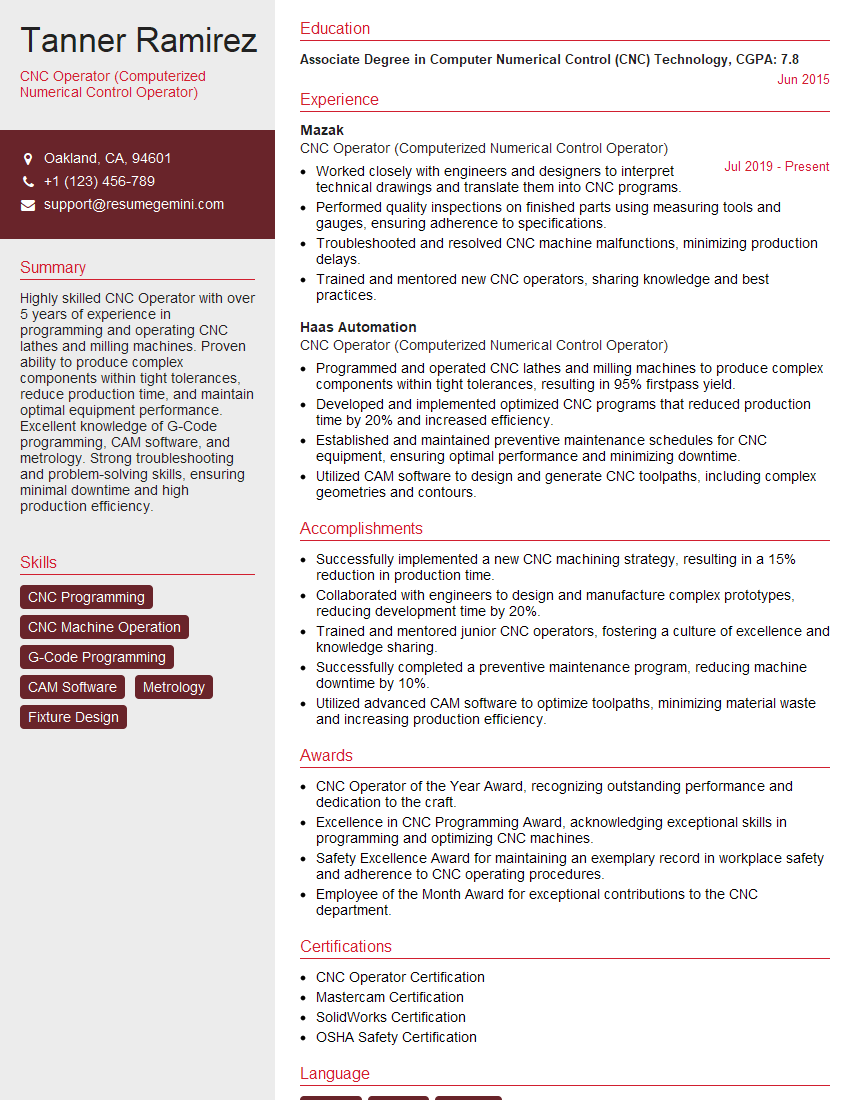
Ever felt underprepared for that crucial job interview? Or perhaps you’ve landed the interview but struggled to articulate your skills and experiences effectively? Fear not! We’ve got you covered. In this blog post, we’re diving deep into the CNC Operator (Computerized Numerical Control Operator) interview questions that you’re most likely to encounter. But that’s not all. We’ll also provide expert insights into the key responsibilities of a CNC Operator (Computerized Numerical Control Operator) so you can tailor your answers to impress potential employers.
Acing the interview is crucial, but landing one requires a compelling resume that gets you noticed. Crafting a professional document that highlights your skills and experience is the first step toward interview success. ResumeGemini can help you build a standout resume that gets you called in for that dream job.






Essential Interview Questions For CNC Operator (Computerized Numerical Control Operator)
1. Explain the process of setting up a CNC machine for a new job?
- Review the job specifications and determine the required tooling and materials
- Secure the workpiece on the machine table and align it according to the specified coordinate system
- Load the CNC program into the machine’s controller and verify the tool offsets and parameters
- Run a test cut to check for any errors or adjustments before committing to the full production run
- Monitor the machine during operation and make any necessary adjustments to maintain accuracy and efficiency
2. How do you troubleshoot common CNC machine errors?
subheading of the answer
- Identify the error message or symptom
- Consult the machine’s documentation or diagnostic tools to determine the possible causes
- Check for loose connections, worn components, or other signs of mechanical or electrical issues
- Review the CNC program for any errors or inconsistencies
- Reset the machine and restart the program to see if the error persists
subheading of the answer
- If the error persists, contact the machine manufacturer or a qualified technician for further assistance
- Document the error and the steps taken to troubleshoot it for future reference
3. What are the different types of CNC programming methods and when would you use each one?
- G-code programming: A common language used for CNC machines, it provides precise control over the machine’s movements and actions
- CAD/CAM software: Computer-aided design and manufacturing software that allows users to create 3D models and generate CNC programs directly from the design
- Conversational programming: A user-friendly method that uses a simplified language and interactive menus to create CNC programs
- Use cases:
- G-code is suitable for complex parts with tight tolerances and precise motion control
- CAD/CAM is ideal for creating complex 3D geometries and generating optimized CNC programs
- Conversational programming is useful for quick setup and programming of simple parts
4. How do you ensure the accuracy and precision of CNC machined parts?
- Regular calibration and maintenance: Ensuring the machine is properly calibrated and maintained to minimize errors
- Proper tooling selection and setup: Using sharp and appropriate cutting tools and ensuring they are correctly aligned and secured
- Careful programming: Writing CNC programs with precision and following best practices to avoid mistakes
- Monitoring and adjustment: Continuously monitoring the machining process and making adjustments as needed to maintain accuracy
- Quality control: Implementing quality control measures, such as inspections and measurements, to ensure parts meet specifications
5. What are the safety precautions you must observe when working with CNC machines?
- Wear appropriate safety gear: Including safety glasses, gloves, and proper clothing
- Keep the work area clean and organized: To prevent tripping hazards and ensure proper access to controls
- Be aware of the machine’s movements: Stay clear of moving parts and pay attention to the machine’s operation
- Never reach into the machine while it is running: Wait for the machine to come to a complete stop before making adjustments or retrieving parts
- Follow proper lockout/tagout procedures: When performing maintenance or repairs
6. Describe your experience with different types of CNC machines and their applications?
- Type 1: Experience with vertical machining centers (VMCs) for precision machining of complex parts
- Type 2: Familiarity with horizontal machining centers (HMCs) for large-scale and heavy-duty machining
- Type 3: Knowledge of lathe machines for turning operations and creating cylindrical parts
- Applications:
- VMCs: aerospace, medical, and automotive industries
- HMCs: heavy equipment, construction, and energy sectors
- Lathes: manufacturing shafts, gears, and cylindrical components
7. How do you handle complex CNC programming challenges and ensure efficient machining?
- Break down complex programs: Divide large programs into smaller, manageable modules
- Use subroutines: Create reusable code blocks to streamline programming and reduce errors
- Optimize toolpaths: Plan efficient toolpaths to minimize machining time and improve surface finish
- Utilize simulation software: Simulate programs before execution to identify potential issues and optimize parameters
- Collaborate with engineers and designers: Consult with experts to ensure programs align with design requirements
8. How do you manage multiple CNC machines simultaneously and prioritize tasks?
- Planning and scheduling: Create a production schedule and allocate machines accordingly
- Prioritization: Determine the urgency and importance of tasks and prioritize them based on deadlines
- Monitoring: Regularly check the status of each machine and adjust the schedule as needed
- Communication: Keep colleagues informed about machine availability and progress to avoid conflicts
- Continuous improvement: Analyze production data and identify areas for optimization
9. How do you stay updated with the latest advancements in CNC technology and best practices?
- Attend industry conferences and exhibitions: Engage with experts and learn about new technologies
- Read technical journals and publications: Stay informed about industry trends and best practices
- Participate in online forums and discussion groups: Connect with other CNC professionals and exchange knowledge
- Seek training and certifications: Enhance skills and stay current with industry standards
- Collaborate with vendors and manufacturers: Learn about new products and advancements directly from industry leaders
10. How do you measure your productivity and identify areas for improvement as a CNC Operator?
- Track key performance indicators (KPIs): Monitor metrics such as cycle times, scrap rates, and machine utilization
- Analyze production data: Identify trends and patterns to understand areas for improvement
- Seek feedback from colleagues and supervisors: Get constructive criticism and suggestions on performance
- Set personal goals: Establish targets for improvement and track progress
- Continuously evaluate and adjust processes: Regularly review and optimize workflows to enhance efficiency
Interviewers often ask about specific skills and experiences. With ResumeGemini‘s customizable templates, you can tailor your resume to showcase the skills most relevant to the position, making a powerful first impression. Also check out Resume Template specially tailored for CNC Operator (Computerized Numerical Control Operator).
Career Expert Tips:
- Ace those interviews! Prepare effectively by reviewing the Top 50 Most Common Interview Questions on ResumeGemini.
- Navigate your job search with confidence! Explore a wide range of Career Tips on ResumeGemini. Learn about common challenges and recommendations to overcome them.
- Craft the perfect resume! Master the Art of Resume Writing with ResumeGemini’s guide. Showcase your unique qualifications and achievements effectively.
- Great Savings With New Year Deals and Discounts! In 2025, boost your job search and build your dream resume with ResumeGemini’s ATS optimized templates.
Researching the company and tailoring your answers is essential. Once you have a clear understanding of the CNC Operator (Computerized Numerical Control Operator)‘s requirements, you can use ResumeGemini to adjust your resume to perfectly match the job description.
Key Job Responsibilities
A CNC Operator is responsible for the safe and efficient operation of Computerized Numerical Control (CNC) machines. Their primary duties involve setting up, operating, and maintaining CNC equipment to produce high-quality parts and components.
1. Machine Setup and Operation
Setting up CNC machines by mounting and securing workpieces, selecting and loading cutting tools, and programming machine parameters based on engineering drawings.
- Interpreting and analyzing technical blueprints to determine machining requirements.
- Selecting and installing appropriate cutting tools and workholding devices.
2. Machine Monitoring and Maintenance
Ensuring the smooth operation of CNC machines by monitoring cutting processes, checking tool wear, and making necessary adjustments. Maintaining machine components, such as lubricating moving parts, calibrating sensors, and troubleshooting minor issues.
- Performing routine inspections and cleaning of machine components.
- Identifying and resolving machine malfunctions.
3. Quality Control and Inspection
Inspecting finished parts and components using measuring instruments and gauges to ensure they meet specifications. Maintaining quality records and reporting any defects or deviations from standards.
- Measuring and verifying dimensions, tolerances, and surface finishes.
- Documenting inspection results and identifying areas for improvement.
4. Tooling and Fixture Maintenance
Maintaining and managing cutting tools, fixtures, and other accessories to ensure optimal performance and accuracy. Maintaining inventory levels and requesting replacement tools and materials as needed.
- Sharpening, regrinding, and replacing cutting tools.
- Ensuring proper storage and handling of tools and fixtures.
Interview Tips
To ace a CNC Operator interview, it’s crucial to demonstrate a strong understanding of CNC machining principles and a commitment to delivering high-quality results.
1. Highlight Your Technical Skills
Emphasize your proficiency in CNC programming, machine setup, and maintenance. Discuss specific techniques and technologies you have worked with, such as G-code programming, CAD/CAM software, and automated tool changing.
- Provide examples of complex machining projects you have successfully completed.
- Discuss your experience with different CNC machine types and control systems.
2. Showcase Your Attention to Detail
CNC Operators must be meticulous and have a sharp eye for detail. Highlight your ability to inspect parts to precise specifications, identify potential issues, and maintain a clean and organized work area.
- Describe your quality control procedures and the tools you use for inspection.
- Explain how you ensure the accuracy and consistency of your work.
3. Emphasize Safety and Efficiency
CNC Operators must prioritize safety and efficiency in their work. Discuss your adherence to safety protocols and your ability to optimize machine performance. Highlight any experience you have with lean manufacturing or continuous improvement initiatives.
- Provide examples of safety precautions you have taken to prevent accidents.
- Describe your efforts to minimize machine downtime and increase production efficiency.
4. Prepare for Common Interview Questions
Review common CNC Operator interview questions, such as:
- Tell me about your experience with CNC programming.
- How do you ensure the accuracy and quality of your work?
- What are your strengths and weaknesses as a CNC Operator?
- Why are you interested in this position?
- What are your salary expectations?
Prepare well-structured answers that showcase your skills and experience, and be ready to provide specific examples to support your claims.
Next Step:
Now that you’re armed with interview-winning answers and a deeper understanding of the CNC Operator (Computerized Numerical Control Operator) role, it’s time to take action! Does your resume accurately reflect your skills and experience for this position? If not, head over to ResumeGemini. Here, you’ll find all the tools and tips to craft a resume that gets noticed. Don’t let a weak resume hold you back from landing your dream job. Polish your resume, hit the “Build Your Resume” button, and watch your career take off! Remember, preparation is key, and ResumeGemini is your partner in interview success.