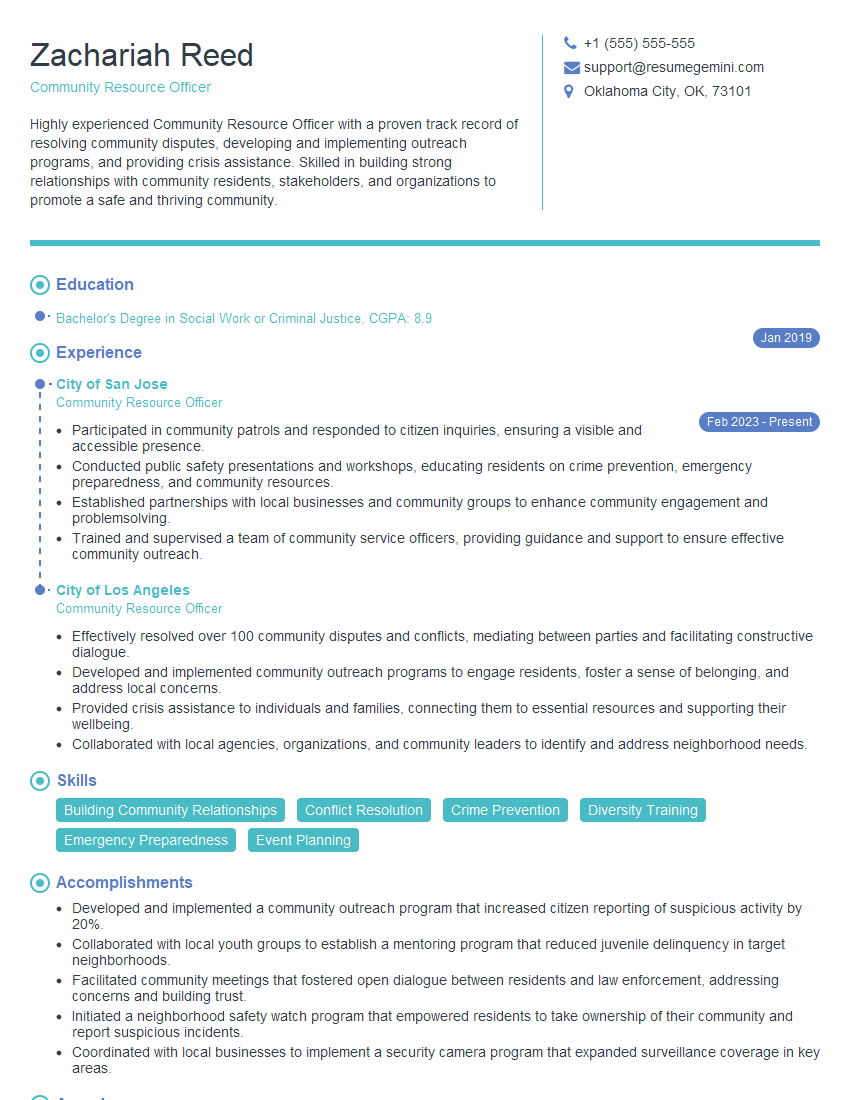
Ever felt underprepared for that crucial job interview? Or perhaps you’ve landed the interview but struggled to articulate your skills and experiences effectively? Fear not! We’ve got you covered. In this blog post, we’re diving deep into the Community Resource Officer interview questions that you’re most likely to encounter. But that’s not all. We’ll also provide expert insights into the key responsibilities of a Community Resource Officer so you can tailor your answers to impress potential employers.
Acing the interview is crucial, but landing one requires a compelling resume that gets you noticed. Crafting a professional document that highlights your skills and experience is the first step toward interview success. ResumeGemini can help you build a standout resume that gets you called in for that dream job.






Essential Interview Questions For Community Resource Officer
1. Describe your understanding of the role of a Community Resource Officer?
.
- A Community Resource Officer (CRO) serves as a liaison between law enforcement and the community.
- CROs work to build relationships with residents and businesses, identify community needs, and develop programs and initiatives to address those needs.
- CROs also work to prevent crime and disorder, and to promote public safety.
2. What are the key skills and qualities that you believe are essential for a successful Community Resource Officer?
Communication and interpersonal skills:
- CROs must be able to communicate effectively with people from all walks of life.
- They must be able to build rapport with residents and businesses, and to earn their trust.
Problem-solving skills:
- CROs must be able to identify and solve problems in the community.
- They must be able to think creatively and to develop innovative solutions to complex issues.
Cultural sensitivity:
- CROs must be culturally sensitive and understand the needs of the diverse community they serve.
- They must be able to work effectively with people from all cultural backgrounds.
Community policing experience:
- CROs should have experience with community policing.
- This experience will help them to understand the needs of the community and to develop effective strategies for addressing those needs.
3. How would you approach building relationships with residents and businesses in a new community?
.
- I would start by getting to know the community and its residents.
- I would attend community events, meet with local leaders, and talk to residents about their concerns.
- I would also work to identify and address the needs of the community.
- By building relationships with residents and businesses, I would be able to better understand the community’s needs and to develop effective strategies for addressing those needs.
4. What are some of the challenges that you anticipate facing as a Community Resource Officer?
.
- One of the challenges that I anticipate facing as a Community Resource Officer is building trust with the community.
- This can be difficult, especially in communities that have had negative experiences with law enforcement.
- Another challenge is balancing the needs of the community with the needs of law enforcement.
- CROs must be able to work effectively with both the community and law enforcement to ensure that the needs of both are met.
5. How would you handle a situation where a resident or business owner is upset with the police?
.
- If a resident or business owner is upset with the police, I would first try to understand their concerns.
- I would listen to their perspective and try to see the situation from their point of view.
- I would then explain the police department’s policies and procedures and try to resolve the issue in a fair and equitable manner.
6. What are some of the ways that you would work to prevent crime and disorder in the community?
.
- There are a number of ways that I would work to prevent crime and disorder in the community.
- I would work to build relationships with residents and businesses and to identify the needs of the community.
- I would also work to develop and implement programs and initiatives that address the needs of the community and that help to prevent crime and disorder.
7. How would you work to promote public safety in the community?
.
- I would work to promote public safety in the community by working with residents and businesses to identify and address the needs of the community.
- I would also work to develop and implement programs and initiatives that promote public safety, such as neighborhood watch programs and community policing initiatives.
8. What are your thoughts on the use of body cameras by police officers?
.
- I believe that body cameras are a valuable tool for law enforcement.
- They can help to increase transparency and accountability, and they can also help to protect officers from false accusations.
- I would support the use of body cameras by police officers in my community.
9. What are your thoughts on the use of social media by law enforcement?
.
- I believe that social media can be a valuable tool for law enforcement.
- It can help to build relationships with the community, to share information, and to prevent crime.
- I would support the use of social media by law enforcement in my community.
10. What are your thoughts on the use of data and analytics by law enforcement?
.
- I believe that data and analytics can be valuable tools for law enforcement.
- They can help to identify crime patterns, to predict future crime, and to develop more effective crime prevention strategies.
- I would support the use of data and analytics by law enforcement in my community.
Interviewers often ask about specific skills and experiences. With ResumeGemini‘s customizable templates, you can tailor your resume to showcase the skills most relevant to the position, making a powerful first impression. Also check out Resume Template specially tailored for Community Resource Officer.
Career Expert Tips:
- Ace those interviews! Prepare effectively by reviewing the Top 50 Most Common Interview Questions on ResumeGemini.
- Navigate your job search with confidence! Explore a wide range of Career Tips on ResumeGemini. Learn about common challenges and recommendations to overcome them.
- Craft the perfect resume! Master the Art of Resume Writing with ResumeGemini’s guide. Showcase your unique qualifications and achievements effectively.
- Great Savings With New Year Deals and Discounts! In 2025, boost your job search and build your dream resume with ResumeGemini’s ATS optimized templates.
Researching the company and tailoring your answers is essential. Once you have a clear understanding of the Community Resource Officer‘s requirements, you can use ResumeGemini to adjust your resume to perfectly match the job description.
Key Job Responsibilities
As a Community Resource Officer, you will play a vital role in building and maintaining strong relationships between law enforcement and the community it serves. Your primary focus will be on fostering positive interactions, providing support, and empowering community members.
1. Community Engagement
Initiate and participate in community outreach programs, meetings, and events to establish trust and open lines of communication.
- Conduct presentations and workshops on crime prevention, safety, and other community-related topics.
- Collaborate with community organizations, schools, and businesses to address local needs and concerns.
2. Problem-Solving
Identify and address community issues through collaborative problem-solving.
- Analyze neighborhood trends and crime patterns to develop targeted intervention strategies.
- Work with residents, businesses, and other stakeholders to develop and implement community-based solutions.
3. Crime Prevention
Implement crime prevention initiatives and educate the community on safety measures.
- Conduct safety audits and provide guidance on crime prevention techniques.
- Develop and distribute crime prevention materials and resources.
4. Support and Outreach
Provide support and assistance to vulnerable populations and individuals in need.
- Connect individuals with social services, counseling, and other support systems.
- Assist in crisis situations and provide referrals to appropriate resources.
Interview Tips
Preparing for an interview for a Community Resource Officer position requires a well-rounded approach that incorporates knowledge of the job responsibilities, as well as an understanding of the interviewer’s perspective. Here are some tips to help you ace your interview:
1. Research the Organization and Position
Before the interview, thoroughly research the law enforcement agency and the specific role you are applying for. Understand the agency’s mission, values, and the community it serves. This will demonstrate your genuine interest in the position and show that you have taken the time to learn about the organization.
2. Highlight Your Community Engagement Experience
Emphasize your experience and skills in building relationships with diverse communities. Provide specific examples of how you have successfully engaged with community members, addressed their concerns, and worked collaboratively to solve problems. This is a crucial aspect of the Community Resource Officer role.
3. Showcase Your Problem-Solving Abilities
Discuss your approach to identifying and addressing community issues. Explain how you gather information, analyze data, and develop effective solutions in collaboration with stakeholders. Real-world examples of your problem-solving skills will be highly valued by the interviewer.
4. Demonstrate Your Commitment to Community Policing
Articulate your understanding of community policing principles and your commitment to building trust and fostering positive relationships between law enforcement and the community. Explain how you have applied these principles in your previous experiences and how you plan to incorporate them into this role.
5. Prepare for Common Interview Questions
Anticipate and prepare for common interview questions related to community engagement, problem-solving, and your motivation for pursuing this career path. Practice answering these questions succinctly and confidently, providing specific examples whenever possible.
Next Step:
Now that you’re armed with interview-winning answers and a deeper understanding of the Community Resource Officer role, it’s time to take action! Does your resume accurately reflect your skills and experience for this position? If not, head over to ResumeGemini. Here, you’ll find all the tools and tips to craft a resume that gets noticed. Don’t let a weak resume hold you back from landing your dream job. Polish your resume, hit the “Build Your Resume” button, and watch your career take off! Remember, preparation is key, and ResumeGemini is your partner in interview success.