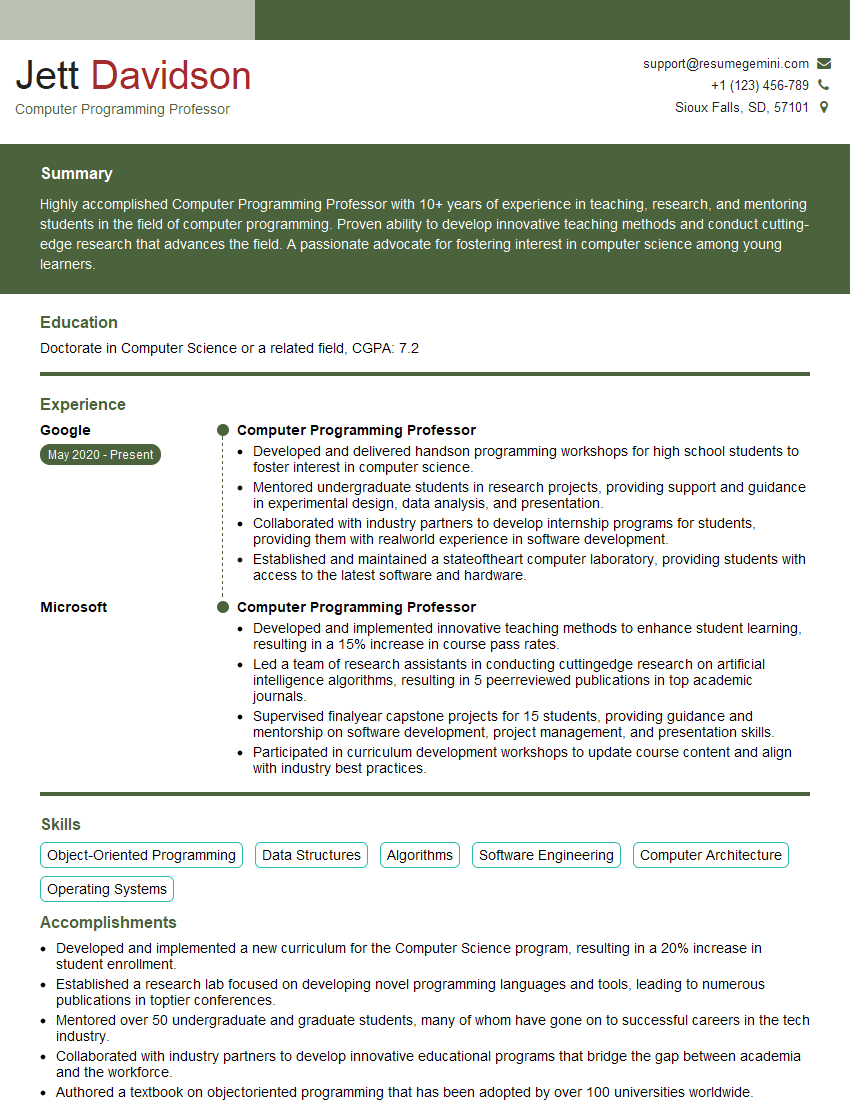
Feeling lost in a sea of interview questions? Landed that dream interview for Computer Programming Professor but worried you might not have the answers? You’re not alone! This blog is your guide for interview success. We’ll break down the most common Computer Programming Professor interview questions, providing insightful answers and tips to leave a lasting impression. Plus, we’ll delve into the key responsibilities of this exciting role, so you can walk into your interview feeling confident and prepared.
Acing the interview is crucial, but landing one requires a compelling resume that gets you noticed. Crafting a professional document that highlights your skills and experience is the first step toward interview success. ResumeGemini can help you build a standout resume that gets you called in for that dream job.






Essential Interview Questions For Computer Programming Professor
1. What are the key principles of object-oriented programming?
- Encapsulation: Bundling of data and methods that operate on that data within a single unit.
- Abstraction: Exposing only essential features and hiding implementation details.
- Inheritance: Creating new classes from existing ones to inherit properties and behavior.
- Polymorphism: Ability for objects of different classes to respond to the same message in a uniform way.
2. Explain the concept of data structures and algorithms.
Data Structures
- Organized way to store and retrieve data efficiently.
- Examples: Arrays, Linked Lists, Stacks, Queues, Trees, Graphs.
Algorithms
- Step-by-step procedure to solve a specific problem.
- Consider factors such as time complexity, space complexity, and efficiency.
3. Describe your approach to teaching computer programming.
- Start with fundamentals and gradually introduce advanced concepts.
- Use hands-on exercises, projects, and real-world examples to enhance understanding.
- Foster collaboration and peer learning through group projects and discussions.
- Provide constructive feedback and encourage students to ask questions.
4. How do you assess student learning in your programming classes?
- Regular assignments and exercises to evaluate understanding of concepts.
- Projects and presentations to assess problem-solving skills and critical thinking.
- Midterm and final exams to test overall knowledge and retention.
- Peer assessments and self-reflections to encourage metacognition.
5. What is your experience with developing and implementing curriculum for computer programming courses?
- Designed and taught courses in introductory programming, data structures, and algorithms.
- Developed course materials, including lecture notes, assignments, and exams.
- Incorporated best practices and innovative teaching methods to enhance student engagement.
- Collaborated with colleagues to create a cohesive and up-to-date curriculum.
6. How do you stay up-to-date with the latest advancements in computer programming?
- Attend conferences, workshops, and seminars.
- Read research papers and industry publications.
- Participate in online forums and discussions.
- Experiment with new technologies and programming languages.
7. What are the challenges you have faced in teaching computer programming and how did you overcome them?
- Challenge: Students with diverse backgrounds and learning styles.
- Solution: Tailored instruction, providing resources and support for all students.
- Challenge: Ensuring students understand complex concepts.
- Solution: Breaking concepts into smaller parts, using visual aids, and providing real-life examples.
8. Describe your research interests in computer programming.
- Exploring new algorithms for data processing.
- Investigating the application of machine learning in software development.
- Developing tools to improve code quality and efficiency.
9. How do you incorporate industry trends and best practices into your teaching?
- Incorporating popular programming languages and technologies.
- Inviting industry professionals as guest lecturers.
- Assigning projects that simulate real-world software development scenarios.
- Encouraging students to participate in open-source projects.
10. What are your thoughts on the future of computer programming education?
- Increased emphasis on data science and machine learning.
- Integration of coding into other disciplines (e.g., science, business).
- Continued growth of online and remote learning options.
- Need for educators to adapt to changing technologies and pedagogical approaches.
Interviewers often ask about specific skills and experiences. With ResumeGemini‘s customizable templates, you can tailor your resume to showcase the skills most relevant to the position, making a powerful first impression. Also check out Resume Template specially tailored for Computer Programming Professor.
Career Expert Tips:
- Ace those interviews! Prepare effectively by reviewing the Top 50 Most Common Interview Questions on ResumeGemini.
- Navigate your job search with confidence! Explore a wide range of Career Tips on ResumeGemini. Learn about common challenges and recommendations to overcome them.
- Craft the perfect resume! Master the Art of Resume Writing with ResumeGemini’s guide. Showcase your unique qualifications and achievements effectively.
- Great Savings With New Year Deals and Discounts! In 2025, boost your job search and build your dream resume with ResumeGemini’s ATS optimized templates.
Researching the company and tailoring your answers is essential. Once you have a clear understanding of the Computer Programming Professor‘s requirements, you can use ResumeGemini to adjust your resume to perfectly match the job description.
Key Job Responsibilities
Computer Programming Professors are responsible for teaching and guiding students in the field of computer programming. They design and deliver lectures, lead discussions, and oversee student projects. Additionally, they conduct research, publish findings, and contribute to the body of knowledge in computer science.
1. Teaching and Curriculum Development
Professors are responsible for developing and delivering course content, including lectures, labs, and assignments. They must also stay up-to-date on the latest advances in computer science and incorporate this knowledge into their teaching.
- Design and deliver lectures, labs, and assignments
- Develop and maintain course curriculum
- Stay up-to-date on the latest advances in computer science
2. Student Advising and Mentoring
Professors provide guidance and support to students both inside and outside the classroom. They help students choose courses, develop research projects, and prepare for careers.
- Advise students on course selection and career planning
- Mentor students on research projects
- Provide support and guidance to students
3. Research and Scholarship
Professors are expected to conduct research and publish their findings in academic journals. This research helps to advance the field of computer science and informs their teaching.
- Conduct research in computer science
- Publish findings in academic journals
- Present research at conferences
4. Service and Outreach
Professors often participate in service and outreach activities, such as serving on departmental committees, organizing conferences, and giving public lectures. This helps to promote the field of computer science and connect with the community.
- Serve on departmental committees
- Organize conferences
- Give public lectures
Interview Tips
Preparing for an interview for a Computer Programming Professor position requires a combination of technical expertise and a strong understanding of the academic landscape. Here are some tips to help you ace the interview:
1. Research the Institution and Department
Before the interview, take the time to learn about the institution and the specific department where you are applying. This will help you understand the institution’s mission, values, and research priorities. You should also familiarize yourself with the department’s faculty and their research interests.
- Visit the institution’s website
- Read the department’s mission statement
- Review the faculty’s research interests
2. Prepare for Technical Questions
Be prepared to answer technical questions about computer science fundamentals, programming languages, and algorithms. You should also be able to discuss your research interests and how they align with the department’s research priorities.
- Review basic computer science concepts
- Practice programming in several languages
- Study common algorithms and data structures
3. Highlight Your Teaching Experience
In the interview, be sure to highlight your teaching experience and your passion for teaching. You should be able to articulate your teaching philosophy and demonstrate how you create an engaging and supportive learning environment.
- Discuss your teaching experience and philosophy
- Provide examples of innovative teaching methods
- Share your plans for student engagement and support
4. Ask Thoughtful Questions
Asking thoughtful questions at the end of the interview is a great way to show your interest in the position and the institution. It also gives you an opportunity to learn more about the department and its culture. Some questions you might consider asking include:
- What are the department’s current research priorities?
- What are the opportunities for professional development for faculty?
- What is the institution’s commitment to diversity and inclusion?
Next Step:
Now that you’re armed with interview-winning answers and a deeper understanding of the Computer Programming Professor role, it’s time to take action! Does your resume accurately reflect your skills and experience for this position? If not, head over to ResumeGemini. Here, you’ll find all the tools and tips to craft a resume that gets noticed. Don’t let a weak resume hold you back from landing your dream job. Polish your resume, hit the “Build Your Resume” button, and watch your career take off! Remember, preparation is key, and ResumeGemini is your partner in interview success.