1. What are the different types of conveyor belts and their applications?
Sample Answer:
- Flat belts: Used for short-distance transport and handle lighter loads.
- Trough Belt conveyors: Used for long-distance transport and can handle heavier loads.
- Bucket elevators: Used for vertical movement of materials.
- Screw conveyors: Used for moving materials horizontally or at an incline.
- Pneumatic conveyors: Used for conveying materials using air pressure.
2. How does a conveyor belt system work?
Sample Answer:
- Drive pulley: Powers the conveyor belt.
- Tail pulley: Provides tension to the belt.
- Idlers: Support and guide the belt.
- Take-up pulley: Adjusts belt tension.
- Belt cleaner: Removes debris from the belt.
3. What are the common problems that can occur with conveyor belts and how do you troubleshoot them?
Sample Answer:
- Belt misalignment: Can cause premature wear and tear, resolved by adjusting idlers.
- Belt damage: Caused by cuts, tears, or punctures, repaired using specialized repair kits.
- Spillage: Occurs due to belt overload or misalignment, resolved by adjusting belt tension or loading.
- Motor overload: Caused by excessive load or mechanical defects, resolved by replacing or repairing the motor.
- Electrical faults: Can cause safety hazards, resolved by isolating the system and calling an electrician.
4. What are the safety precautions that need to be taken when working with conveyor belts?
Sample Answer:
- Wear appropriate PPE (e.g., safety glasses, gloves).
- Stay clear of moving belts.
- Never step on or over a moving belt.
- Lock out equipment before performing maintenance.
- Follow established safety protocols.
5. What are the different types of materials used in conveyor belts?
Sample Answer:
- Rubber: Durable and resistant to wear and tear.
- PVC: Lightweight and resistant to chemicals.
- Nylon: High tensile strength and abrasion resistance.
- Steel: Used for heavy-duty applications.
- Fabric: Used for applications where flexibility is important.
6. How do you maintain and inspect conveyor belts?
Sample Answer:
- Visual inspection: Check for wear, damage, or misalignment.
- Tension check: Ensure proper tension to prevent belt slippage.
- Cleaning: Remove debris to prevent damage.
- Lubrication: Lubricate bearings to reduce friction.
- Regular maintenance: Conduct scheduled maintenance checks to identify potential issues early on.
7. What are the different control systems used for conveyor belts?
Sample Answer:
- Manual control: Operator controls the conveyor belt manually.
- Semi-automatic control: Operator starts and stops the conveyor, but the system controls speed and direction.
- Automatic control: PLC or computer controls the entire system, including speed, direction, and safety features.
8. How do you calculate the capacity of a conveyor belt?
Sample Answer:
- Consider the following factors:
- Belt width
- Belt speed
- Material density
- Formula: Capacity = Belt width x Belt speed x Material density
9. What are the different methods used to convey materials on conveyor belts?
Sample Answer:
- Belt conveying: Materials are transported directly on the belt.
- Bucket conveying: Materials are carried in buckets attached to the belt.
- Screw conveying: Materials are moved by a rotating screw within a trough.
- Pneumatic conveying: Materials are transported using air pressure.
10. What are the advantages and limitations of using conveyor belts?
Sample Answer:
Advantages:- High efficiency
- Continuous operation
- Flexible routing
- Bulk handling
- Can only transport materials in one direction
- Limited capacity for certain materials
- Require regular maintenance
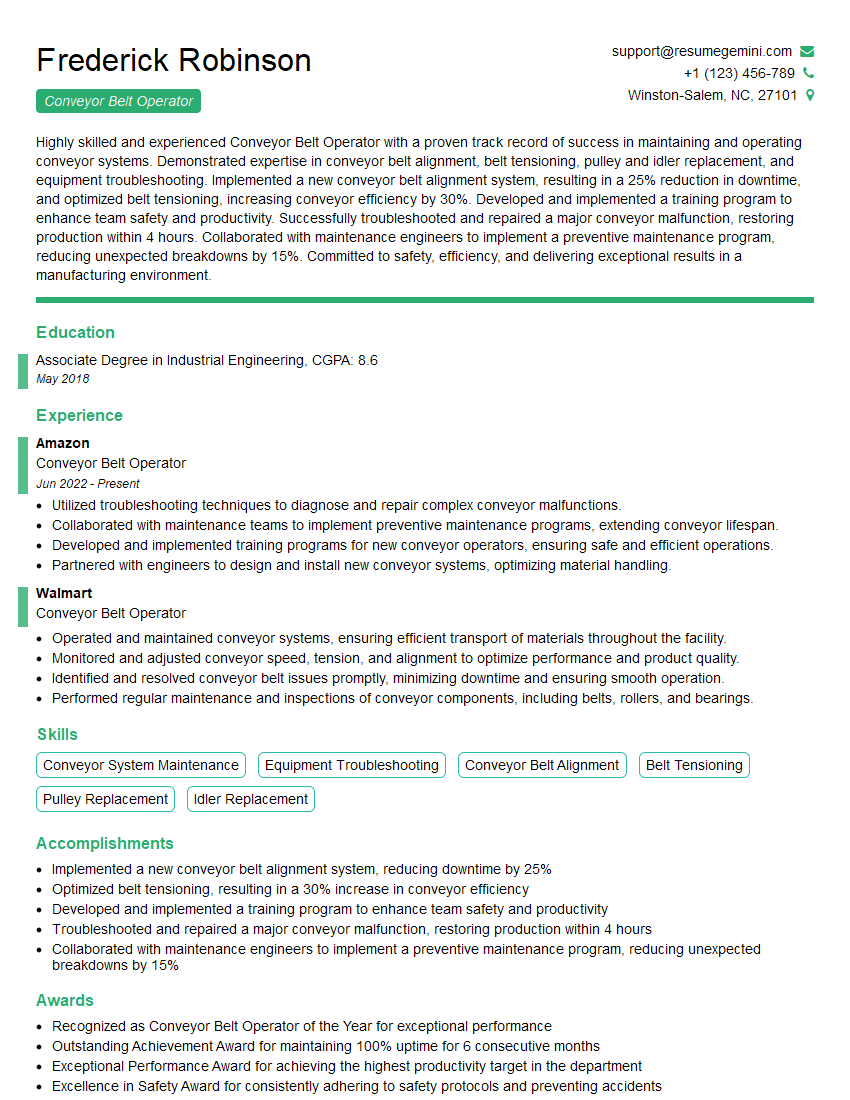
Interviewers often ask about specific skills and experiences. With ResumeGemini‘s customizable templates, you can tailor your resume to showcase the skills most relevant to the position, making a powerful first impression. Also check out Resume Template specially tailored for Conveyor Belt Operator.
Key Job Responsibilities
Conveyor belt operators play a crucial role in ensuring the smooth functioning of conveyor systems in manufacturing and industrial settings.
1. Monitor and Control Conveyor System
Monitor the conveyor system for any irregularities, such as equipment malfunctions or material blockages
- Adjust conveyor speed and tension to maintain optimal material flow
- Stop and start the conveyor system as needed
2. Maintain and Inspect Equipment
Perform regular maintenance and inspections of conveyor equipment, including belts, rollers, and motors
- Lubricate and clean equipment to prevent wear and tear
- Inspect belts for damage and replace if necessary
3. Clear Material Blockages and Spills
Remove material blockages and spills from the conveyor system promptly
- Use brooms, shovels, or vacuums to clear blockages
- Report any spills or accidents to the supervisor
4. Ensure Safety and Follow Regulations
Operate the conveyor belt safely and in compliance with all safety regulations
- Wear appropriate protective gear, such as gloves and safety glasses
- Keep the work area clean and free of hazards
Interview Tips
Preparing thoroughly for an interview is essential to making a good impression and showcasing your qualifications for the role of Conveyor Belt Operator. Here are some tips to help you ace your interview:
1. Research the Company and Position
Before the interview, research the company and the specific position you are applying for. This will demonstrate your interest in the opportunity and give you a better understanding of the company’s values, culture, and expectations.
- Visit the company’s website and social media pages.
- Read industry news and articles related to the company and the position.
2. Practice Your Answers
Take some time to practice answering common interview questions. This will help you feel more confident and prepared during the actual interview.
- Prepare answers to questions about your experience, skills, and qualifications.
- Practice answering questions about your availability, salary expectations, and why you are interested in the position.
3. Prepare Questions for the Interviewer
Asking thoughtful questions at the end of the interview shows that you are engaged and interested in the position. It also gives you an opportunity to clarify any aspects of the role or company.
- Prepare questions about the company’s growth plans, the team you would be working with, and the opportunities for professional development.
- Avoid asking questions about benefits or salary at this stage.
4. Dress Professionally and Arrive on Time
First impressions matter, so dress professionally and arrive on time for your interview. This shows that you respect the interviewer’s time and that you are serious about the opportunity.
- Choose business attire that is clean, pressed, and fits well.
- Plan your route and allow extra time for traffic or unexpected delays.