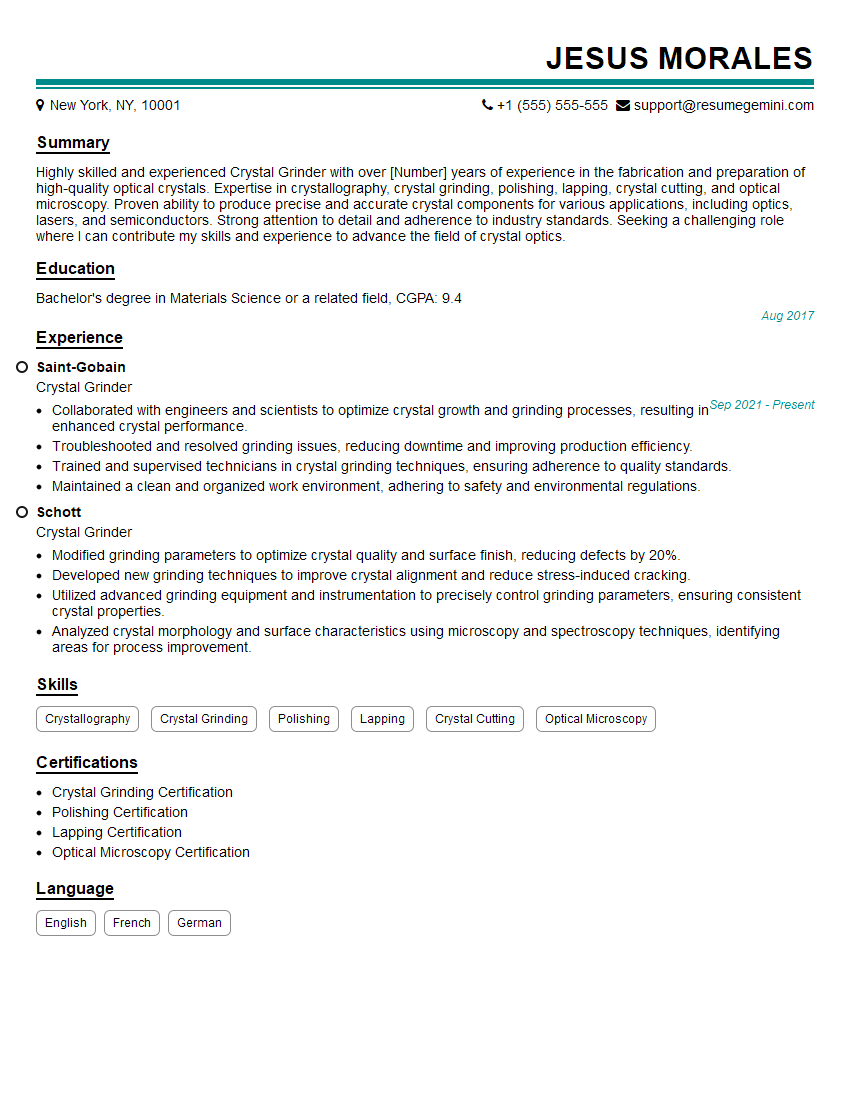
Are you gearing up for a career shift or aiming to ace your next interview? Look no further! We’ve curated a comprehensive guide to help you crack the interview for the coveted Crystal Grinder position. From understanding the key responsibilities to mastering the most commonly asked questions, this blog has you covered. So, buckle up and let’s embark on this journey together.
Acing the interview is crucial, but landing one requires a compelling resume that gets you noticed. Crafting a professional document that highlights your skills and experience is the first step toward interview success. ResumeGemini can help you build a standout resume that gets you called in for that dream job.






Essential Interview Questions For Crystal Grinder
1. Explain the process of grinding a crystal?
The process of grinding a crystal involves several key steps:
- Preparation: The crystal is first prepared for grinding by removing any surface impurities or defects.
- Rough Grinding: The crystal is then subjected to rough grinding using a coarse grinding wheel to remove excess material and achieve a desired shape.
- Fine Grinding: After rough grinding, the crystal is further ground using a finer grinding wheel to refine its shape and surface finish.
- Polishing (optional): To achieve a highly polished surface, the crystal may undergo polishing using a polishing wheel and polishing compound.
2. What are the different types of grinding wheels used for crystal grinding and their advantages and disadvantages?
Diamond Grinding Wheels
- Advantages: High grinding efficiency, long lifespan, precise shape retention
- Disadvantages: Expensive, sensitive to high temperatures
CBN Grinding Wheels
- Advantages: High hardness, suitable for grinding hard materials, long lifespan
- Disadvantages: Lower grinding efficiency than diamond wheels
Electroplated Grinding Wheels
- Advantages: Good shape retention, high grinding accuracy
- Disadvantages: Lower durability than sintered wheels
3. How do you determine the appropriate grinding parameters (grinding wheel speed, feed rate, coolant flow) for a specific crystal grinding operation?
Determining appropriate grinding parameters involves considering the following factors:
- Crystal properties: Hardness, toughness, brittleness
- Grinding wheel characteristics: Type, grit size, bond strength
- Grinding machine capabilities: Spindle speed, feed rate, coolant system
- Desired grinding results: Surface quality, shape accuracy
Experimental testing and empirical data can also guide the selection of optimal parameters.
4. How do you measure and control the dimensional accuracy of a ground crystal?
Dimensional accuracy can be measured and controlled through:
- Coordinate Measuring Machine (CMM): Provides precise measurements of complex shapes and dimensions.
- Optical Comparator: Compares the ground crystal to a reference template to detect deviations.
- Laser Scanning: Non-contact measurement technique that generates a 3D model of the crystal.
- Regular calibration of grinding machinery: Ensures consistent and accurate grinding operations.
5. What safety precautions should be taken when working with crystal grinding equipment?
Essential safety precautions include:
- Proper eye protection: Wear safety glasses or goggles to protect from flying debris.
- Respiratory protection: Use a dust mask or respirator to prevent inhalation of harmful dust particles.
- Protective clothing: Wear gloves, apron, and other protective gear to prevent cuts and abrasions.
- Machine guarding: Ensure all moving parts are properly guarded to prevent contact.
- Adequate ventilation: Maintain proper air circulation to remove dust and fumes.
6. How do you select the appropriate coolant for crystal grinding operations?
Coolant selection depends on several factors:
- Crystal material: Some coolants may react with certain crystal materials.
- Grinding process: Different grinding operations may require specific cooling properties.
- Coolant characteristics: Lubricating ability, cooling efficiency, environmental considerations.
- Cost and availability: Consider the economic and practical aspects of coolant usage.
7. How do you maintain and troubleshoot crystal grinding equipment?
Regular maintenance and troubleshooting ensure optimal equipment performance:
Maintenance:
- Regular cleaning: Remove dust, debris, and coolant buildup.
- Spindle lubrication: Ensure proper lubrication of spindle bearings.
- Wheel balancing: Check and balance grinding wheels to prevent vibrations.
- Calibration: Calibrate the machine regularly for accurate grinding results.
Troubleshooting:
- Excessive vibrations: Check wheel balance, spindle bearings, and machine foundation.
- Poor surface finish: Adjust grinding parameters, inspect wheel condition, or consider coolant issues.
- Diminished grinding efficiency: Replace the grinding wheel, check coolant flow, or troubleshoot machine settings.
8. What are the common defects that can occur during crystal grinding and how can they be prevented?
Common defects and prevention measures include:
Defects:
- Surface scratches: Use sharp grinding wheels, proper coolant, and prevent excessive grinding force.
- Edge chipping: Avoid high grinding pressures, use a suitable grinding wheel bond, and ensure proper wheel dressing.
- Thermal damage: Use appropriate coolant, optimize grinding parameters, and prevent excessive heat buildup.
9. How do you ensure the quality of ground crystals meet customer specifications?
Quality assurance involves:
- Establishing clear specifications: Understand customer requirements for dimensions, surface finish, and other parameters.
- Regular inspection: Inspect ground crystals throughout the process, using appropriate measuring equipment.
- Process control: Monitor and control grinding parameters, such as wheel speed, feed rate, and coolant flow, to achieve consistent results.
- Documentation and traceability: Maintain records of grinding operations and inspection results for quality traceability.
10. How do you stay updated on the latest advancements in crystal grinding technology?
To stay abreast of advancements:
- Attend industry conferences and exhibitions: Engage with experts and learn about new technologies and trends.
- Read technical journals and publications: Keep up with research and development in crystal grinding.
- Collaborate with equipment manufacturers and suppliers: Seek information about innovative solutions and best practices.
- Continuous learning: Engage in professional development opportunities to enhance knowledge and skills.
Interviewers often ask about specific skills and experiences. With ResumeGemini‘s customizable templates, you can tailor your resume to showcase the skills most relevant to the position, making a powerful first impression. Also check out Resume Template specially tailored for Crystal Grinder.
Career Expert Tips:
- Ace those interviews! Prepare effectively by reviewing the Top 50 Most Common Interview Questions on ResumeGemini.
- Navigate your job search with confidence! Explore a wide range of Career Tips on ResumeGemini. Learn about common challenges and recommendations to overcome them.
- Craft the perfect resume! Master the Art of Resume Writing with ResumeGemini’s guide. Showcase your unique qualifications and achievements effectively.
- Great Savings With New Year Deals and Discounts! In 2025, boost your job search and build your dream resume with ResumeGemini’s ATS optimized templates.
Researching the company and tailoring your answers is essential. Once you have a clear understanding of the Crystal Grinder‘s requirements, you can use ResumeGemini to adjust your resume to perfectly match the job description.
Key Job Responsibilities
As a Crystal Grinder, you will be to process and grind raw crystals to create high-quality crystal components for jewelry, industrial, and scientific applications.
1. Crystal Processing
You will be responsible for receiving and inspecting raw csystals, sorting and sizing them based on quality and specifications.
2. Grinding and Polishing
Using specialized grinding and polishing equipment, you will grind and polish crystals to achieve desired shapes, sizes, and surface finishes.
3. Quality Control
You will adhere to strict quality control standards, including measuring and inspecting crystals to ensure they meet specifications, identifying any defects, and conducting necessary adjustments.
4. Safety and Maintenance
You will prioritize safety in the workplace, and be responsible for keeping your work area and equipment clean and well-maintained.
Interview Tips
To ace your interview for the Crystal Grinder position, consider the following tips and hacks.
1. Research the Company and Industry
Familiarize yourself with the company you are applying to, its industry, and the crystal grinding sector. This knowledge will enable you to speak intelligently about the company’s mission, values, and the wider market landscape.
2. Highlight Relevant Experience and Skills
Emphasize your experience in crystal processing, grinding, and polishing. Showcase your technical skills, such as your understanding of different grinding and polishing techniques, as well as your ability to operate and maintain specialized equipment.
3. Demonstrate Quality Consciousness
Highlight your commitment to quality assurance and your attention to detail. Explain how you ensure precision in your work, how you identify and address defects, and how you maintain high standards of craftsmanship.
4. Ask Insightful Questions
During the interview, take the opportunity to ask thoughtful questions. This demonstrates your interest in the role, the company, and the industry. It also allows you to assess whether the position and the company are the right fit for your career goals.
Next Step:
Now that you’re armed with interview-winning answers and a deeper understanding of the Crystal Grinder role, it’s time to take action! Does your resume accurately reflect your skills and experience for this position? If not, head over to ResumeGemini. Here, you’ll find all the tools and tips to craft a resume that gets noticed. Don’t let a weak resume hold you back from landing your dream job. Polish your resume, hit the “Build Your Resume” button, and watch your career take off! Remember, preparation is key, and ResumeGemini is your partner in interview success.