Ever felt underprepared for that crucial job interview? Or perhaps you’ve landed the interview but struggled to articulate your skills and experiences effectively? Fear not! We’ve got you covered. In this blog post, we’re diving deep into the Distribution System Operator interview questions that you’re most likely to encounter. But that’s not all. We’ll also provide expert insights into the key responsibilities of a Distribution System Operator so you can tailor your answers to impress potential employers.
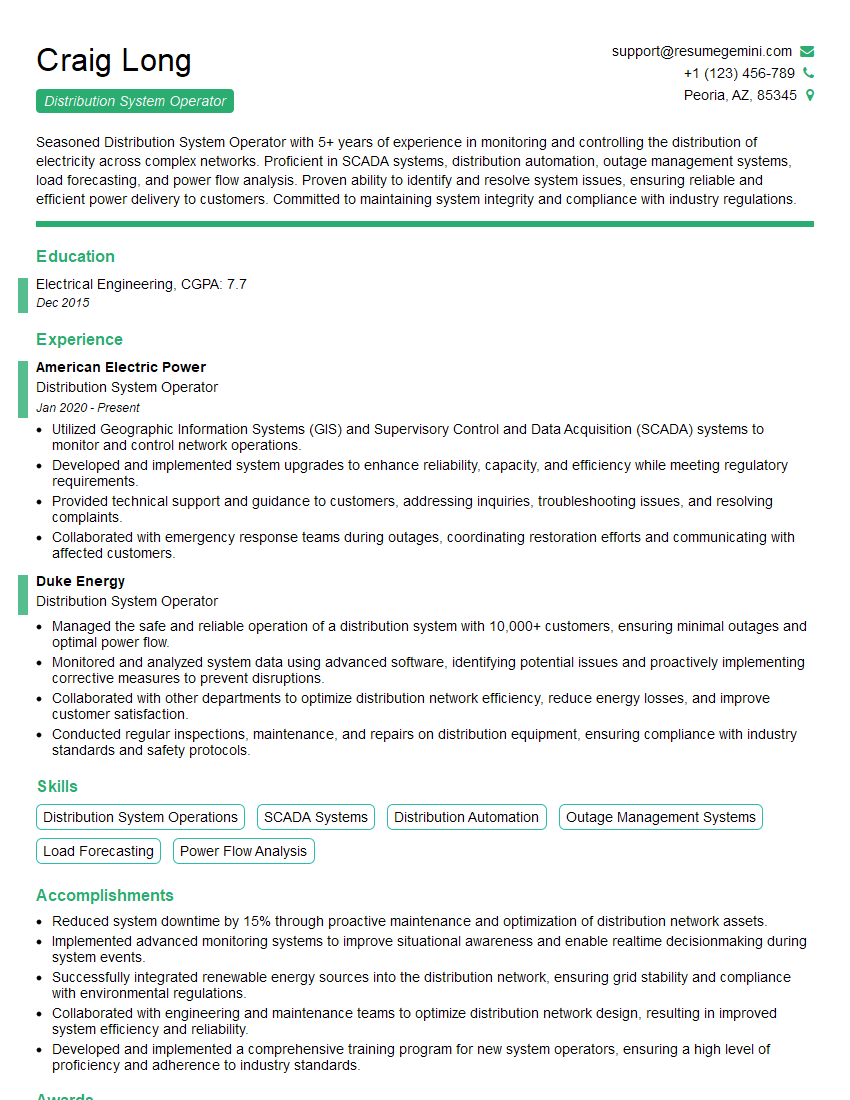
Acing the interview is crucial, but landing one requires a compelling resume that gets you noticed. Crafting a professional document that highlights your skills and experience is the first step toward interview success. ResumeGemini can help you build a standout resume that gets you called in for that dream job.






Essential Interview Questions For Distribution System Operator
1. What is the role of a Distribution System Operator (DSO)?
- Monitor and control the flow of electricity through the distribution network
- Maintain the reliability and stability of the network
- Plan and execute maintenance and upgrade activities
- Respond to outages and restore service quickly
2. What are the key challenges facing DSOs today?
- Increasing demand for electricity
- The integration of renewable energy sources
- The need to upgrade aging infrastructure
- The threat of cyberattacks
3. What are the key skills and qualities required to be a successful DSO?
- Strong technical knowledge of electrical distribution systems
- Excellent communication and interpersonal skills
- The ability to work independently and as part of a team
- The ability to make quick decisions in stressful situations
4. What are the different types of distribution networks?
- Radial networks
- Ring networks
- Mesh networks
5. What is the difference between a distribution network and a transmission network?
- Distribution networks operate at lower voltages (typically 10-30 kV) and are used to deliver electricity to homes and businesses.
- Transmission networks operate at higher voltages (typically 100-500 kV) and are used to transport electricity over long distances.
6. What is the role of a SCADA system in a distribution network?
- SCADA (Supervisory Control and Data Acquisition) systems are used to monitor and control distribution networks.
- SCADA systems collect data from sensors and devices throughout the network and use this data to create a real-time picture of the network’s operation.
- SCADA systems can be used to identify and correct problems on the network, and to optimize network performance.
7. What are the different types of faults that can occur on a distribution network?
- Open-circuit faults
- Short-circuit faults
- Ground faults
8. What are the different methods used to protect distribution networks from faults?
- Fuses
- Circuit breakers
- Reclosers
9. What are the different types of maintenance activities that are carried out on distribution networks?
- Preventive maintenance
- Corrective maintenance
- Emergency maintenance
10. What are the different methods used to restore service after an outage?
- Automatic restoration
- Manual restoration
- Priority restoration
Interviewers often ask about specific skills and experiences. With ResumeGemini‘s customizable templates, you can tailor your resume to showcase the skills most relevant to the position, making a powerful first impression. Also check out Resume Template specially tailored for Distribution System Operator.
Career Expert Tips:
- Ace those interviews! Prepare effectively by reviewing the Top 50 Most Common Interview Questions on ResumeGemini.
- Navigate your job search with confidence! Explore a wide range of Career Tips on ResumeGemini. Learn about common challenges and recommendations to overcome them.
- Craft the perfect resume! Master the Art of Resume Writing with ResumeGemini’s guide. Showcase your unique qualifications and achievements effectively.
- Great Savings With New Year Deals and Discounts! In 2025, boost your job search and build your dream resume with ResumeGemini’s ATS optimized templates.
Researching the company and tailoring your answers is essential. Once you have a clear understanding of the Distribution System Operator‘s requirements, you can use ResumeGemini to adjust your resume to perfectly match the job description.
Key Job Responsibilities
A Distribution System Operator (DSO) is responsible for the safe and reliable operation of the distribution system, which delivers electricity to homes and businesses. Key job responsibilities include:
1. Monitoring and Control
DSOs monitor and control the distribution system to ensure that it is operating within safe and acceptable limits. This includes monitoring voltage, current, and power flow, as well as identifying and responding to system disturbances.
- Monitor and control the flow of electricity through the distribution system
- Identify and respond to system disturbances, such as outages and voltage fluctuations
2. System Maintenance
DSOs perform maintenance on the distribution system to keep it in good working condition. This includes inspecting and repairing transformers, substations, and other equipment, as well as clearing vegetation and debris from power lines.
- Inspect and repair transformers, substations, and other equipment
- Clear vegetation and debris from power lines
3. Outage Management
DSOs manage outages on the distribution system. This includes responding to outages, restoring power as quickly as possible, and investigating the cause of outages to prevent them from happening again.
- Respond to outages and restore power as quickly as possible
- Investigate the cause of outages to prevent them from happening again
4. Safety
DSOs must ensure that the distribution system is operated in a safe manner. This includes following safety procedures, using proper equipment, and wearing appropriate protective gear.
- Follow safety procedures and use proper equipment
- Wear appropriate protective gear
Interview Tips
Preparing for an interview for a Distribution System Operator position can be daunting, but with the right tips and tricks, you can increase your chances of success. Here are a few tips to help you ace your interview:
1. Research the Company and the Position
Before you go on an interview, it’s important to do your research on the company and the position you’re applying for. This will help you understand the company’s culture and values, as well as the specific requirements of the job. You can do this by visiting the company’s website, reading news articles and press releases, and talking to people who work there.
- Visit the company’s website
- Read news articles and press releases
- Talk to people who work there
2. Practice Answering Common Interview Questions
There are certain questions that are commonly asked in interviews for Distribution System Operator positions. It’s a good idea to practice answering these questions in advance so that you can deliver polished and confident responses. Some common interview questions include:
- “Tell me about your experience in the electric utility industry.”
- “What are your strengths and weaknesses as a Distribution System Operator?”
- “Why are you interested in working for our company?”
3. Highlight Your Skills and Experience
When you’re answering interview questions, be sure to highlight your skills and experience that are relevant to the job. For example, if you have experience in monitoring and controlling distribution systems, be sure to mention this in your answer to the question, “What are your strengths and weaknesses as a Distribution System Operator?”
- Highlight your skills and experience in monitoring and controlling distribution systems
- Mention your experience in system maintenance and outage management
- Emphasize your safety record
4. Be Professional and Enthusiastic
First impressions matter, so it’s important to be professional and enthusiastic during your interview. Dress appropriately, arrive on time, and make eye contact with the interviewer. Be sure to answer questions clearly and concisely, and ask questions of your own to show that you’re interested in the position and the company.
- Dress appropriately
- Arrive on time
- Make eye contact with the interviewer
- Answer questions clearly and concisely
- Ask questions of your own
Next Step:
Armed with this knowledge, you’re now well-equipped to tackle the Distribution System Operator interview with confidence. Remember, a well-crafted resume is your first impression. Take the time to tailor your resume to highlight your relevant skills and experiences. And don’t forget to practice your answers to common interview questions. With a little preparation, you’ll be on your way to landing your dream job. So what are you waiting for? Start building your resume and start applying! Build an amazing resume with ResumeGemini.