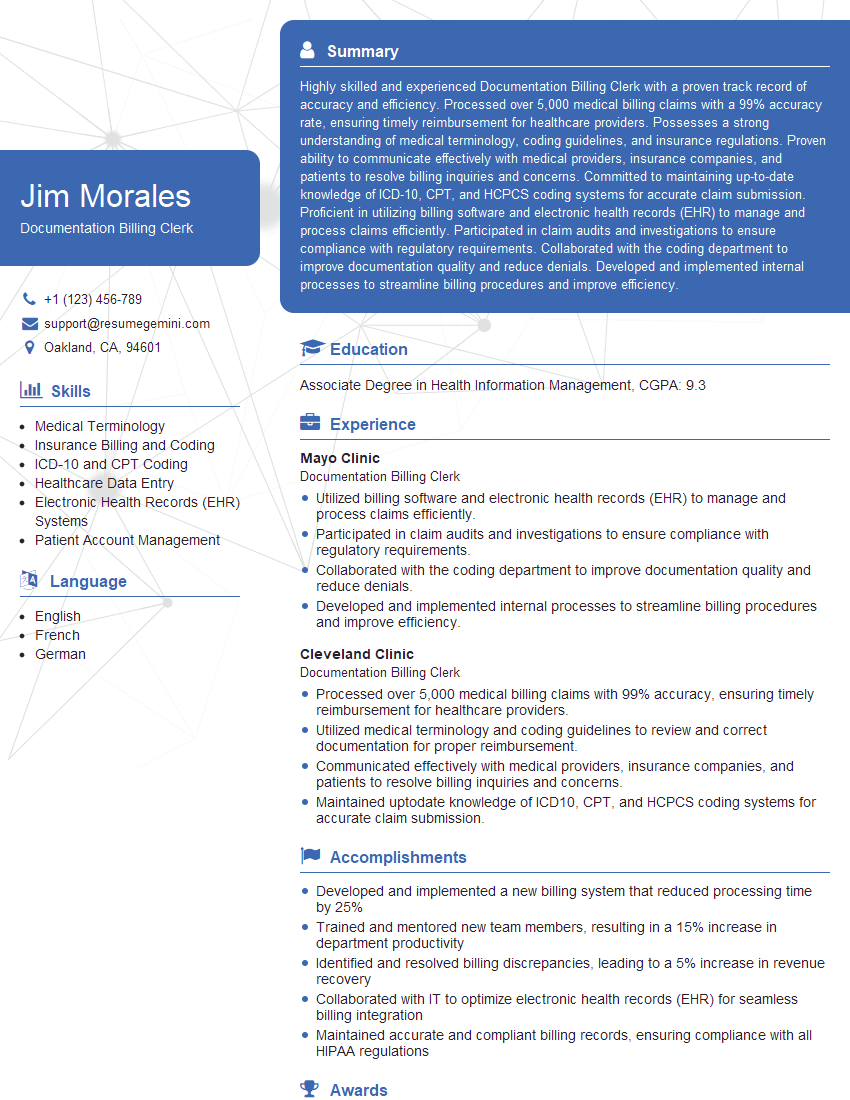
Feeling lost in a sea of interview questions? Landed that dream interview for Documentation Billing Clerk but worried you might not have the answers? You’re not alone! This blog is your guide for interview success. We’ll break down the most common Documentation Billing Clerk interview questions, providing insightful answers and tips to leave a lasting impression. Plus, we’ll delve into the key responsibilities of this exciting role, so you can walk into your interview feeling confident and prepared.
Acing the interview is crucial, but landing one requires a compelling resume that gets you noticed. Crafting a professional document that highlights your skills and experience is the first step toward interview success. ResumeGemini can help you build a standout resume that gets you called in for that dream job.






Essential Interview Questions For Documentation Billing Clerk
1. What are the key elements of a medical bill?
The key elements of a medical bill typically include:
- Patient information (name, address, date of birth, insurance information)
- Provider information (name, address, phone number)
- Date of service
- Procedure or service codes (CPT or HCPCS codes)
- Description of services provided
- Charges for each service
- Total amount due
2. What are the different types of medical insurance?
Commercial insurance
- Provided by private insurance companies
- Can be employer-sponsored or purchased individually
Government insurance
- Medicare: for individuals 65 years of age and older, and those with certain disabilities
- Medicaid: for low-income individuals and families
- CHIP: for children from low-income families
Other types of insurance
- Workers’ compensation: for injuries or illnesses sustained on the job
- Disability insurance: for individuals who are unable to work due to a disability
- Long-term care insurance: for individuals who need long-term care services
3. What are the common errors that occur in medical billing?
Some common errors that occur in medical billing include:
- Incorrect patient information
- Missing or incomplete documentation
- Incorrect procedure or service codes
- Incorrect charges
- Double billing
- Failing to meet insurance requirements
4. What are the key factors that affect the accuracy of medical billing?
The accuracy of medical billing is affected by several factors, including:
- The completeness and accuracy of the patient’s medical record
- The provider’s knowledge of medical billing regulations
- The use of electronic health records (EHRs)
- The efficiency of the billing process
- The accuracy of the insurance company’s claims processing system
5. What are the consequences of inaccurate medical billing?
Inaccurate medical billing can have several consequences, including:
- Delayed or denied claims
- Reduced revenue for providers
- Increased costs for patients
- Fraud and abuse
- Legal liability
6. How can medical billing errors be prevented?
Medical billing errors can be prevented by implementing several strategies, such as:
- Using standardized billing forms and procedures
- Educating providers about medical billing regulations
- Using electronic health records (EHRs)
- Implementing a quality assurance program
- Working closely with insurance companies
7. What are the ethical considerations in medical billing?
Ethical considerations in medical billing include:
- Accuracy and transparency
- Patient privacy
- Avoiding conflicts of interest
- Compliance with laws and regulations
- Fairness and equity
8. What are the career opportunities for medical billing professionals?
- Medical billing and coding specialist
- Medical biller
- Medical coder
- Medical billing manager
- Medical billing auditor
9. What are the skills and qualifications required for a medical billing professional?
- Strong knowledge of medical billing regulations
- Experience with medical billing software
- Excellent communication and interpersonal skills
- Attention to detail and accuracy
- Ability to work independently and as part of a team
10. What are the trends in medical billing?
- Increased use of electronic health records (EHRs)
- Adoption of value-based care models
- Focus on patient engagement
- Use of artificial intelligence (AI) and machine learning
- Increased emphasis on compliance and fraud prevention
Interviewers often ask about specific skills and experiences. With ResumeGemini‘s customizable templates, you can tailor your resume to showcase the skills most relevant to the position, making a powerful first impression. Also check out Resume Template specially tailored for Documentation Billing Clerk.
Career Expert Tips:
- Ace those interviews! Prepare effectively by reviewing the Top 50 Most Common Interview Questions on ResumeGemini.
- Navigate your job search with confidence! Explore a wide range of Career Tips on ResumeGemini. Learn about common challenges and recommendations to overcome them.
- Craft the perfect resume! Master the Art of Resume Writing with ResumeGemini’s guide. Showcase your unique qualifications and achievements effectively.
- Great Savings With New Year Deals and Discounts! In 2025, boost your job search and build your dream resume with ResumeGemini’s ATS optimized templates.
Researching the company and tailoring your answers is essential. Once you have a clear understanding of the Documentation Billing Clerk‘s requirements, you can use ResumeGemini to adjust your resume to perfectly match the job description.
Key Job Responsibilities
Documentation Billing Clerks are responsible for processing and verifying medical documentation to ensure accurate billing and timely reimbursement. Their key responsibilities include:
1. Medical Record Review
Review medical records to extract relevant information for billing and coding purposes.
- Verify patient demographics, insurance information, and medical history.
- Identify and code procedures, diagnoses, and services provided.
2. Billing Statement Preparation
Prepare and process billing statements based on the medical record review.
- Calculate charges and fees according to established fee schedules.
- Generate and send invoices to insurance companies and patients.
3. Payment Processing
Handle payments received from insurance companies and patients.
- Record payments and update patient accounts.
- Resolve any billing or payment disputes.
4. Quality Assurance
Maintain high-quality billing and documentation.
- Conduct internal audits to ensure accuracy and compliance with regulations.
- Stay updated on changes in billing and coding practices.
Interview Tips
Preparing for an interview as a Documentation Billing Clerk requires a combination of technical knowledge and communication skills. Here are some effective tips to help you ace the interview:
1. Research the Company and Position
Take the time to research the healthcare organization and the specific role you’re applying for. This will give you a better understanding of their processes, procedures, and the industry landscape.
- Visit the company website and read about their mission, values, and services.
- Review the job description thoroughly and identify the key responsibilities and qualifications.
2. Highlight Your Technical Skills
Emphasize your proficiency in medical documentation and billing processes. Showcase your knowledge of coding systems, fee schedules, and insurance regulations.
- Highlight any experience you have with medical software, such as EMRs and billing systems.
- Provide examples of how you have maintained high levels of accuracy in your billing work.
3. Demonstrate Strong Communication Skills
In this role, effective communication with healthcare providers, patients, and insurance companies is crucial. Highlight your ability to clearly communicate complex information and handle inquiries professionally.
- Describe situations where you successfully resolved billing disputes or provided clear explanations to clients.
- Emphasize your ability to work well in a team environment and collaborate with colleagues.
4. Stay Updated on Industry Best Practices
The healthcare industry is constantly evolving, so it’s essential to stay abreast of the latest changes in billing and coding practices.
- Attend industry workshops or conferences to stay informed about regulatory updates and best practices.
- Join professional organizations, such as the American Health Information Management Association (AHIMA), for continuing education opportunities.
5. Practice Your Answers
Prepare thoughtful responses to common interview questions. Practice answering them in a clear and concise manner, highlighting your skills and experience.
- Prepare examples of your attention to detail and commitment to accuracy.
- Rehearse how you would handle challenging situations or resolve billing disputes.
Next Step:
Armed with this knowledge, you’re now well-equipped to tackle the Documentation Billing Clerk interview with confidence. Remember, preparation is key. So, start crafting your resume, highlighting your relevant skills and experiences. Don’t be afraid to tailor your application to each specific job posting. With the right approach and a bit of practice, you’ll be well on your way to landing your dream job. Build your resume now from scratch or optimize your existing resume with ResumeGemini. Wish you luck in your career journey!