Are you gearing up for a career shift or aiming to ace your next interview? Look no further! We’ve curated a comprehensive guide to help you crack the interview for the coveted Double Bass Player position. From understanding the key responsibilities to mastering the most commonly asked questions, this blog has you covered. So, buckle up and let’s embark on this journey together.
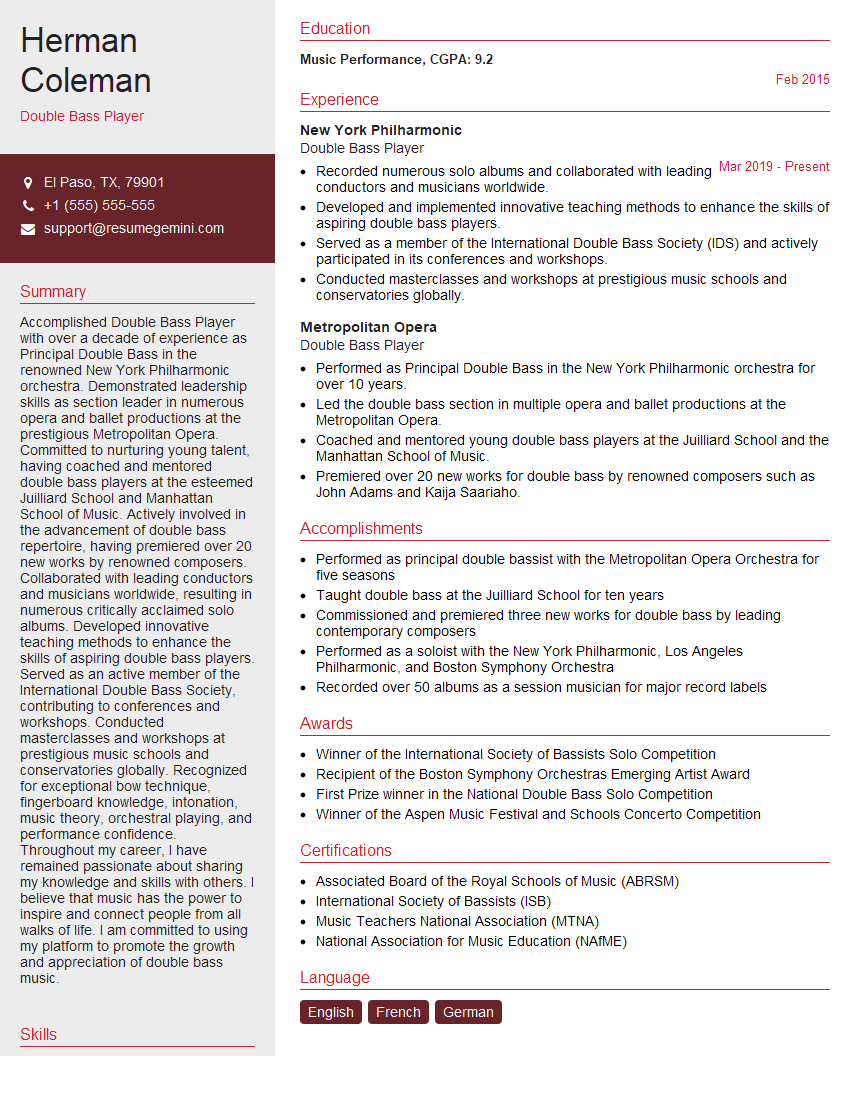
Acing the interview is crucial, but landing one requires a compelling resume that gets you noticed. Crafting a professional document that highlights your skills and experience is the first step toward interview success. ResumeGemini can help you build a standout resume that gets you called in for that dream job.






Essential Interview Questions For Double Bass Player
1. What is your approach to intonation and how do you maintain it on the double bass?
- Explain the importance of intonation in double bass playing.
- Describe the techniques you use to establish and maintain accurate intonation, such as using the harmonic series as a reference and listening attentively to other instruments in the ensemble.
- Discuss the challenges of maintaining intonation on the double bass, such as the lack of frets and the wide range of notes played.
- Explain how you adjust your intonation in different playing situations, such as when performing in a solo or in an ensemble.
2. How do you approach rhythmic precision and how do you develop it?
Practicing with a metronome
- Emphasize the importance of rhythmic precision in double bass playing.
- Explain how you practice with a metronome to develop and maintain rhythmic accuracy.
- Describe the different types of exercises you use to improve your rhythmic skills, such as scales, arpeggios, and rhythmic patterns.
Playing with other musicians
- Discuss the benefits of playing with other musicians to develop rhythmic precision.
- Explain how listening to others and responding accordingly helps you improve your rhythmic skills.
- Describe how you adjust your playing to fit the rhythmic style of different genres and ensembles.
3. What are the most important aspects of double bass technique?
- Explain the fundamental principles of double bass technique, such as proper posture, hand position, and bowing technique.
- Describe the different techniques used to produce different sounds on the double bass, such as pizzicato, arco, and harmonics.
- Discuss the importance of developing a strong foundation in basic technique and how it serves as a basis for more advanced techniques.
4. How do you deal with the physical challenges of playing the double bass?
- Acknowledge the physical demands of playing the double bass, such as the weight of the instrument and the extended playing positions.
- Describe the physical preparation you undertake to maintain good posture and avoid injuries.
- Explain how you manage discomfort or pain during performances and practice sessions.
5. How do you approach the interpretation of double bass parts in different musical styles?
- Describe the different musical styles you are familiar with and how you adapt your playing to suit each style.
- Explain how you analyze the musical score and interpret the composer’s intentions.
- Discuss the importance of collaborating with other musicians to create a unified interpretation.
6. What are the most important qualities of a successful double bass player?
- Discuss the essential qualities of a successful double bass player, such as musicality, technical proficiency, adaptability, and dedication.
- Explain how you develop and maintain these qualities.
- Describe how these qualities contribute to your success as a double bass player.
7. How do you stay motivated and continue to improve as a double bass player?
- Explain what motivates you to practice and improve your skills.
- Describe the strategies you use to identify areas for improvement and set realistic goals.
- Discuss the importance of seeking feedback from teachers, colleagues, and mentors.
8. What are your strengths and weaknesses as a double bass player?
- Identify your strengths as a double bass player, such as your technical proficiency, musicality, or experience in different musical styles.
- Acknowledge your weaknesses and explain how you are working to improve them.
- Be honest and self-aware in your assessment.
9. What are your career goals as a double bass player?
- Describe your short-term and long-term career goals.
- Explain how this position aligns with your career aspirations.
- Discuss your plans for continued professional development.
10. Why are you interested in playing with our ensemble?
- Express your enthusiasm for the ensemble and its artistic vision.
- Describe how your skills and experience would contribute to the ensemble.
- Explain why you believe you are the best candidate for the position.
Interviewers often ask about specific skills and experiences. With ResumeGemini‘s customizable templates, you can tailor your resume to showcase the skills most relevant to the position, making a powerful first impression. Also check out Resume Template specially tailored for Double Bass Player.
Career Expert Tips:
- Ace those interviews! Prepare effectively by reviewing the Top 50 Most Common Interview Questions on ResumeGemini.
- Navigate your job search with confidence! Explore a wide range of Career Tips on ResumeGemini. Learn about common challenges and recommendations to overcome them.
- Craft the perfect resume! Master the Art of Resume Writing with ResumeGemini’s guide. Showcase your unique qualifications and achievements effectively.
- Great Savings With New Year Deals and Discounts! In 2025, boost your job search and build your dream resume with ResumeGemini’s ATS optimized templates.
Researching the company and tailoring your answers is essential. Once you have a clear understanding of the Double Bass Player‘s requirements, you can use ResumeGemini to adjust your resume to perfectly match the job description.
Key Job Responsibilities of a Double Bass Player
Double Bass Players are responsible for providing the foundation and rhythmic support for a musical ensemble. Their key responsibilities include:
1. Playing the double bass
Double Bass Players must be proficient in playing the double bass, a large, low-pitched stringed instrument. They must have a strong understanding of music theory and technique, as well as the ability to read and interpret musical notation.
- Performing in a variety of musical settings, such as orchestras, jazz bands, and chamber groups
- Following the conductor’s instructions and playing in time with other musicians
2. Tuning and maintaining the double bass
Double Bass Players are responsible for ensuring that their instruments are properly tuned and maintained. They must be able to use a variety of tools and techniques to tune their instruments, and they must also be able to identify and repair any problems that may arise.
- Tuning the double bass to the appropriate pitch using a tuner or by ear
- Adjusting the bridge and strings to ensure optimal sound quality
3. Collaborating with other musicians
Double Bass Players must be able to work effectively with other musicians in a collaborative environment. They must be able to listen to and follow the lead of other musicians, and they must be able to contribute to the overall sound of the ensemble.
- Listening to and following the cues of other musicians
- Providing rhythmic and harmonic support to other instruments
4. Rehearsing and performing
Double Bass Players must be able to rehearse and perform to a high standard. They must be able to learn new music quickly and accurately, and they must be able to perform consistently under pressure.
- Attending rehearsals and performances as scheduled
- Practicing regularly to maintain and improve skills
Interview Tips for Double Bass Players
To ace an interview for a Double Bass Player position, it is important to be prepared. Here are some tips to help you prepare for your interview:
1. Research the orchestra or ensemble
Before your interview, it is important to research the orchestra or ensemble that you are applying to join. This will help you to understand their repertoire, their history, and their artistic vision. You will also be able to demonstrate your knowledge of the organization during your interview.
- Visit the orchestra’s website to learn about their history, mission, and upcoming performances
- Listen to recordings of the orchestra’s performances to get a sense of their sound and style
2. Practice your playing
It is important to practice your double bass playing before your interview. This will help you to perform your best during the audition portion of the interview. You should also prepare a piece of music to play for the audition committee.
- Practice playing scales, arpeggios, and other technical exercises
- Prepare a piece of music that showcases your skills and abilities
3. Be prepared to talk about your experience
During your interview, you will be asked about your experience as a Double Bass Player. Be prepared to talk about your musical training, your performance experience, and your goals for your career. You should also be able to articulate why you are interested in joining the orchestra or ensemble.
- Highlight your most relevant experience and skills
- Be prepared to discuss your musical influences and aspirations
4. Dress professionally
It is important to dress professionally for your interview. This will show the audition committee that you are serious about your career and that you are respectful of the opportunity that they have given you. You should wear a suit or other formal attire.
- Choose clothing that is clean, pressed, and fits well
- Avoid wearing clothing that is too revealing or too casual
5. Be confident and enthusiastic
It is important to be confident and enthusiastic during your interview. This will show the audition committee that you are passionate about your music and that you are excited about the opportunity to join the orchestra or ensemble. You should make eye contact with the audition committee, speak clearly and confidently, and answer their questions honestly and enthusiastically.
- Maintain a positive attitude throughout the interview
- Express your enthusiasm for music and for the opportunity to join the orchestra or ensemble
Next Step:
Armed with this knowledge, you’re now well-equipped to tackle the Double Bass Player interview with confidence. Remember, a well-crafted resume is your first impression. Take the time to tailor your resume to highlight your relevant skills and experiences. And don’t forget to practice your answers to common interview questions. With a little preparation, you’ll be on your way to landing your dream job. So what are you waiting for? Start building your resume and start applying! Build an amazing resume with ResumeGemini.