Are you gearing up for a career shift or aiming to ace your next interview? Look no further! We’ve curated a comprehensive guide to help you crack the interview for the coveted Echometer Engineer position. From understanding the key responsibilities to mastering the most commonly asked questions, this blog has you covered. So, buckle up and let’s embark on this journey together.
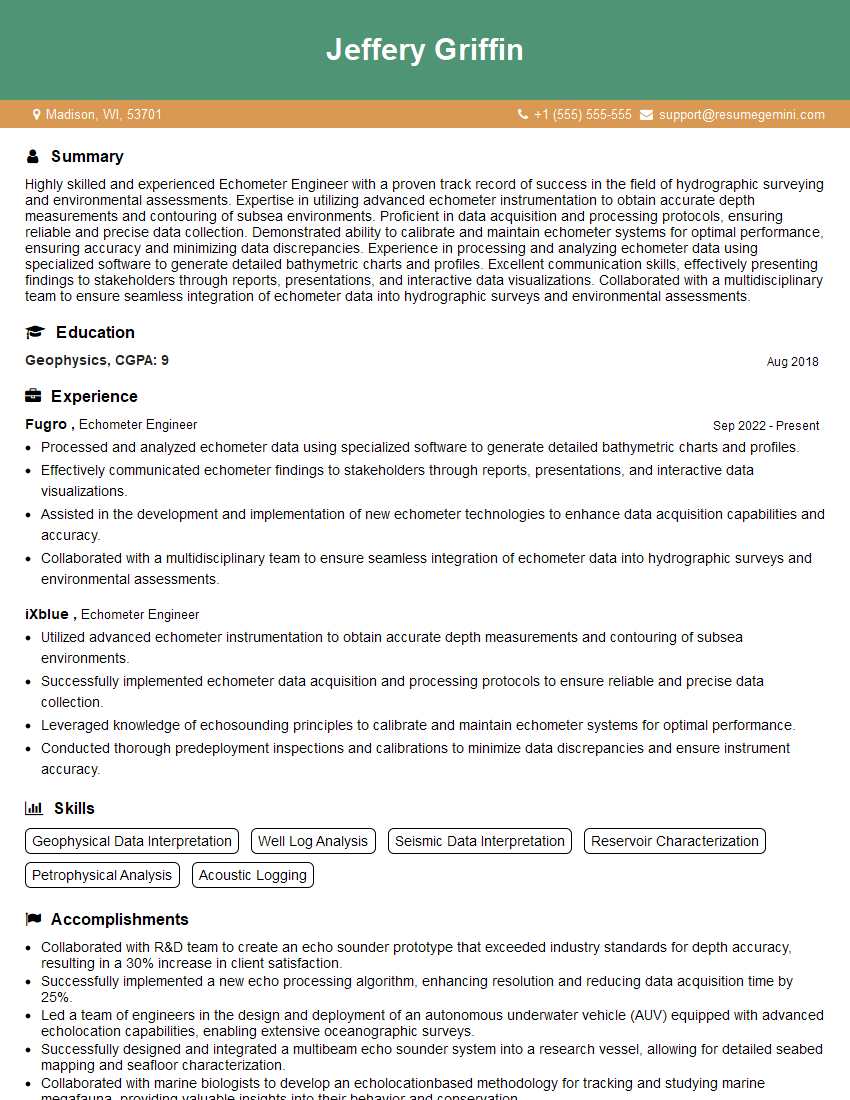
Acing the interview is crucial, but landing one requires a compelling resume that gets you noticed. Crafting a professional document that highlights your skills and experience is the first step toward interview success. ResumeGemini can help you build a standout resume that gets you called in for that dream job.






Essential Interview Questions For Echometer Engineer
1. What are the key components of an echometer system?
The key components of an echometer system include:
- Transducer: Converts electrical signals into acoustic waves and vice versa.
- Transmitter: Generates the electrical signals that drive the transducer.
- Receiver: Amplifies and processes the acoustic signals received by the transducer.
- Display: Provides a visual representation of the measured data.
- Controller: Manages the operation of the system and interfaces with the user.
2. How does an echometer measure distance?
Time-of-Flight Method
- The transmitter generates a short pulse of sound.
- The sound pulse travels through the medium to the target and reflects back to the transducer.
- The time between the transmission and reception of the pulse is measured.
- The distance to the target is calculated using the speed of sound in the medium.
Doppler Shift Method
- The transmitter emits a continuous wave.
- As the target moves, the frequency of the reflected wave changes due to the Doppler effect.
- The distance to the target is calculated by measuring the frequency shift.
3. What are the different types of transducers used in echometers?
The different types of transducers used in echometers include:
- Piezoelectric transducers: Use the piezoelectric effect to convert electrical signals into acoustic waves.
- Capacitive transducers: Use a change in capacitance to detect the presence of an acoustic wave.
- Inductive transducers: Use a change in inductance to detect the presence of an acoustic wave.
- Optical transducers: Use light to detect the presence of an acoustic wave.
4. What factors affect the accuracy of echometer measurements?
The factors that affect the accuracy of echometer measurements include:
- Speed of sound in the medium being measured.
- Temperature and pressure of the medium.
- Noise in the environment.
- Calibration of the echometer.
- Reflectivity of the target.
5. What are the applications of echometers?
Echometers are used in a wide variety of applications, including:
- Distance measurement.
- Level measurement.
- Thickness measurement.
- Flow measurement.
- Medical imaging.
6. What are the advantages of using echometers?
The advantages of using echometers include:
- Non-contact measurement.
- High accuracy and precision.
- Wide range of applications.
- Rugged construction.
- Easy to use.
7. What are the disadvantages of using echometers?
The disadvantages of using echometers include:
- Limited range of measurement.
- Susceptibility to noise and interference.
- Temperature and pressure sensitivity.
- Cost.
8. What are the latest developments in echometer technology?
The latest developments in echometer technology include:
- Development of new transducer materials with improved performance.
- Use of digital signal processing to improve the accuracy and precision of measurements.
- Development of new techniques for noise reduction and interference suppression.
- Development of new applications for echometers.
9. What are the future trends in echometer technology?
The future trends in echometer technology include:
- Continued development of new transducer materials with improved performance.
- Increased use of digital signal processing for data analysis and visualization.
- Development of new techniques for multi-parameter measurement.
- Development of new applications for echometers in various industries.
10. What are the challenges in the design and development of echometer systems?
The challenges in the design and development of echometer systems include:
- Improving the accuracy and precision of measurements.
- Reducing the size and cost of echometer systems.
- Developing new techniques for noise reduction and interference suppression.
- Meeting the requirements of different applications.
Interviewers often ask about specific skills and experiences. With ResumeGemini‘s customizable templates, you can tailor your resume to showcase the skills most relevant to the position, making a powerful first impression. Also check out Resume Template specially tailored for Echometer Engineer.
Career Expert Tips:
- Ace those interviews! Prepare effectively by reviewing the Top 50 Most Common Interview Questions on ResumeGemini.
- Navigate your job search with confidence! Explore a wide range of Career Tips on ResumeGemini. Learn about common challenges and recommendations to overcome them.
- Craft the perfect resume! Master the Art of Resume Writing with ResumeGemini’s guide. Showcase your unique qualifications and achievements effectively.
- Great Savings With New Year Deals and Discounts! In 2025, boost your job search and build your dream resume with ResumeGemini’s ATS optimized templates.
Researching the company and tailoring your answers is essential. Once you have a clear understanding of the Echometer Engineer‘s requirements, you can use ResumeGemini to adjust your resume to perfectly match the job description.
Key Job Responsibilities
An Echometer Engineer is a specialized engineer responsible for the design, maintenance, and operation of echometers, sophisticated devices that use sound waves to measure water depths. They play a critical role in ensuring the safety of navigation and conducting underwater surveys.
The key job responsibilities of an Echometer Engineer include:
1. System Design and Implementation
Design and develop echometer systems for various applications, including hydrographic surveys, underwater exploration, and navigation.
- Conduct feasibility studies and develop technical specifications for echometer systems.
- Collaborate with other engineers and technicians to integrate echometer systems into larger vessels or underwater vehicles.
2. Equipment Calibration and Maintenance
Perform regular calibration and maintenance of echometer systems to ensure accuracy and reliability.
- Diagnose and troubleshoot technical issues, replacing faulty components as necessary.
- Maintain accurate records of calibration and maintenance activities.
3. Data Acquisition and Analysis
Operate echometer systems to collect depth data during hydrographic surveys or underwater explorations.
- Monitor and interpret data to identify underwater features, obstacles, and potential hazards.
- Produce maps, charts, and reports based on the collected data.
4. Project Management
Manage echometer-related projects, including planning, execution, and reporting.
- Coordinate with clients and stakeholders to define project requirements and deliverables.
- Supervise project teams, ensuring that timelines and budgets are met.
Interview Tips
To ace the interview for an Echometer Engineer position, it is important to demonstrate your technical expertise, problem-solving abilities, and project management skills.
Here are some interview preparation tips:
1. Research the Company and Position
Thoroughly research the company’s history, values, and the specific role you are interviewing for. This will help you tailor your answers to the interviewer’s questions and demonstrate your interest in the position.
- Identify the key responsibilities of the Echometer Engineer role and prepare examples that highlight your relevant skills and experience.
- Review the company’s website and social media pages to gain insights into their culture and work environment.
2. Practice Your Technical Skills
Be prepared to answer questions about echometer technology, calibration procedures, and data analysis techniques.
- Review the basics of sound wave propagation and reflection, as well as the principles of echometer operation.
- Practice troubleshooting common echometer issues and explain your approach to resolving them.
3. Showcase Your Project Management Experience
Highlight your project management skills by providing specific examples of projects you have successfully led or contributed to.
- Describe your role in planning, executing, and reporting on echometer-related projects.
- Quantify your results and explain how your efforts contributed to the project’s success.
4. Emphasize Your Problem-Solving Abilities
Be prepared to discuss how you approach and solve problems in a technical setting.
- Give examples of how you have used logical thinking, analytical skills, and creativity to resolve complex issues.
- Explain your preferred problem-solving strategies and how they have helped you achieve successful outcomes.
Next Step:
Now that you’re armed with the knowledge of Echometer Engineer interview questions and responsibilities, it’s time to take the next step. Build or refine your resume to highlight your skills and experiences that align with this role. Don’t be afraid to tailor your resume to each specific job application. Finally, start applying for Echometer Engineer positions with confidence. Remember, preparation is key, and with the right approach, you’ll be well on your way to landing your dream job. Build an amazing resume with ResumeGemini