Are you gearing up for an interview for a Educational Aid position? Whether you’re a seasoned professional or just stepping into the role, understanding what’s expected can make all the difference. In this blog, we dive deep into the essential interview questions for Educational Aid and break down the key responsibilities of the role. By exploring these insights, you’ll gain a clearer picture of what employers are looking for and how you can stand out. Read on to equip yourself with the knowledge and confidence needed to ace your next interview and land your dream job!
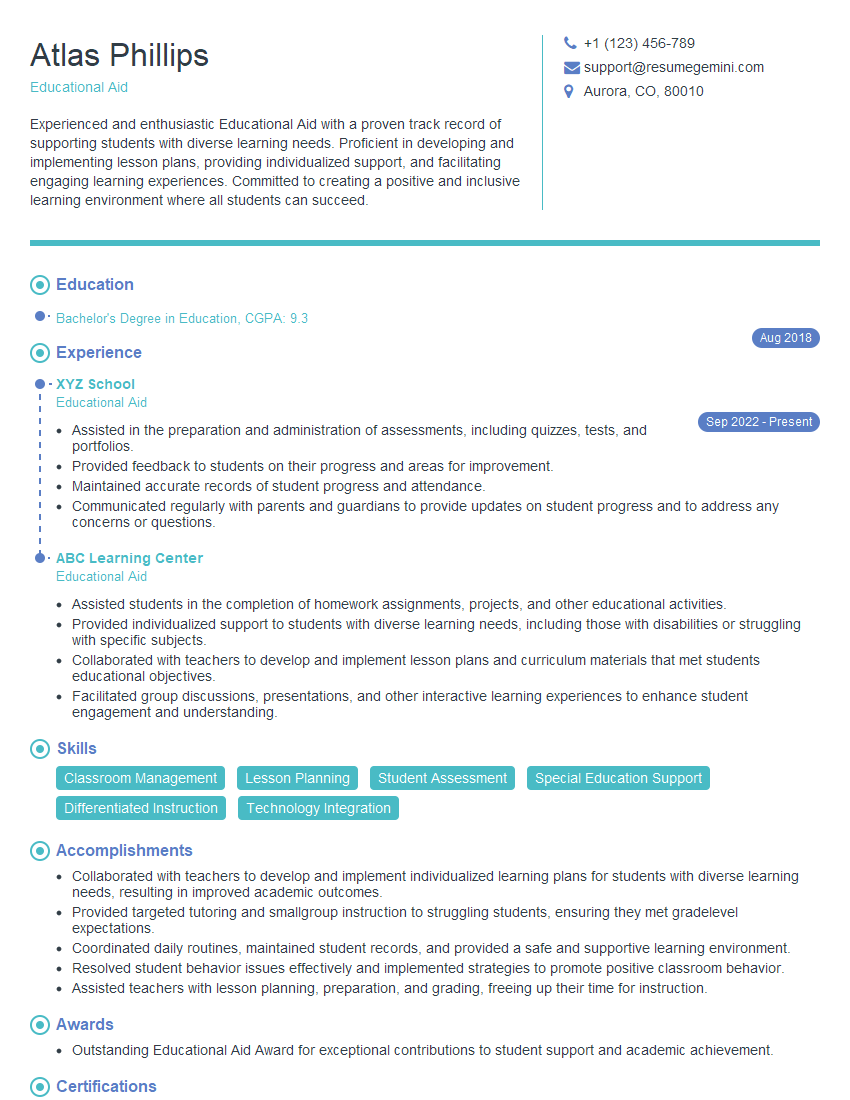
Acing the interview is crucial, but landing one requires a compelling resume that gets you noticed. Crafting a professional document that highlights your skills and experience is the first step toward interview success. ResumeGemini can help you build a standout resume that gets you called in for that dream job.






Essential Interview Questions For Educational Aid
1. What are the essential qualities of an effective Educational Aid?
An effective Educational Aid possesses several essential qualities:
- Strong communication and interpersonal skills
- Patience and understanding
- Ability to work independently and as part of a team
- Excellent organizational and time management skills
- Knowledge of educational best practices
- Ability to create a positive and supportive learning environment
2. How would you handle a situation where a student is struggling academically?
When a student is struggling academically, I would:
- Meet with the student to discuss their concerns and assess their needs
- Develop an individualized plan to address their learning challenges
- Provide extra support and resources as needed
- Collaborate with teachers and parents to ensure a consistent approach
- Monitor the student’s progress and adjust the plan accordingly
3. How do you stay up-to-date on the latest educational trends and best practices?
To stay up-to-date on the latest educational trends and best practices, I:
- Attend professional development workshops and conferences
- Read educational journals and research
- Network with other educators
- Utilize online resources and platforms
- Collaborate with teachers and administrators to share ideas and insights
4. How would you create a supportive and inclusive learning environment for all students?
To create a supportive and inclusive learning environment for all students, I would:
- Establish clear expectations and rules for respectful and cooperative behavior
- Build relationships with students based on trust and understanding
- Use differentiated instruction to meet the diverse needs of learners
- Provide opportunities for students to collaborate and learn from each other
- Celebrate diversity and create a space where all students feel valued and respected
5. What role do you believe technology should play in the classroom?
I believe technology should be integrated into the classroom in a way that enhances student learning and engagement. It can be used to:
- Access educational resources and materials
- Collaborate with peers and teachers
- Personalize learning experiences
- Develop critical thinking and problem-solving skills
- Prepare students for the technologically advanced world they will enter
6. How would you collaborate with teachers and parents to support student success?
Collaboration is essential for student success. I would:
- Communicate regularly with teachers to share observations and discuss student progress
- Attend parent-teacher conferences and provide feedback
- Involve parents in their child’s learning by providing resources and suggestions
- Facilitate meetings and workshops to enhance communication and collaboration
- Work together to create a positive and supportive learning community
7. What motivates you to work as an Educational Aid?
I am passionate about education and believe that all students have the potential to succeed. I am motivated to work as an Educational Aid because I want to make a positive difference in the lives of students by:
- Supporting their academic and social development
- Inspiring them to become lifelong learners
- Creating a safe and nurturing learning environment where they can thrive
- Collaborating with teachers and parents to ensure their success
- Making a meaningful contribution to my community
8. How would you assess student learning and progress?
Assessing student learning and progress is crucial for identifying areas of strength and need. I would utilize various assessment methods such as:
- Observations and anecdotal notes
- Formal and informal assessments
- Student self-assessments
- Data analysis
- Progress reports and portfolios
9. What experience do you have with students with special needs?
I have worked with students with special needs in various settings, including in a resource room and in general education classrooms. I:
- Have a strong understanding of different learning disabilities and developmental delays
- Am familiar with individualized education programs (IEPs) and 504 plans
- Know how to adapt and modify materials and activities
- Am skilled in working with students who have behavioral challenges
- Am passionate about creating an inclusive and supportive learning environment for all students
10. How would you handle a situation where a student is disruptive or disrespectful?
When faced with a disruptive or disrespectful student, I would:
- Remain calm and respectful
- Talk to the student privately about their behavior
- Establish clear expectations and consequences
- Provide positive reinforcement for appropriate behavior
- Collaborate with teachers and parents to address ongoing issues
- Use a tiered approach to discipline, starting with verbal warnings and moving to more severe consequences if necessary
Interviewers often ask about specific skills and experiences. With ResumeGemini‘s customizable templates, you can tailor your resume to showcase the skills most relevant to the position, making a powerful first impression. Also check out Resume Template specially tailored for Educational Aid.
Career Expert Tips:
- Ace those interviews! Prepare effectively by reviewing the Top 50 Most Common Interview Questions on ResumeGemini.
- Navigate your job search with confidence! Explore a wide range of Career Tips on ResumeGemini. Learn about common challenges and recommendations to overcome them.
- Craft the perfect resume! Master the Art of Resume Writing with ResumeGemini’s guide. Showcase your unique qualifications and achievements effectively.
- Great Savings With New Year Deals and Discounts! In 2025, boost your job search and build your dream resume with ResumeGemini’s ATS optimized templates.
Researching the company and tailoring your answers is essential. Once you have a clear understanding of the Educational Aid‘s requirements, you can use ResumeGemini to adjust your resume to perfectly match the job description.
Key Job Responsibilities
Educational Aides are responsible for assisting teachers in the classroom with a variety of tasks. They may work with students individually or in small groups, providing support and guidance with academic material. They may also help with classroom management, such as setting up and cleaning up the classroom, distributing materials, and monitoring student behavior. The key job responsibilities of an Educational Aid include:
1. Assisting teachers with instruction
Educational Aides help teachers with instruction by providing one-on-one or small group support to students. This may include helping students with their work, answering their questions, and providing feedback on their progress. Educational Aides may also lead small group activities or work with students on specific projects.
- Providing individual and small group support to students
- Helping students with their work
- Answering students’ questions
- Providing feedback on students’ progress
- Leading small group activities
- Working with students on specific projects
2. Assisting with classroom management
Educational Aides assist with classroom management by helping to set up and clean up the classroom, distributing materials, and monitoring student behavior. They may also help with special events or activities, such as field trips or assemblies.
- Setting up and cleaning up the classroom
- Distributing materials
- Monitoring student behavior
- Helping with special events and activities
3. Working with parents and guardians
Educational Aides may work with parents and guardians to provide information about their child’s progress and to discuss any concerns. They may also help parents understand the school’s policies and procedures.
- Providing information about students’ progress to parents and guardians
- Discussing concerns with parents and guardians
- Helping parents understand the school’s policies and procedures
4. Maintaining confidentiality
Educational Aides must maintain confidentiality of student information. This includes not discussing students’ personal information with anyone outside of the school staff. Educational Aides must also be aware of the school’s policies and procedures for reporting child abuse or neglect.
- Not discussing students’ personal information with anyone outside of the school staff
- Being aware of the school’s policies and procedures for reporting child abuse or neglect
Interview Tips
Preparing for an interview can be nerve-wracking, but with the right tips and preparation, you can increase your chances of success. Here are some tips to help you ace your interview for an Educational Aide position:
1. Research the school and the position
Before your interview, take some time to research the school and the position you are applying for. This will help you understand the school’s mission and values, as well as the specific responsibilities of the Educational Aide position. You can find information about the school on the school’s website or by visiting the school in person.
- Visit the school’s website
- Visit the school in person
- Read the job description carefully
2. Practice answering common interview questions
There are a number of common interview questions that you are likely to be asked in an interview for an Educational Aide position. These questions may include:
- “Tell me about yourself.”
- “Why are you interested in this position?”
- “What are your strengths and weaknesses?”
- “How do you handle challenging students?”
- “What are your goals for this position?”
Practice answering these questions in advance so that you can feel confident and prepared during your interview.
3. Dress professionally
First impressions matter, so it is important to dress professionally for your interview. This means wearing clean, pressed clothes that are appropriate for a school setting. You should also avoid wearing any clothing that is too revealing or distracting.
- Wear clean, pressed clothes
- Dress appropriately for a school setting
- Avoid wearing any clothing that is too revealing or distracting
4. Be on time
Punctuality is important, so make sure to arrive for your interview on time. If you are running late, call the school to let them know. It is also a good idea to arrive a few minutes early so that you have time to compose yourself before the interview.
- Arrive for your interview on time
- If you are running late, call the school to let them know
- Arrive a few minutes early so that you have time to compose yourself before the interview
5. Be yourself
The most important thing is to be yourself during your interview. The interviewer wants to get to know the real you, so don’t try to be someone you’re not. Be honest and genuine, and let your personality shine through.
- Be yourself
- Be honest and genuine
- Let your personality shine through
6. Follow up
After your interview, it is important to follow up with the interviewer. This can be done by sending a thank-you note or email. In your thank-you note, you should reiterate your interest in the position and thank the interviewer for their time.
- Send a thank-you note or email
- Reiterate your interest in the position
- Thank the interviewer for their time
Next Step:
Now that you’re armed with the knowledge of Educational Aid interview questions and responsibilities, it’s time to take the next step. Build or refine your resume to highlight your skills and experiences that align with this role. Don’t be afraid to tailor your resume to each specific job application. Finally, start applying for Educational Aid positions with confidence. Remember, preparation is key, and with the right approach, you’ll be well on your way to landing your dream job. Build an amazing resume with ResumeGemini