Are you gearing up for a career shift or aiming to ace your next interview? Look no further! We’ve curated a comprehensive guide to help you crack the interview for the coveted Electromyographic Technician position. From understanding the key responsibilities to mastering the most commonly asked questions, this blog has you covered. So, buckle up and let’s embark on this journey together.
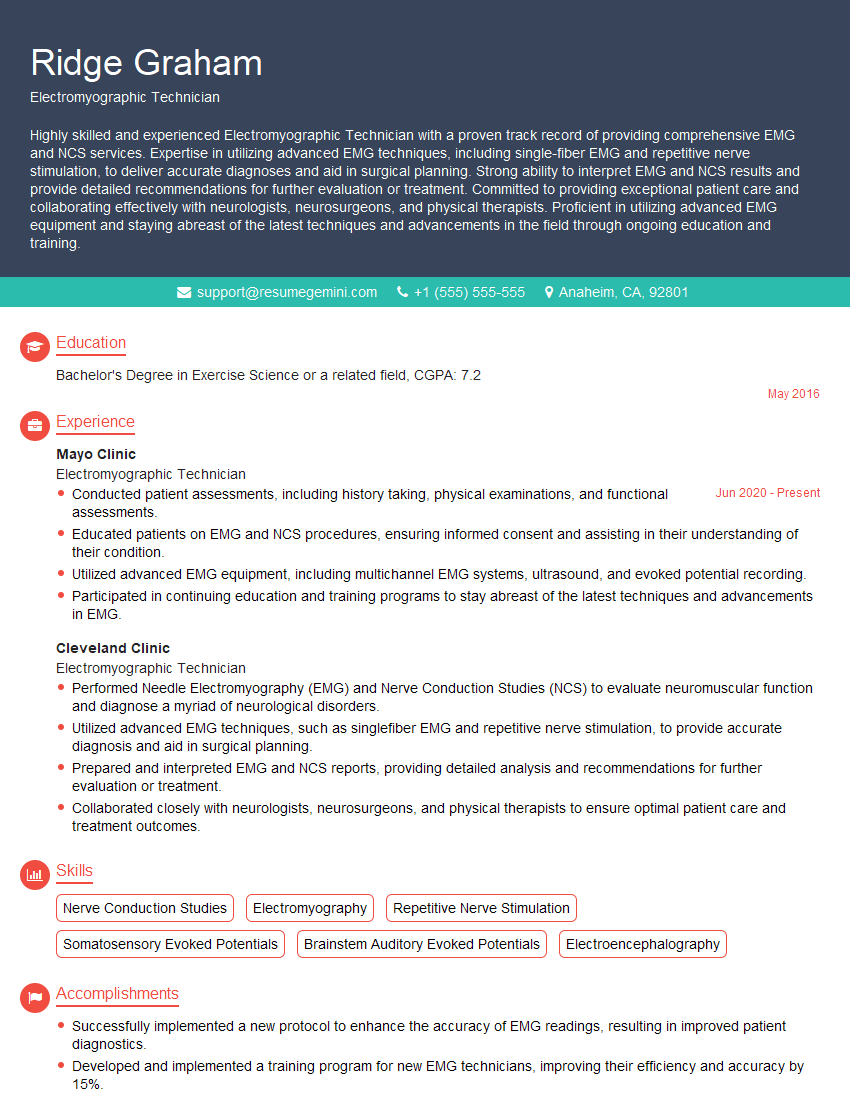
Acing the interview is crucial, but landing one requires a compelling resume that gets you noticed. Crafting a professional document that highlights your skills and experience is the first step toward interview success. ResumeGemini can help you build a standout resume that gets you called in for that dream job.






Essential Interview Questions For Electromyographic Technician
1. How would you explain the process of electromyography (EMG) to a patient?
- EMG is a technique for assessing the electrical activity of muscles.
- It involves inserting a fine needle electrode into the muscle and recording the electrical signals generated during muscle contraction
- These signals are then amplified and displayed on a computer screen, allowing the healthcare professional to evaluate the muscle’s function.
2. What are the different types of EMG tests?
Sensory nerve conduction studies (NCS)
- Measure the electrical activity of sensory nerves to assess their function.
- Involves placing electrodes on the skin over the nerve and delivering a small electrical stimulus to the nerve.
Motor nerve conduction studies (NCS)
- Measure the electrical activity of motor nerves to assess their function.
- Involves placing electrodes on the skin over the nerve and delivering a small electrical stimulus to the muscle.
Needle EMG
- Involves inserting a needle electrode into the muscle to record its electrical activity.
- Used to assess the function of individual muscle fibers.
3. What are the common indications for EMG testing?
- Muscle weakness or paralysis
- Numbness or tingling
- Pain
- Difficulty walking or moving
- Muscle cramps or spasms
4. What are the contraindications for EMG testing?
- Bleeding disorders
- Infection at the test site
- Pacemaker or other implanted electrical devices
- Pregnancy (in some cases)
5. What are the potential risks and complications of EMG testing?
- Pain or discomfort at the test site
- Bleeding or bruising
- Infection (rare)
- Damage to the nerve or muscle (very rare)
6. How do you interpret EMG results?
- The amplitude of the EMG signal is proportional to the number of muscle fibers activated.
- The duration of the EMG signal is proportional to the duration of muscle contraction.
- The shape of the EMG signal can provide information about the type of muscle contraction.
7. What are some of the common EMG findings in different neurological disorders?
- Myopathies: Decreased amplitude and duration of EMG signals
- Neuropathies: Decreased amplitude and/or increased duration of EMG signals
- Motor neuron diseases: Abnormal EMG signals, including fibrillation potentials and positive sharp waves
8. How do you ensure the accuracy and reliability of EMG results?
- Proper patient preparation and positioning
- Use of high-quality equipment
- Careful placement of electrodes
- Adequate stimulation intensity
- Proper interpretation of EMG signals
9. What are the ethical considerations in EMG testing?
- Informed consent
- Patient confidentiality
- Proper use of EMG results
10. How do you stay up-to-date on the latest advances in EMG technology and techniques?
- Attending conferences and workshops
- Reading scientific journals
- Participating in online forums and discussion groups
Interviewers often ask about specific skills and experiences. With ResumeGemini‘s customizable templates, you can tailor your resume to showcase the skills most relevant to the position, making a powerful first impression. Also check out Resume Template specially tailored for Electromyographic Technician.
Career Expert Tips:
- Ace those interviews! Prepare effectively by reviewing the Top 50 Most Common Interview Questions on ResumeGemini.
- Navigate your job search with confidence! Explore a wide range of Career Tips on ResumeGemini. Learn about common challenges and recommendations to overcome them.
- Craft the perfect resume! Master the Art of Resume Writing with ResumeGemini’s guide. Showcase your unique qualifications and achievements effectively.
- Great Savings With New Year Deals and Discounts! In 2025, boost your job search and build your dream resume with ResumeGemini’s ATS optimized templates.
Researching the company and tailoring your answers is essential. Once you have a clear understanding of the Electromyographic Technician‘s requirements, you can use ResumeGemini to adjust your resume to perfectly match the job description.
Key Job Responsibilities
An Electromyographic Technician is a skilled medical professional who assists physicians in the diagnosis and treatment of neuromuscular disorders. They specialize in the administration of electromyography (EMG) and nerve conduction studies (NCS), which are diagnostic procedures that measure the electrical activity of muscles and nerves.
1. Patient Care
EMT’s are responsible for providing quality patient care throughout the EMG/NCS procedure. This includes:
- Preparing patients for the test
- Positioning patients for optimal testing
- Monitoring patients during the test for any adverse reactions
- Explaining the test procedure to patients and answering any questions they may have
2. Equipment Operation
EMT’s must be proficient in the operation of EMG/NCS equipment. This includes:
- Setting up and calibrating the equipment
- Performing EMG/NCS studies
- Interpreting the results of the studies
- Maintaining the equipment in good working order
3. Data Analysis
EMT’s are responsible for analyzing the data from EMG/NCS studies. This includes:
- Identifying and interpreting abnormal waveforms
- Correlating the results of the studies with the patient’s symptoms
- Preparing reports of the findings for the physician
4. Other Duties
EMT’s may also be responsible for other duties, such as:
- Assisting with research projects
- Educating patients and staff about EMG/NCS
- Participating in continuing education programs
Interview Tips
Preparing for an interview for an Electromyographic Technician position can be daunting, but with the right preparation, you can increase your chances of success.
1. Research the Company and Position
Take the time to learn about the company you are applying to and the specific position you are interested in. This will help you understand the company’s culture and the specific requirements of the job. You can research the company’s website, LinkedIn page, and Glassdoor reviews.
2. Practice Your Answers to Common Interview Questions
There are a number of common interview questions that you are likely to be asked, such as “Tell me about yourself” and “Why are you interested in this position?”. It is helpful to practice your answers to these questions in advance so that you can deliver them confidently and concisely.
3. Be Prepared to Discuss Your Experience and Skills
The interviewer will want to know about your experience and skills as an Electromyographic Technician. Be prepared to discuss your previous job experience, your education, and any certifications you have. You should also be able to provide examples of your work that demonstrate your skills and abilities.
4. Be Enthusiastic and Professional
It is important to be enthusiastic and professional throughout the interview. This will show the interviewer that you are interested in the position and that you are confident in your abilities. Be sure to make eye contact, smile, and dress appropriately.
5. Ask Questions
At the end of the interview, be sure to ask the interviewer any questions you have about the position or the company. This shows that you are interested in the opportunity and that you are serious about the interview.
Next Step:
Armed with this knowledge, you’re now well-equipped to tackle the Electromyographic Technician interview with confidence. Remember, a well-crafted resume is your first impression. Take the time to tailor your resume to highlight your relevant skills and experiences. And don’t forget to practice your answers to common interview questions. With a little preparation, you’ll be on your way to landing your dream job. So what are you waiting for? Start building your resume and start applying! Build an amazing resume with ResumeGemini.