Are you gearing up for a career shift or aiming to ace your next interview? Look no further! We’ve curated a comprehensive guide to help you crack the interview for the coveted Electronic Operator position. From understanding the key responsibilities to mastering the most commonly asked questions, this blog has you covered. So, buckle up and let’s embark on this journey together.
Acing the interview is crucial, but landing one requires a compelling resume that gets you noticed. Crafting a professional document that highlights your skills and experience is the first step toward interview success. ResumeGemini can help you build a standout resume that gets you called in for that dream job.






Essential Interview Questions For Electronic Operator
1. Explain Electronic Operator and its role in electronic manufacturing?
An electronic operator is an individual who is responsible for setting up, operating, and maintaining electronic equipment used in the manufacture of electronic products.
- The role involves working with various automated and semi-automated machines, such as pick-and-place machines, solder paste printers, and reflow ovens.
- Electronic operators need to ensure that the equipment is operating properly, that the materials used in the manufacturing process are of good quality, and that the manufactured products meet the required specifications.
2. Describe the different types of electronic components you have worked with?
Resistors
- Resistors limit the flow of current in a circuit.
- Types: fixed resistors, variable resistors, carbon resistors, and metal film resistors.
Capacitors
- Capacitors store electrical energy in an electric field.
- Types: electrolytic capacitors, ceramic capacitors, and film capacitors.
Transistors
- Transistors amplify or switch electronic signals.
- Types: bipolar junction transistors (BJT) and field-effect transistors (FET).
Integrated Circuits (ICs)
- ICs are complex electronic circuits that contain millions of transistors on a single chip.
- Types: digital ICs, analog ICs, and mixed-signal ICs.
3. Describe the process of assembling electronic components onto a printed circuit board (PCB)?
The process of assembling electronic components onto a PCB involves several steps:
- The first step is to apply solder paste to the pads on the PCB where the components will be placed.
- Next, the components are placed on the PCB using a pick-and-place machine or by hand.
- The PCB is then placed in a reflow oven, which heats the solder paste and causes it to melt and form solder joints between the components and the PCB.
- Once the solder joints have cooled and hardened, the PCB is inspected to ensure that all of the components are properly assembled.
4. What are the different types of soldering techniques used in electronics manufacturing?
- Hand soldering: Involves using a soldering iron and solder wire to manually solder components onto a PCB.
- Wave soldering: Involves passing a PCB through a wave of molten solder to solder all of the components on the PCB at once.
- Reflow soldering: Involves using a reflow oven to heat solder paste and form solder joints between components and a PCB.
5. Describe the different types of test methods used to ensure the quality of electronic products?
- Visual inspection: Involves manually inspecting a product to identify any defects or errors.
- Electrical testing: Involves using electrical test equipment to measure the electrical characteristics of a product and ensure that it meets the required specifications.
- Functional testing: Involves testing a product to ensure that it is functioning properly and meets the intended design.
6. Describe the different types of electronic equipment used in electronic manufacturing?
- Pick-and-place machines: Used to automatically place components onto PCBs.
- Solder paste printers: Used to apply solder paste to PCBs.
- Reflow ovens: Used to heat PCBs and melt solder paste to form solder joints.
- Automated optical inspection (AOI) machines: Used to inspect PCBs for defects or errors.
7. Describe your experience with troubleshooting electronic products?
Troubleshooting involves identifying and resolving issues or defects in electronic products.
- The first step in troubleshooting is to identify the symptoms of the issue or defect.
- Next, the potential causes of the issue or defect need to be identified.
- Once the potential causes have been identified, tests can be performed to determine the root cause of the issue or defect.
- Finally, the root cause of the issue or defect can be resolved.
8. What are the safety precautions that need to be taken when working with electronic equipment?
- Wear appropriate safety gear, such as safety glasses, gloves, and a lab coat.
- Be aware of the potential hazards of working with electricity and take precautions to avoid electrical shock.
- Do not touch or handle electronic equipment that is energized unless it is necessary to do so.
- Follow all safety instructions and procedures when working with electronic equipment.
9. What are the key quality standards that need to be met in electronic manufacturing?
- ISO 9001: A quality management standard that outlines the requirements for a quality management system in electronic manufacturing.
- IPC-A-610: Acceptability of Electronic Assemblies standard that provides guidelines for the acceptable quality of workmanship in electronic assemblies.
- UL 61010-1: A safety standard for electrical equipment used in electronic manufacturing.
10. What are the different career paths that are available for electronic operators?
- Production supervisor: Responsible for overseeing the production process and ensuring that products are manufactured to the required quality standards.
- Quality control inspector: Responsible for inspecting products to ensure that they meet the required quality standards.
- Maintenance technician: Responsible for maintaining and repairing electronic equipment.
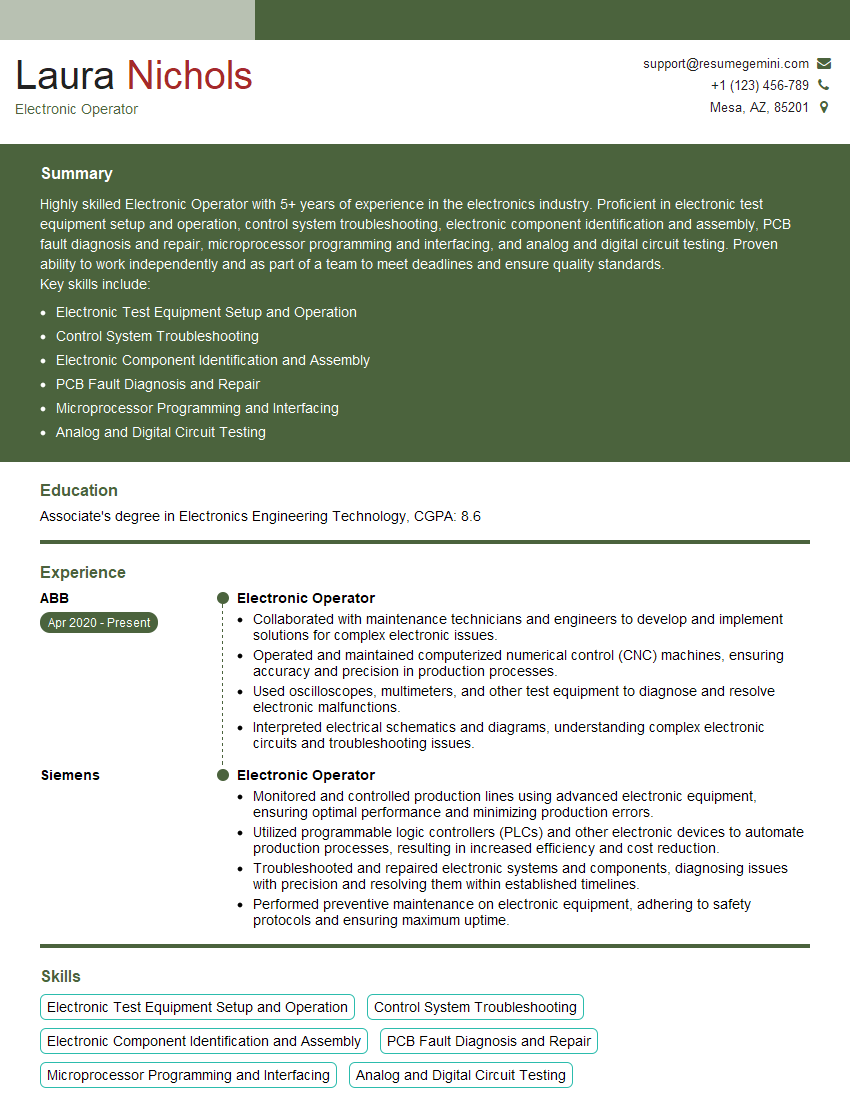
Interviewers often ask about specific skills and experiences. With ResumeGemini‘s customizable templates, you can tailor your resume to showcase the skills most relevant to the position, making a powerful first impression. Also check out Resume Template specially tailored for Electronic Operator.
Career Expert Tips:
- Ace those interviews! Prepare effectively by reviewing the Top 50 Most Common Interview Questions on ResumeGemini.
- Navigate your job search with confidence! Explore a wide range of Career Tips on ResumeGemini. Learn about common challenges and recommendations to overcome them.
- Craft the perfect resume! Master the Art of Resume Writing with ResumeGemini’s guide. Showcase your unique qualifications and achievements effectively.
- Great Savings With New Year Deals and Discounts! In 2025, boost your job search and build your dream resume with ResumeGemini’s ATS optimized templates.
Researching the company and tailoring your answers is essential. Once you have a clear understanding of the Electronic Operator‘s requirements, you can use ResumeGemini to adjust your resume to perfectly match the job description.
Key Job Responsibilities
Electronic Operators are responsible for the efficient operation and maintenance of electronic equipment and systems in various industries, including manufacturing, telecommunications, and healthcare. Their key job responsibilities include:
1. Equipment Monitoring and Operation
Monitor and operate electronic equipment, including computers, servers, and network devices, to ensure optimal performance and prevent malfunctions.
2. Troubleshooting and Repair
Diagnose and resolve technical issues with electronic equipment. Perform repairs and maintenance tasks to restore functionality.
3. System Installation and Configuration
Install, configure, and maintain electronic systems, such as computer networks, telecommunication systems, and security systems.
4. Quality Control and Testing
Conduct quality control inspections and tests on electronic equipment and systems to ensure they meet specifications.
5. Documentation and Reporting
Maintain accurate records of equipment operation, repairs, and maintenance activities. Prepare reports and logs to document system performance and any issues encountered.
Interview Tips
To ace the interview for an Electronic Operator position, it’s essential to prepare effectively and demonstrate your skills and knowledge. Here are some tips:
1. Research the Company and Role
Familiarize yourself with the company’s culture and industry to understand their specific needs and requirements for the role of Electronic Operator.
2. Highlight Relevant Skills and Experience
Emphasize your technical skills, experience in electronic equipment operation, troubleshooting, and system maintenance. Provide specific examples to demonstrate your capabilities.
3. Showcase Problem-Solving Abilities
Interviewers will often ask about your ability to resolve technical issues. Share real-life examples of how you diagnosed and fixed equipment malfunctions effectively.
4. Emphasize Attention to Detail
Electronic Operators must be meticulous in their work. Highlight your attention to detail and ability to follow instructions accurately.
5. Prepare for Technical Questions
Review basic electronics concepts and terminology. You may be asked questions about circuit design, voltage measurement, and troubleshooting techniques.
6. Be Enthusiastic and Ask Questions
Show enthusiasm about the role and the company. Ask relevant questions to demonstrate your interest and curiosity about the job and the organization.
7. Practice Mock Interviews
Rehearsing common interview questions can help you build confidence and improve your delivery. Consider asking a friend, family member, or career counselor to conduct mock interviews.
Next Step:
Armed with this knowledge, you’re now well-equipped to tackle the Electronic Operator interview with confidence. Remember, a well-crafted resume is your first impression. Take the time to tailor your resume to highlight your relevant skills and experiences. And don’t forget to practice your answers to common interview questions. With a little preparation, you’ll be on your way to landing your dream job. So what are you waiting for? Start building your resume and start applying! Build an amazing resume with ResumeGemini.