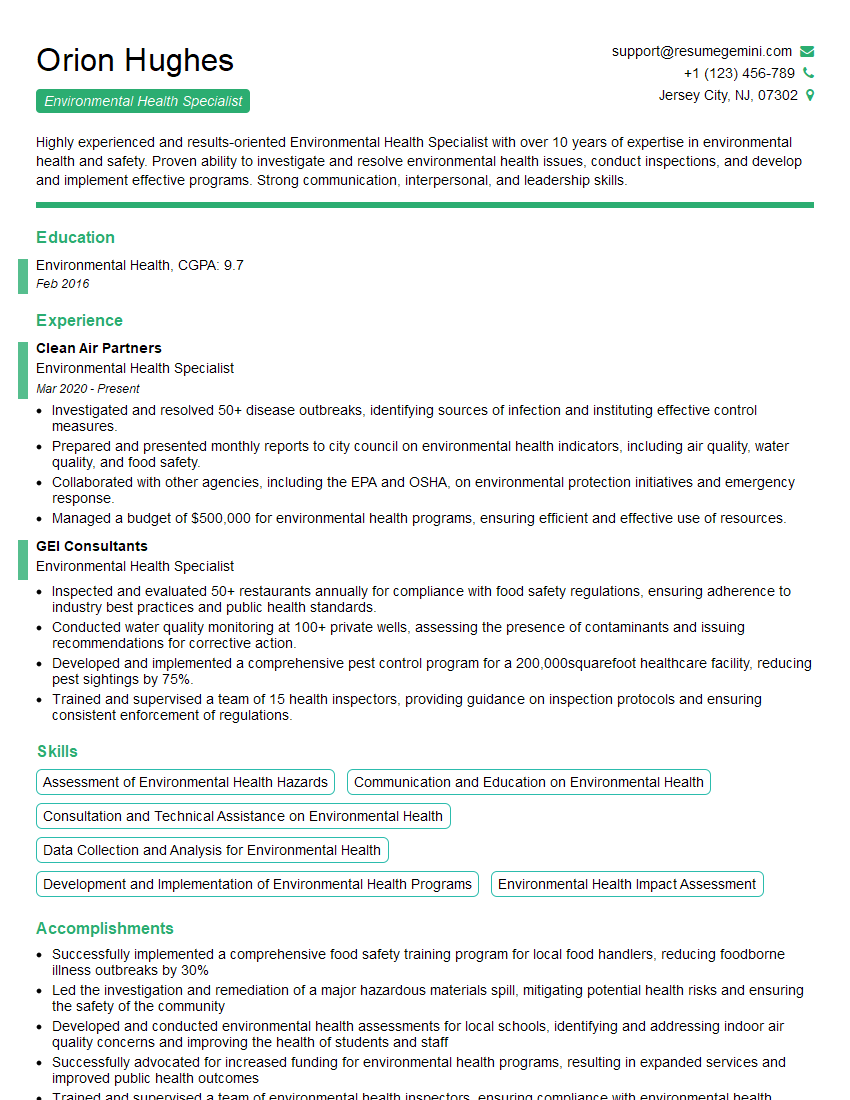
Are you gearing up for a career shift or aiming to ace your next interview? Look no further! We’ve curated a comprehensive guide to help you crack the interview for the coveted Environmental Health Specialist position. From understanding the key responsibilities to mastering the most commonly asked questions, this blog has you covered. So, buckle up and let’s embark on this journey together
Acing the interview is crucial, but landing one requires a compelling resume that gets you noticed. Crafting a professional document that highlights your skills and experience is the first step toward interview success. ResumeGemini can help you build a standout resume that gets you called in for that dream job.






Essential Interview Questions For Environmental Health Specialist
1. Explain the key components of an environmental health risk assessment?
An environmental health risk assessment typically includes the following key components:
- Hazard identification: Identifying the environmental hazards or stressors that may pose a risk to human health.
- Dose-response assessment: Determining the relationship between the exposure to a hazard and the adverse health effects it can cause.
- Exposure assessment: Estimating the levels of exposure to the hazard in the population of interest.
- Risk characterization: Integrating the hazard identification, dose-response assessment, and exposure assessment to estimate the likelihood and severity of adverse health effects in the population.
- Risk management: Evaluating and implementing strategies to control or mitigate the identified risks.
2. Describe the role of environmental health specialists in protecting public health during a natural disaster?
Emergency response
- Assessing and monitoring environmental hazards
- Providing guidance on safe water, food, and sanitation
- Investigating disease outbreaks
Long-term recovery
- Developing and implementing recovery plans
- Assessing the environmental impact of the disaster
- Educating the public about environmental health risks
3. What are the key principles of environmental health ethics?
The key principles of environmental health ethics include:
- Beneficence: Acting in the best interests of the population and minimizing harm.
- Non-maleficence: Avoiding causing harm to the population or the environment.
- Justice: Ensuring that the benefits and burdens of environmental health policies are distributed fairly.
- Autonomy: Respecting the rights of individuals to make decisions about their own health and environment.
- Sustainability: Protecting the environment for future generations.
4. What are the common environmental health hazards associated with solid waste management?
The common environmental health hazards associated with solid waste management include:
- Air pollution: Landfills and waste treatment facilities can release harmful gases such as methane and hydrogen sulfide.
- Water pollution: Leachate from landfills can contaminate groundwater and surface water.
- Soil pollution: Heavy metals and other contaminants in solid waste can contaminate soil.
- Vector-borne diseases: Landfills and waste dumps can attract rodents and insects that can transmit diseases.
5. Discuss the role of environmental health specialists in promoting healthy housing?
Environmental health specialists play a vital role in promoting healthy housing by:
- Inspecting housing units for health and safety hazards such as lead, mold, and pests.
- Educating the public about healthy housing practices.
- Developing and enforcing housing codes to ensure that housing units meet minimum health and safety standards.
- Working with other agencies to address the social and economic factors that can affect housing health.
6. What are the key elements of an effective food safety program?
The key elements of an effective food safety program include:
- Hazard analysis and critical control points (HACCP): Identifying and controlling potential hazards in food production and handling.
- Good manufacturing practices (GMPs): Ensuring that food is produced and handled in a sanitary and safe environment.
- Food safety training: Educating food handlers about food safety practices.
- Inspections and audits: Regularly monitoring food establishments to ensure compliance with food safety regulations.
- Recall procedures: Having a plan in place to quickly recall unsafe food products.
7. Describe the major environmental health concerns associated with climate change?
The major environmental health concerns associated with climate change include:
- Extreme weather events: Heat waves, floods, droughts, and wildfires can cause injuries, deaths, and displacement.
- Air pollution: Climate change can worsen air quality by increasing the formation of ground-level ozone and particulate matter.
- Water quality: Changes in precipitation patterns can affect water quality and availability.
- Vector-borne diseases: Climate change can expand the range of vectors that transmit diseases such as malaria, dengue fever, and Zika virus.
- Food security: Climate change can affect crop yields and food production, leading to food shortages and malnutrition.
8. What are the different methods for assessing the health risks of environmental exposures?
The different methods for assessing the health risks of environmental exposures include:
- Toxicological studies: Testing chemicals and other agents in animals or cells to determine their toxicity.
- Epidemiological studies: Studying the relationship between environmental exposures and health outcomes in human populations.
- Risk assessment modeling: Using mathematical models to estimate the risks of environmental exposures.
- Biomonitoring: Measuring the levels of environmental contaminants in people’s bodies.
9. Describe the role of environmental health specialists in developing and implementing public health policies?
Environmental health specialists play a vital role in developing and implementing public health policies by:
- Providing scientific evidence: Conducting research and collecting data to inform policy decisions.
- Translating science into policy: Helping policymakers understand the health risks of environmental exposures and the effectiveness of different interventions.
- Advocating for health: Promoting policies that protect public health from environmental hazards.
- Evaluating policies: Monitoring and evaluating the effectiveness of public health policies.
10. What are the emerging trends and challenges in environmental health?
Some of the emerging trends and challenges in environmental health include:
- Climate change: The increasing frequency and intensity of extreme weather events, rising sea levels, and changing precipitation patterns are posing new challenges to public health.
- New and emerging contaminants: The development and use of new chemicals and technologies are creating new potential health risks.
- Health disparities: Environmental health risks are often disproportionately distributed among vulnerable populations, such as low-income communities and communities of color.
- Data science and technology: The rapid advancement of data science and technology is providing new opportunities for environmental health research and intervention.
Interviewers often ask about specific skills and experiences. With ResumeGemini‘s customizable templates, you can tailor your resume to showcase the skills most relevant to the position, making a powerful first impression. Also check out Resume Template specially tailored for Environmental Health Specialist.
Career Expert Tips:
- Ace those interviews! Prepare effectively by reviewing the Top 50 Most Common Interview Questions on ResumeGemini.
- Navigate your job search with confidence! Explore a wide range of Career Tips on ResumeGemini. Learn about common challenges and recommendations to overcome them.
- Craft the perfect resume! Master the Art of Resume Writing with ResumeGemini’s guide. Showcase your unique qualifications and achievements effectively.
- Great Savings With New Year Deals and Discounts! In 2025, boost your job search and build your dream resume with ResumeGemini’s ATS optimized templates.
Researching the company and tailoring your answers is essential. Once you have a clear understanding of the Environmental Health Specialist‘s requirements, you can use ResumeGemini to adjust your resume to perfectly match the job description.
Key Job Responsibilities
Environmental Health Specialists play a critical role in protecting public health and the environment. The key job responsibilities of an Environmental Health Specialist include:
1. Inspect and assess environmental hazards
Conduct inspections and assessments to identify potential environmental hazards, such as air and water pollution, hazardous waste, and infectious diseases.
- Evaluate the potential risks to public health and the environment.
- Develop and implement plans to mitigate or eliminate identified hazards.
2. Enforce environmental regulations
Inspect and investigate complaints to ensure compliance with environmental regulations.
- Issue citations and penalties for violations.
- Work with businesses and individuals to achieve compliance.
3. Educate and inform the public
Provide information and education about environmental health issues to the public.
- Develop and disseminate educational materials.
- Conduct workshops and presentations.
4. Participate in research and development
Conduct research and contribute to the development of new environmental health policies and regulations.
- Stay abreast of the latest scientific research in environmental health.
- Participate in professional organizations and conferences.
Interview Tips
Preparing for an interview for an Environmental Health Specialist position requires a combination of technical expertise, passion for environmental health, and strong communication skills. Here are some tips to help you ace the interview:
1. Research the company and position
Before the interview, thoroughly research the company and the specific position you are applying for. This will help you understand the company’s mission, values, and environmental goals.
- Visit the company’s website and read their environmental reports.
- Look up the company on social media and industry news sources.
2. Highlight your relevant experience and skills
Emphasize your experience in environmental health, including any previous internships or volunteer work. If you have specific skills in areas such as air quality monitoring, water sampling, or hazardous waste management, be sure to highlight them.
- Use specific examples to demonstrate your abilities.
- Quantify your accomplishments whenever possible.
3. Be prepared to discuss your passion for environmental health
Environmental Health Specialists are passionate about protecting public health and the environment. Be prepared to discuss your motivations for pursuing this career.
- Share your personal experiences that have inspired your passion for environmental health.
- Explain how your values align with the company’s environmental goals.
4. Ask thoughtful questions
Asking thoughtful questions at the end of the interview demonstrates your interest in the position and the company. Prepare questions about the company’s environmental initiatives, the specific role you would be playing, and the company’s culture.
- Avoid asking generic questions that can be easily answered by reading the company’s website.
- Show that you are engaged and interested in the company’s mission.
Next Step:
Now that you’re armed with interview-winning answers and a deeper understanding of the Environmental Health Specialist role, it’s time to take action! Does your resume accurately reflect your skills and experience for this position? If not, head over to ResumeGemini. Here, you’ll find all the tools and tips to craft a resume that gets noticed. Don’t let a weak resume hold you back from landing your dream job. Polish your resume, hit the “Build Your Resume” button, and watch your career take off! Remember, preparation is key, and ResumeGemini is your partner in interview success.