Ever felt underprepared for that crucial job interview? Or perhaps you’ve landed the interview but struggled to articulate your skills and experiences effectively? Fear not! We’ve got you covered. In this blog post, we’re diving deep into the Fisheries Biologist interview questions that you’re most likely to encounter. But that’s not all. We’ll also provide expert insights into the key responsibilities of a Fisheries Biologist so you can tailor your answers to impress potential employers.
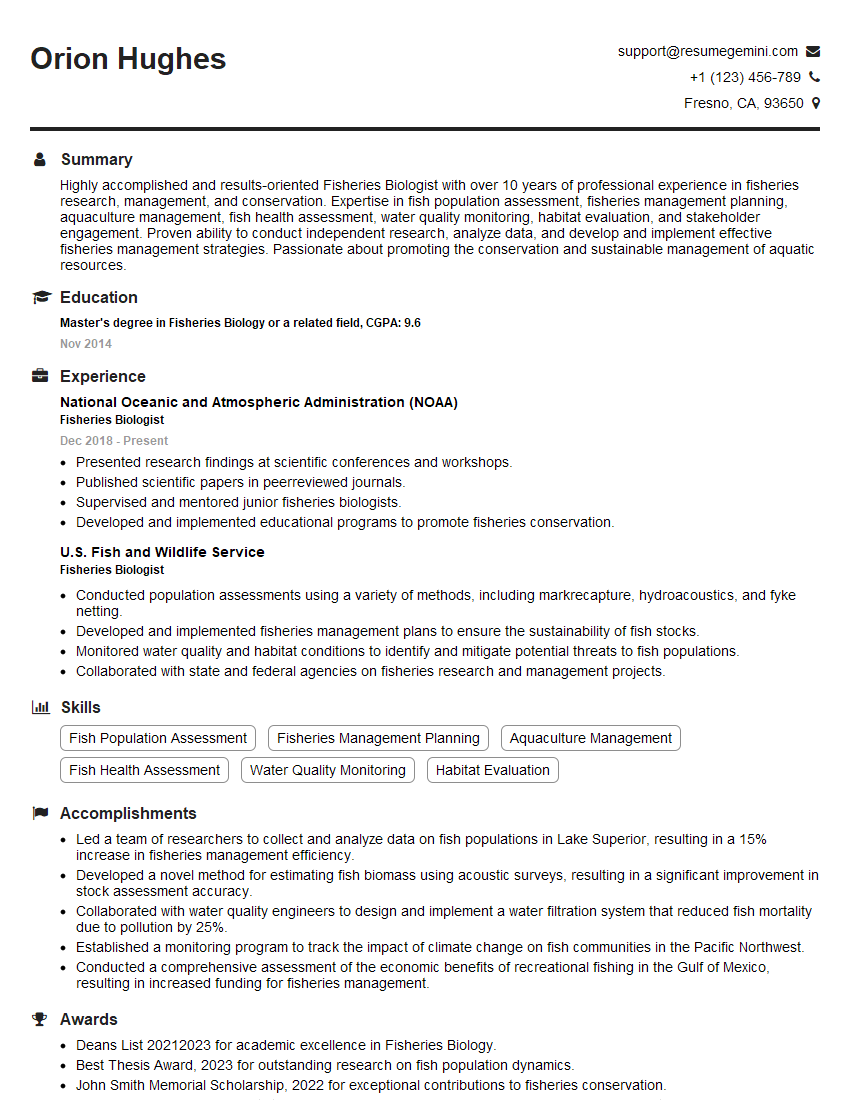
Acing the interview is crucial, but landing one requires a compelling resume that gets you noticed. Crafting a professional document that highlights your skills and experience is the first step toward interview success. ResumeGemini can help you build a standout resume that gets you called in for that dream job.






Essential Interview Questions For Fisheries Biologist
1. Describe the key principles of population dynamics and how they are used to manage fish populations.
Population dynamics is the study of how populations change over time. It is a complex field, but there are a few key principles that are essential for understanding how to manage fish populations. These principles include:
- Population growth rate: The rate at which a population increases or decreases is determined by the birth rate, death rate, and immigration and emigration rates.
- Carrying capacity: The maximum population size that can be sustained by a given environment.
- Density-dependent factors: Factors that affect the population growth rate, such as food availability, predation, and competition.
- Density-independent factors: Factors that do not affect the population growth rate, such as weather events and natural disasters.
These principles are used to manage fish populations by setting fishing quotas, protecting habitat, and restoring populations that have been depleted.
2. Explain the different methods used to sample fish populations.
There are a variety of methods that can be used to sample fish populations. The most common methods include:
- Visual surveys: This method involves counting fish visually from a boat or from the shore.
- Trawls: This method involves using a net to catch fish. Trawls can be towed behind a boat or set on the bottom.
- Seines: This method involves using a net to encircle a group of fish.
- Gill nets: This method involves using a net that hangs in the water and catches fish by their gills.
- Hook and line: This method involves using a hook and line to catch fish.
The method that is used to sample a fish population will depend on the species of fish, the size of the population, and the habitat in which the fish live.
3. Describe the different types of fish habitat and how they are used by fish.
There are a variety of different types of fish habitat, each with its own unique characteristics. These habitats include:
- Coral reefs: Coral reefs are complex ecosystems that provide food and shelter for a wide variety of fish species.
- Mangrove forests: Mangrove forests are coastal forests that provide food and shelter for a variety of fish species.
- Seagrass beds: Seagrass beds are underwater meadows that provide food and shelter for a variety of fish species.
- Kelp forests: Kelp forests are underwater forests that provide food and shelter for a variety of fish species.
- Estuaries: Estuaries are areas where rivers meet the ocean. They are important nursery habitats for many fish species.
The type of habitat that a fish uses will depend on the species of fish, the size of the fish, and the life stage of the fish.
4. Explain the different types of fishing gear and how they are used to catch fish.
There are a variety of different types of fishing gear, each with its own unique design and purpose. These gear types include:
- Nets: Nets are used to catch fish by entangling them. There are a variety of different types of nets, including gill nets, seines, and trawls.
- Hooks and lines: Hooks and lines are used to catch fish by piercing their mouths. There are a variety of different types of hooks and lines, including bait hooks, lures, and jigs.
- Traps: Traps are used to catch fish by enclosing them in a cage or container. There are a variety of different types of traps, including crab traps, lobster traps, and fish traps.
The type of fishing gear that is used to catch a fish will depend on the species of fish, the size of the fish, and the habitat in which the fish live.
5. Describe the different types of fishery management techniques.
There are a variety of different types of fishery management techniques, each with its own unique purpose and effectiveness. These techniques include:
- Fishing quotas: Fishing quotas are limits on the amount of fish that can be caught. Quotas can be based on the species of fish, the size of the fish, or the area in which the fish are caught.
- Closed seasons: Closed seasons are periods of time when fishing is prohibited. Closed seasons can be used to protect fish during spawning or migration.
- Marine protected areas: Marine protected areas are areas of the ocean that are closed to fishing. Marine protected areas can be used to protect fish habitat and to restore fish populations.
- Gear restrictions: Gear restrictions limit the type of fishing gear that can be used. Gear restrictions can be used to reduce bycatch and to protect fish habitat.
The type of fishery management technique that is used will depend on the species of fish, the size of the fish, and the habitat in which the fish live.
6. Explain the importance of sustainable fishing practices.
Sustainable fishing practices are those that do not deplete fish populations or damage fish habitat. Sustainable fishing practices include using selective fishing gear, avoiding bycatch, and protecting fish habitat. Sustainable fishing practices are important because they ensure that there will be fish for future generations.
7. Describe the different challenges facing fisheries management today.
Fisheries management today faces a number of challenges, including:
- Overfishing: Overfishing is the taking of fish at a rate that exceeds their ability to reproduce. Overfishing can lead to the depletion of fish stocks and the collapse of fisheries.
- Bycatch: Bycatch is the incidental catch of non-target species in fishing gear. Bycatch can lead to the death of non-target species and can damage fish habitat.
- Habitat loss: Habitat loss is the destruction or degradation of fish habitat. Habitat loss can lead to the depletion of fish stocks and the collapse of fisheries.
- Climate change: Climate change is having a significant impact on fish populations and fisheries. Climate change can lead to changes in fish distribution, abundance, and productivity.
Fisheries managers are working to address these challenges and to ensure the sustainability of fish populations and fisheries.
8. What do you think are the most important qualities for a Fisheries Biologist?
The most important qualities for a Fisheries Biologist include:
- Strong scientific background: Fisheries Biologists need to have a strong understanding of biology, ecology, and statistics.
- Field experience: Fisheries Biologists need to have experience collecting and analyzing data in the field.
- Communication skills: Fisheries Biologists need to be able to effectively communicate their findings to a variety of audiences.
- Problem-solving skills: Fisheries Biologists need to be able to identify and solve problems related to fisheries management.
- Passion for fisheries: Fisheries Biologists need to be passionate about fisheries and dedicated to protecting and managing fish populations.
9. Why are you interested in working as a Fisheries Biologist?
I am interested in working as a Fisheries Biologist because I am passionate about fish and fisheries. I have always been fascinated by the diversity and complexity of fish populations and the ecosystems in which they live. I am also concerned about the threats facing fish populations and fisheries, and I believe that Fisheries Biologists play an important role in protecting and managing these resources.
10. What are your career goals as a Fisheries Biologist?
My career goals as a Fisheries Biologist are to contribute to the sustainability of fish populations and fisheries. I hope to use my skills and knowledge to help solve problems related to fisheries management and to protect fish habitat. I also hope to inspire others to appreciate and care for fish and fisheries.
Interviewers often ask about specific skills and experiences. With ResumeGemini‘s customizable templates, you can tailor your resume to showcase the skills most relevant to the position, making a powerful first impression. Also check out Resume Template specially tailored for Fisheries Biologist.
Career Expert Tips:
- Ace those interviews! Prepare effectively by reviewing the Top 50 Most Common Interview Questions on ResumeGemini.
- Navigate your job search with confidence! Explore a wide range of Career Tips on ResumeGemini. Learn about common challenges and recommendations to overcome them.
- Craft the perfect resume! Master the Art of Resume Writing with ResumeGemini’s guide. Showcase your unique qualifications and achievements effectively.
- Great Savings With New Year Deals and Discounts! In 2025, boost your job search and build your dream resume with ResumeGemini’s ATS optimized templates.
Researching the company and tailoring your answers is essential. Once you have a clear understanding of the Fisheries Biologist‘s requirements, you can use ResumeGemini to adjust your resume to perfectly match the job description.
Key Job Responsibilities
Fisheries Biologists are the backbone of marine conservation because they conduct surveys, gather data, and utilize their knowledge of aquatic ecosystems to enhance the lives of fish species. Their responsibilities are broad and essential for the protection and management of fisheries.
1. Research and Monitoring
Fisheries Biologists design and execute research projects to collect data on fish populations, habitats, and ecosystems. This includes:
- Conducting field surveys to collect data on fish species, abundance, distribution, and behavior.
- Monitoring water quality, temperature, and other environmental factors that affect fish populations.
- Analyzing data to identify trends and patterns in fish populations and ecosystems.
2. Conservation and Management
Based on their research findings, Fisheries Biologists develop and implement conservation and management plans to protect and enhance fish populations. This involves:
- Recommending regulations on fishing practices, such as catch limits, gear restrictions, and closed seasons.
- Developing and implementing habitat restoration projects to improve fish spawning and feeding areas.
- Collaborating with stakeholders, such as fishermen, conservation organizations, and government agencies, to ensure the sustainability of fisheries.
3. Education and Outreach
Fisheries Biologists play a crucial role in educating the public about the importance of fisheries and aquatic ecosystems. This includes:
- Giving presentations and workshops to schools, community groups, and other organizations.
- Developing educational materials, such as brochures, websites, and social media content.
- Working with the media to raise awareness about fisheries issues and conservation efforts.
4. Policy Development and Advocacy
Fisheries Biologists often provide scientific expertise to policymakers and advocate for policies that protect and enhance fisheries. This involves:
- Providing testimony before legislative committees and regulatory agencies.
- Participating in the development of fishing regulations and policies.
- Advocating for funding for fisheries research and conservation programs.
Interview Tips
Preparing for an interview can be daunting, but with the right strategies, you can increase your chances of success. Here are some tips to help you ace your interview for a Fisheries Biologist position:
1. Research the Organization and Position
Before the interview, take the time to thoroughly research the organization you’re applying to and the specific Fisheries Biologist position. This will help you understand the company’s mission, values, and the specific responsibilities of the role. You can find this information on the company’s website, LinkedIn page, and other online resources.
2. Highlight Your Skills and Experience
When answering interview questions, be sure to highlight your relevant skills and experience that match the job requirements. For example, if the job description mentions experience in fish surveys, emphasize your expertise in conducting field surveys and collecting data on fish populations.
3. Prepare Examples
Interviewers often ask for specific examples of your work experience. Prepare several examples of your accomplishments that demonstrate your skills and abilities as a Fisheries Biologist. For instance, you could share an example of a research project you led that resulted in the development of new fishing regulations or a conservation plan.
4. Practice Answering Common Interview Questions
There are several common interview questions that you’re likely to encounter, such as “Tell me about yourself” or “Why are you interested in this position?” Practice answering these questions in advance to ensure that you can deliver clear and concise responses.
5. Come Prepared with Questions
Asking well-informed questions at the end of the interview shows that you’re engaged and interested in the position. Prepare a few thoughtful questions about the organization, the position, or the industry to ask the interviewer.
By following these tips, you can increase your chances of making a positive impression and ace your interview for a Fisheries Biologist position. Remember to be confident, enthusiastic, and showcase your passion for fisheries and conservation.
Next Step:
Armed with this knowledge, you’re now well-equipped to tackle the Fisheries Biologist interview with confidence. Remember, a well-crafted resume is your first impression. Take the time to tailor your resume to highlight your relevant skills and experiences. And don’t forget to practice your answers to common interview questions. With a little preparation, you’ll be on your way to landing your dream job. So what are you waiting for? Start building your resume and start applying! Build an amazing resume with ResumeGemini.