Are you gearing up for an interview for a Geneticist position? Whether you’re a seasoned professional or just stepping into the role, understanding what’s expected can make all the difference. In this blog, we dive deep into the essential interview questions for Geneticist and break down the key responsibilities of the role. By exploring these insights, you’ll gain a clearer picture of what employers are looking for and how you can stand out. Read on to equip yourself with the knowledge and confidence needed to ace your next interview and land your dream job!
Acing the interview is crucial, but landing one requires a compelling resume that gets you noticed. Crafting a professional document that highlights your skills and experience is the first step toward interview success. ResumeGemini can help you build a standout resume that gets you called in for that dream job.






Essential Interview Questions For Geneticist
1. Describe the principles behind genetic linkage and how it is used in the mapping of disease genes?
- Genetic linkage is the phenomenon where two or more genetic markers are inherited together more often than would be expected by chance.
- This occurs because the markers are located on the same chromosome and are therefore physically linked.
- The closer together the markers are on the chromosome, the stronger the linkage will be.
- Genetic linkage can be used to map disease genes by identifying markers that are linked to the disease.
- By studying the inheritance of these markers in families affected by the disease, it is possible to narrow down the location of the disease gene.
2. Explain the concept of genetic heterogeneity and how it can complicate the identification of disease genes?
Genetic Heterogeneity
- Genetic heterogeneity refers to the situation where a single disease can be caused by mutations in different genes.
- This can make it difficult to identify the gene responsible for the disease, as there are multiple genes that need to be considered.
Impact on Gene Identification
- Genetic heterogeneity can complicate the identification of disease genes because it can lead to different families with the same disease having different genetic causes.
- This can make it difficult to find a common genetic variant that is shared by all families with the disease.
3. How would you approach the genetic analysis of a complex trait, such as height or intelligence?
- Complex traits are those that are influenced by multiple genes and environmental factors.
- To analyze the genetic basis of a complex trait, it is necessary to use a variety of approaches, including family studies, twin studies, and genome-wide association studies (GWAS).
- Family studies can be used to identify genetic variants that are shared by family members who have the trait.
- Twin studies can be used to estimate the heritability of the trait, which is the proportion of the variation in the trait that is due to genetic factors.
- GWAS can be used to identify genetic variants that are associated with the trait in a large population.
4. Describe the role of gene expression analysis in understanding the molecular basis of disease?
- Gene expression analysis can be used to measure the levels of RNA transcripts in a cell or tissue.
- This information can be used to identify genes that are dysregulated in disease.
- Gene expression analysis can also be used to study the effects of environmental factors on gene expression.
- By understanding the molecular basis of disease, it is possible to develop new treatments that target the underlying causes of the disease.
5. How would you use bioinformatics tools to analyze genetic data?
- Bioinformatics tools can be used to analyze genetic data in a variety of ways, including:
- Sequence alignment: Aligning DNA or protein sequences to identify similarities and differences.
- Genome assembly: Assembling DNA sequences into a complete genome.
- Variant calling: Identifying genetic variants, such as SNPs and INDELS.
- Gene expression analysis: Analyzing the expression of genes in different cell types or under different conditions.
- Statistical analysis: Performing statistical tests to identify genetic variants that are associated with disease.
6. Describe the ethical issues that need to be considered when conducting genetic research?
- Privacy: Genetic information is highly personal and can be used to identify individuals and family members.
- Discrimination: Genetic information can be used to discriminate against individuals in employment, insurance, and other areas.
- Stigma: Genetic information can be used to stigmatize individuals who have certain genetic conditions.
- Informed consent: Individuals should be informed of the risks and benefits of genetic research before they participate.
7. What are the current trends in genetic research and how do you see the field evolving in the future?
- Personalized medicine: Using genetic information to tailor medical treatment to individual patients.
- Genetic testing: The development of new genetic tests for a variety of diseases.
- Gene editing: The ability to make precise changes to DNA.
- Synthetic biology: The creation of new biological systems from scratch.
- Artificial intelligence: The use of AI to analyze genetic data and make predictions.
8. How would you stay up-to-date with the latest advances in genetic research?
- Reading scientific journals: Reading scientific journals is a great way to stay up-to-date with the latest research in genetic research.
- Attending conferences: Attending scientific conferences is another great way to learn about the latest advances in genetic research.
- Taking courses: Taking courses in genetic research can also help you stay up-to-date with the latest advances in the field.
- Networking with other geneticists: Networking with other geneticists can also help you stay up-to-date on the latest research.
9. What is your favorite genetic research topic and why?
This is a personal question and the answer will vary depending on the candidate’s interests.
10. What are your career goals and how do you see this position helping you achieve them?
This is a personal question and the answer will vary depending on the candidate’s career goals.
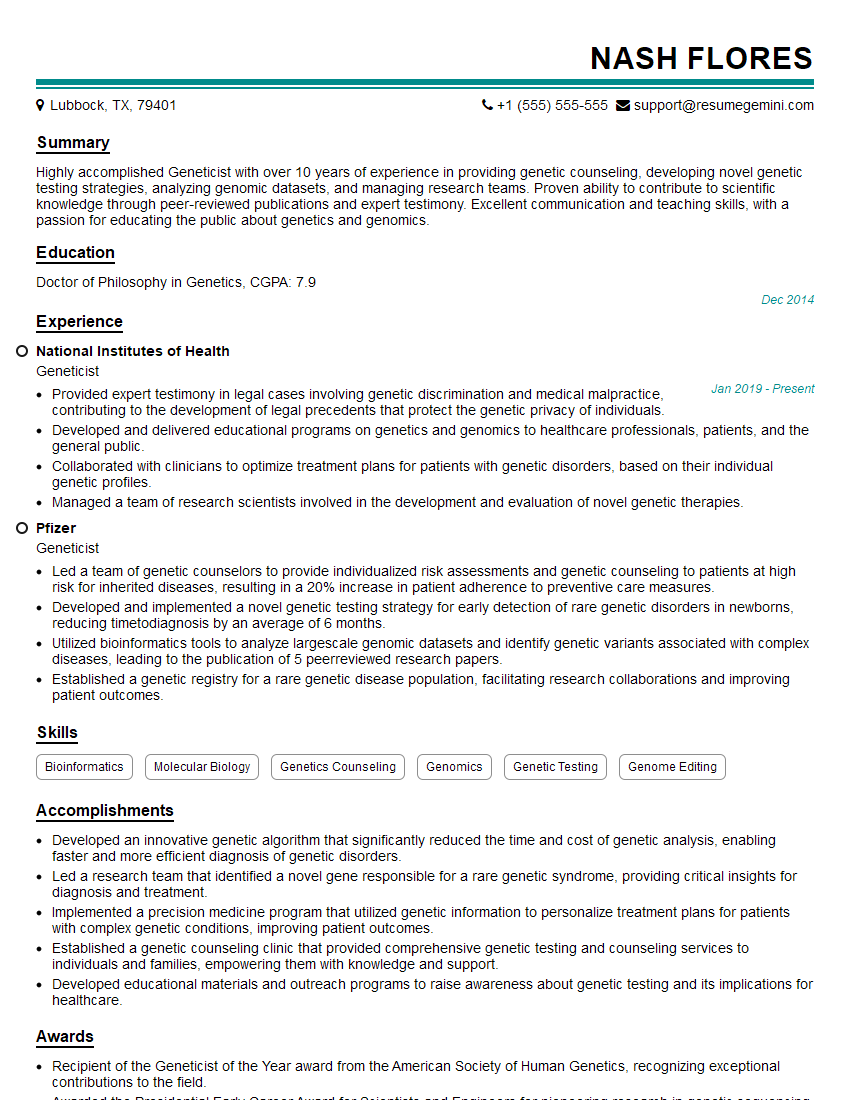
Interviewers often ask about specific skills and experiences. With ResumeGemini‘s customizable templates, you can tailor your resume to showcase the skills most relevant to the position, making a powerful first impression. Also check out Resume Template specially tailored for Geneticist.
Career Expert Tips:
- Ace those interviews! Prepare effectively by reviewing the Top 50 Most Common Interview Questions on ResumeGemini.
- Navigate your job search with confidence! Explore a wide range of Career Tips on ResumeGemini. Learn about common challenges and recommendations to overcome them.
- Craft the perfect resume! Master the Art of Resume Writing with ResumeGemini’s guide. Showcase your unique qualifications and achievements effectively.
- Great Savings With New Year Deals and Discounts! In 2025, boost your job search and build your dream resume with ResumeGemini’s ATS optimized templates.
Researching the company and tailoring your answers is essential. Once you have a clear understanding of the Geneticist‘s requirements, you can use ResumeGemini to adjust your resume to perfectly match the job description.
Key Job Responsibilities
Geneticists are highly trained professionals who study the inheritance and variation of genes.
1. Conducting Genetic Research
Geneticists design and conduct research studies to investigate the genetic basis of diseases, traits, and conditions.
- Identify and characterize genetic variations associated with specific diseases or traits.
- Develop and implement experimental models to study gene function and regulation.
2. Providing Genetic Counseling
Geneticists provide genetic counseling to individuals and families to help them understand their genetic risks and make informed decisions about their health.
- Interpret genetic test results and provide information about the implications for individuals and their families.
- Discuss reproductive options and other strategies for managing genetic conditions.
3. Developing and Evaluating Genetic Tests
Geneticists develop and evaluate genetic tests to identify genetic variations associated with diseases and traits.
- Design and optimize genetic testing methods using various techniques such as DNA sequencing and microarrays.
- Validate and interpret genetic test results to ensure accuracy and reliability.
4. Collaborating with Healthcare Professionals
Geneticists collaborate with other healthcare professionals, including physicians, nurses, and researchers, to provide comprehensive patient care.
- Consult with other healthcare professionals to provide genetic expertise and guidance on patient management.
- Participate in interdisciplinary research projects to advance understanding of genetic diseases.
Interview Tips
Preparing for a geneticist interview requires a solid understanding of the field, research experience, and communication skills. Here are some tips to help candidates ace the interview:
1. Research the Company and Position
Thoroughly research the company and the specific geneticist position you are applying for. Understand the company’s mission, values, and current research or clinical initiatives. This will help you tailor your answers and demonstrate your alignment with the organization’s goals.
2. Highlight Your Research Experience
Emphasize your research experience and technical skills in genetics. Discuss your contributions to research projects, including your role in designing experiments, analyzing data, and interpreting results. Quantify your accomplishments whenever possible to demonstrate the impact of your work.
3. Showcase Your Communication Skills
Geneticists must effectively communicate complex genetic information to a diverse audience. Provide examples of your written and verbal communication skills, such as presenting research findings at conferences or writing scientific papers. Highlight your ability to simplify complex concepts and engage with both scientific and non-scientific audiences.
4. Prepare for Common Interview Questions
Practice answering common interview questions that geneticists may face. These questions may include:
- Describe your experience in human genetics research.
- How do you interpret genetic test results and counsel patients?
- What are the ethical considerations in genetic research?
- How do you stay up-to-date with advancements in genetics?
- What are your research interests and career aspirations?
5. Ask Insightful Questions
At the end of the interview, ask thoughtful questions to demonstrate your interest in the position and the company. This shows that you are engaged and eager to learn more. Consider asking about ongoing research projects, the organization’s approach to genetic counseling, or opportunities for professional development.
Next Step:
Now that you’re armed with the knowledge of Geneticist interview questions and responsibilities, it’s time to take the next step. Build or refine your resume to highlight your skills and experiences that align with this role. Don’t be afraid to tailor your resume to each specific job application. Finally, start applying for Geneticist positions with confidence. Remember, preparation is key, and with the right approach, you’ll be well on your way to landing your dream job. Build an amazing resume with ResumeGemini