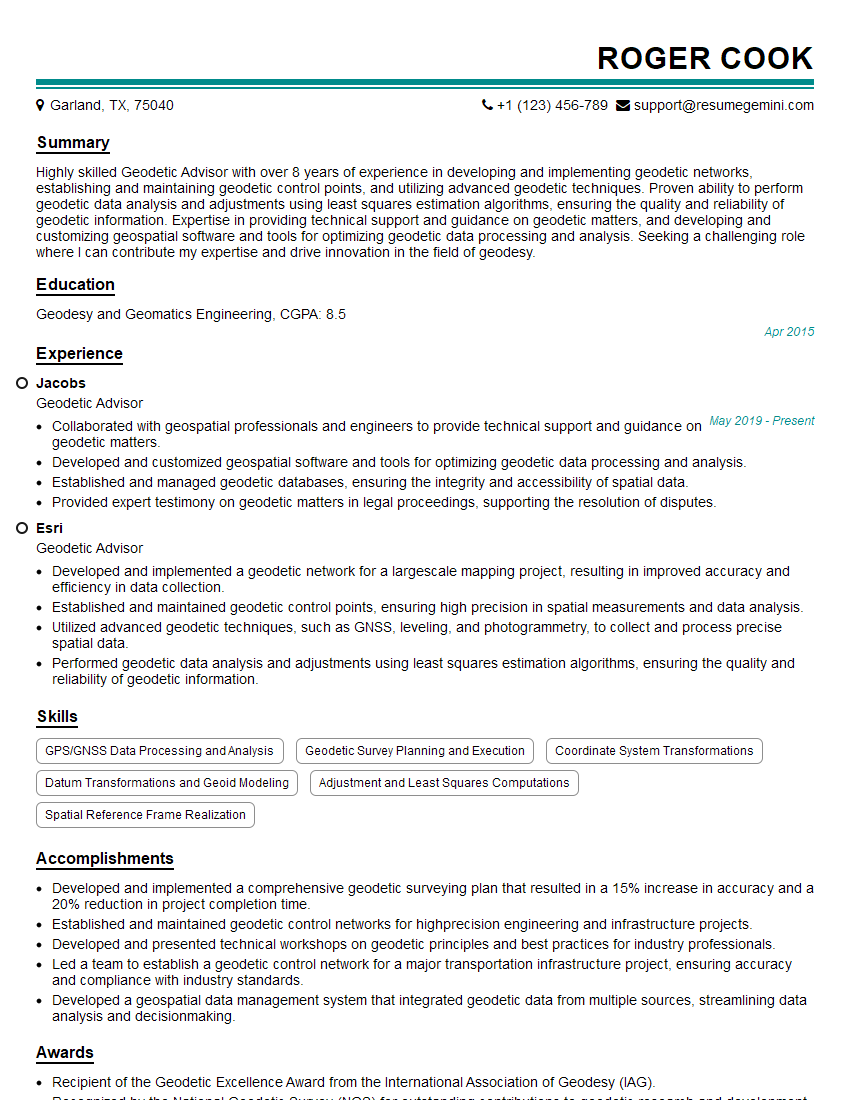
Feeling lost in a sea of interview questions? Landed that dream interview for Geodetic Advisor but worried you might not have the answers? You’re not alone! This blog is your guide for interview success. We’ll break down the most common Geodetic Advisor interview questions, providing insightful answers and tips to leave a lasting impression. Plus, we’ll delve into the key responsibilities of this exciting role, so you can walk into your interview feeling confident and prepared.
Acing the interview is crucial, but landing one requires a compelling resume that gets you noticed. Crafting a professional document that highlights your skills and experience is the first step toward interview success. ResumeGemini can help you build a standout resume that gets you called in for that dream job.






Essential Interview Questions For Geodetic Advisor
1. What are the key responsibilities of a Geodetic Advisor?
As a Geodetic Advisor, my primary responsibilities would encompass:
- Providing expert guidance on geodetic principles, methodologies, and best practices to stakeholders and project teams.
- Developing and implementing geodetic strategies and solutions to meet project requirements and ensure accurate positioning and navigation.
2. Explain the difference between a geodetic datum and a coordinate system.
Datum:
- A reference framework that defines the origin, scale, and orientation of a coordinate system.
- Establishes the relationship between the physical Earth and the mathematical model.
Coordinate System:
- A system that assigns unique coordinates to points on the Earth’s surface.
- Based on a specific datum and defines the units of measurement, axis orientation, and the projection method.
3. How do you approach the task of establishing a new geodetic network?
My approach to establishing a new geodetic network involves the following steps:
- Define Project Objectives: Determine the purpose and accuracy requirements of the network.
- Site Selection: Identify and select suitable locations for control points based on visibility, accessibility, and stability.
- Data Acquisition: Perform precise measurements of angles, distances, and elevations using state-of-the-art surveying equipment.
- Data Processing: Apply rigorous adjustment techniques to derive coordinates and assess the accuracy of the network.
4. Discuss the various methods used to determine the height of a point above mean sea level.
The determination of the height of a point above mean sea level can be achieved through several methods:
- Spirit Leveling: Precise measurement of vertical distances using a spirit level and a leveling rod.
- Trigonometric Leveling: Determination of height differences using trigonometry and angle measurements to a known reference point.
- Global Navigation Satellite Systems (GNSS): Utilization of GNSS receivers to obtain accurate height information from satellite signals.
5. Describe the role of remote sensing in geodetic applications.
Remote sensing plays a crucial role in geodetic applications, offering valuable data and insights:
- Digital Elevation Models (DEMs): Generation of detailed terrain models from satellite imagery or LiDAR data, providing accurate height information.
- Land Cover Classification: Identification and mapping of different land cover types using satellite imagery, which can aid in geodetic network planning.
- Change Detection: Monitoring of changes in the Earth’s surface over time using remote sensing data, which can assist in geodetic infrastructure maintenance.
6. How do you ensure the quality and accuracy of geodetic data?
To ensure the quality and accuracy of geodetic data, I adhere to the following practices:
- Rigorous Field Procedures: Implementation of standardized surveying techniques and calibration of equipment to minimize errors.
- Data Validation: Performing thorough checks on data consistency, outliers, and adherence to project specifications.
- Redundancy: Collecting multiple measurements and utilizing different techniques to enhance data reliability.
7. Discuss the challenges and opportunities in the field of geodesy.
Challenges:
- Technological Advancements: Keeping pace with rapid advancements in surveying instruments and data processing techniques.
- Climate Change: Adapting geodetic networks to account for changes in sea level, crustal movements, and climate-induced deformations.
Opportunities:
- Integrated Geospatial Solutions: Combining geodetic data with other geospatial datasets for comprehensive analysis and decision-making.
- Automation and AI: Utilizing automation and artificial intelligence to streamline data processing and improve efficiency.
8. Describe your experience in using geodetic software.
Throughout my career, I have gained proficiency in various geodetic software packages, including:
- Trimble Business Center: Comprehensive software for GNSS data processing, network adjustment, and mapping.
- Leica Geo Office: Advanced software for surveying data management, processing, and visualization.
- ESRI ArcGIS: GIS software used for spatial analysis, data integration, and cartographic representation.
9. How do you stay updated with the latest advancements in geodesy?
To stay abreast of the latest developments in geodesy, I engage in the following activities:
- Conferences and Workshops: Attending industry conferences and workshops to learn about emerging technologies and best practices.
- Professional Journals: Subscribing to and regularly reading scientific journals such as the Journal of Geodesy and Survey Review.
- Online Resources: Exploring authoritative websites and online forums dedicated to geodesy and surveying.
10. How can geodesy contribute to sustainable development?
Geodesy plays a vital role in sustainable development through the following applications:
- Climate Change Monitoring: Monitoring sea level rise, glacier retreat, and other climate-related changes.
- Natural Resource Management: Providing accurate data for land use planning, water resource management, and disaster mitigation.
- Infrastructure Development: Ensuring the precise positioning and alignment of critical infrastructure, such as transportation networks and renewable energy projects.
Interviewers often ask about specific skills and experiences. With ResumeGemini‘s customizable templates, you can tailor your resume to showcase the skills most relevant to the position, making a powerful first impression. Also check out Resume Template specially tailored for Geodetic Advisor.
Career Expert Tips:
- Ace those interviews! Prepare effectively by reviewing the Top 50 Most Common Interview Questions on ResumeGemini.
- Navigate your job search with confidence! Explore a wide range of Career Tips on ResumeGemini. Learn about common challenges and recommendations to overcome them.
- Craft the perfect resume! Master the Art of Resume Writing with ResumeGemini’s guide. Showcase your unique qualifications and achievements effectively.
- Great Savings With New Year Deals and Discounts! In 2025, boost your job search and build your dream resume with ResumeGemini’s ATS optimized templates.
Researching the company and tailoring your answers is essential. Once you have a clear understanding of the Geodetic Advisor‘s requirements, you can use ResumeGemini to adjust your resume to perfectly match the job description.
Key Job Responsibilities
Geodetic Advisors serve as expert consultants, providing guidance and technical assistance on matters related to geodesy, the science of measuring and representing the Earth’s shape, size, and gravitational field.
1. Geodetic Data Analysis
Analyze and interpret geodetic data to derive accurate information about the Earth’s shape, size, and gravity field.
- Process and validate geodetic data from various sources, including GNSS, lidar, and gravity surveys.
- Apply advanced analytical techniques to identify trends, patterns, and anomalies in the data.
2. Geodetic Network Design and Establishment
Design and establish geodetic networks to support various applications, such as surveying, mapping, and navigation.
- Determine the optimal placement and configuration of geodetic control points based on accuracy requirements.
- Collaborate with stakeholders to establish and maintain geodetic networks that meet industry standards.
3. Geodetic Reference Frames and Transformations
Establish and maintain geodetic reference frames, which serve as the basis for accurate positioning and navigation.
- Develop and implement strategies to define and realize geodetic reference frames in accordance with international standards.
- Perform coordinate transformations between different geodetic reference frames to ensure seamless data integration.
4. Geodetic Applications Development
Develop and implement innovative geodetic applications to address real-world challenges in various fields.
- Identify user needs and develop geodetic solutions that meet specific requirements.
- Collaborate with researchers and industry professionals to explore new applications of geodesy in fields such as surveying, engineering, and natural disaster management.
Interview Tips
To ace your interview for a Geodetic Advisor position, it is important to prepare thoroughly and demonstrate your proficiency in the key areas of geodesy.
1. Research the Organization and Position
Before the interview, take the time to thoroughly research the organization and the specific Geodetic Advisor position you are applying for. This will help you understand the company’s mission, goals, and specific needs, enabling you to tailor your answers and highlight your relevant skills and experience.
- Visit the organization’s website to learn about their history, services, and recent projects.
- Review the job description carefully and identify the key responsibilities and qualifications.
2. Highlight Your Technical Expertise
Geodetic Advisors are expected to possess a strong foundation in geodesy, including data analysis, network design, reference frames, and applications development. During the interview, be prepared to discuss your technical skills and how they align with the requirements of the position.
- Provide specific examples of your experience in analyzing geodetic data and deriving meaningful insights.
- Explain your approach to designing and establishing geodetic networks, ensuring accuracy and reliability.
3. Showcase Your Problem-Solving Abilities
Geodetic Advisors often face complex challenges that require analytical thinking and problem-solving skills. In the interview, highlight your ability to identify and solve problems related to geodetic data, network design, or application development.
- Describe a situation where you successfully resolved a geodetic data quality issue, ensuring accurate results for downstream applications.
- Explain how you approached a problem in geodetic network design, considering factors such as accuracy, reliability, and cost-effectiveness.
4. Demonstrate Your Communication Skills
Geodetic Advisors often need to communicate complex technical information to a variety of audiences, including stakeholders, clients, and colleagues. In the interview, demonstrate your ability to communicate effectively, both verbally and in writing.
- Provide examples of your experience in presenting technical findings to non-technical audiences.
- Explain how you ensure clarity and accuracy in your written reports and documentation.
Next Step:
Armed with this knowledge, you’re now well-equipped to tackle the Geodetic Advisor interview with confidence. Remember, preparation is key. So, start crafting your resume, highlighting your relevant skills and experiences. Don’t be afraid to tailor your application to each specific job posting. With the right approach and a bit of practice, you’ll be well on your way to landing your dream job. Build your resume now from scratch or optimize your existing resume with ResumeGemini. Wish you luck in your career journey!