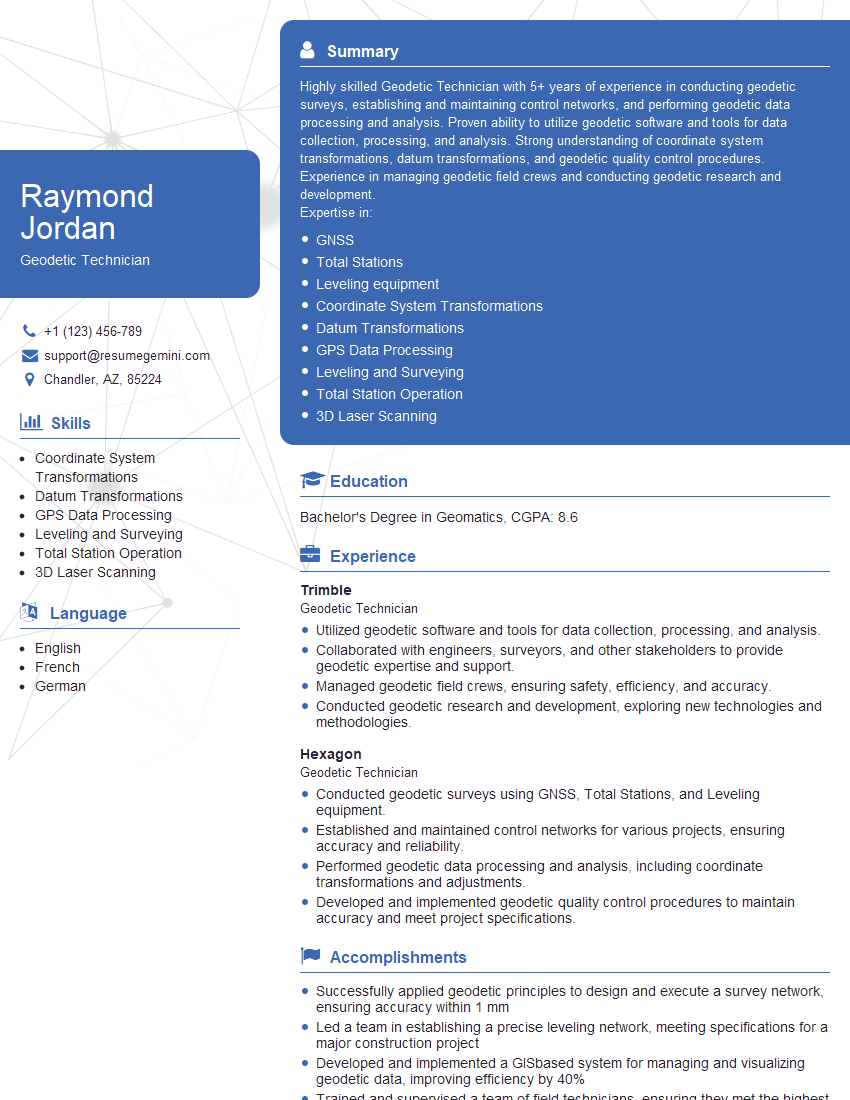
Ever felt underprepared for that crucial job interview? Or perhaps you’ve landed the interview but struggled to articulate your skills and experiences effectively? Fear not! We’ve got you covered. In this blog post, we’re diving deep into the Geodetic Technician interview questions that you’re most likely to encounter. But that’s not all. We’ll also provide expert insights into the key responsibilities of a Geodetic Technician so you can tailor your answers to impress potential employers.
Acing the interview is crucial, but landing one requires a compelling resume that gets you noticed. Crafting a professional document that highlights your skills and experience is the first step toward interview success. ResumeGemini can help you build a standout resume that gets you called in for that dream job.






Essential Interview Questions For Geodetic Technician
1. Describe your experience with using GPS surveying equipment?
In my previous role as a Geodetic Technician, I was responsible for conducting a wide range of GPS surveying tasks, including:
- Establishing and maintaining control networks
- Performing topographic surveys
- Collecting data for GIS mapping
- Providing technical support to field crews
2. What are your strengths and weaknesses as a Geodetic Technician?
Strengths:
- Proficient in using GPS surveying equipment
- Strong understanding of surveying principles and methodologies
- Excellent data analysis and interpretation skills
- Ability to work independently and as part of a team
Weaknesses:
- Limited experience with LiDAR scanning
- Need to improve my knowledge of geodetic software
3. What is your experience with data processing and analysis?
I have experience using a variety of software packages for data processing and analysis, including:
- Trimble Business Center
- Esri ArcGIS
- AutoCAD Civil 3D
I am also proficient in using statistical analysis software, such as SAS and SPSS.
4. How do you stay up-to-date on the latest advancements in geodesy?
I stay up-to-date on the latest advancements in geodesy by reading industry publications, attending conferences, and participating in online forums.
Some of the resources that I use to stay informed include:
- The Journal of Geodesy
- The American Society for Photogrammetry and Remote Sensing (ASPRS)
- The Institute of Electrical and Electronics Engineers (IEEE)
5. What are some of the challenges you have faced as a Geodetic Technician?
Some of the challenges I have faced as a Geodetic Technician include:
- Working in difficult weather conditions
- Dealing with difficult terrain
- Interpreting complex data
- Meeting tight deadlines
However, I have always been able to overcome these challenges by using my technical skills and problem-solving abilities.
6. What is your experience with project management?
I have experience managing a variety of surveying projects, from small-scale to large-scale projects.
My responsibilities as a project manager have included:
- Developing project plans and budgets
- Scheduling and coordinating field crews
- Monitoring project progress
- Preparing project reports
7. What are your career goals?
My career goal is to become a licensed surveyor and to eventually start my own surveying business.
I believe that my skills and experience make me a strong candidate for this position, and I am confident that I can make a significant contribution to your company.
8. What is your understanding of the role of a Geodetic Technician in a construction project?
The role of a Geodetic Technician in a construction project is to provide accurate and reliable surveying data that is used to plan and execute the project.
This data is used to determine the location of property boundaries, the elevation of the land, and the layout of the proposed structures.
Geodetic Technicians also play a role in monitoring the progress of the project and ensuring that it is completed according to the plans and specifications.
9. What are some of the latest trends in geodesy?
Some of the latest trends in geodesy include:
- The use of drones for surveying
- The development of new geodetic software
- The increasing use of geospatial data
- The integration of geodesy with other disciplines, such as GIS and civil engineering
10. What are some of the challenges that Geodetic Technicians face in today’s market?
Some of the challenges that Geodetic Technicians face in today’s market include:
- The increasing complexity of construction projects
- The need for faster and more accurate data
- The shortage of qualified Geodetic Technicians
- The need to stay up-to-date on the latest technologies
Interviewers often ask about specific skills and experiences. With ResumeGemini‘s customizable templates, you can tailor your resume to showcase the skills most relevant to the position, making a powerful first impression. Also check out Resume Template specially tailored for Geodetic Technician.
Career Expert Tips:
- Ace those interviews! Prepare effectively by reviewing the Top 50 Most Common Interview Questions on ResumeGemini.
- Navigate your job search with confidence! Explore a wide range of Career Tips on ResumeGemini. Learn about common challenges and recommendations to overcome them.
- Craft the perfect resume! Master the Art of Resume Writing with ResumeGemini’s guide. Showcase your unique qualifications and achievements effectively.
- Great Savings With New Year Deals and Discounts! In 2025, boost your job search and build your dream resume with ResumeGemini’s ATS optimized templates.
Researching the company and tailoring your answers is essential. Once you have a clear understanding of the Geodetic Technician‘s requirements, you can use ResumeGemini to adjust your resume to perfectly match the job description.
Key Job Responsibilities
A Geodetic Technician plays a crucial role in the field of surveying and geomatics. Their key responsibilities involve:
1. Surveying and Data Collection
Geodetic Technicians are responsible for conducting surveys using specialized equipment like total stations, GPS receivers, and lasers. They gather data on various aspects of the environment, including topography, landmarks, and natural features.
- Perform topographic surveys to determine elevations, contours, and other physical features.
- Conduct boundary surveys to establish property lines and resolve land ownership disputes.
2. Data Processing and Analysis
After collecting raw data, Geodetic Technicians process and analyze it using computer software. They create maps, models, and other representations of the surveyed area.
- Analyze survey data to identify trends, patterns, and errors.
- Produce maps, plans, and other documents to convey survey findings.
3. Equipment Maintenance and Calibration
Geodetic Technicians are responsible for maintaining and calibrating the specialized equipment they use. This ensures accurate and reliable data collection.
- Inspect and maintain surveying equipment, including total stations, GPS receivers, and levels.
- Perform periodic calibrations to ensure equipment accuracy.
4. Collaboration and Communication
Geodetic Technicians often collaborate with other professionals, such as surveyors, engineers, and architects. They also communicate survey findings to clients and stakeholders.
- Communicate survey results to clients, contractors, and other stakeholders.
- Participate in team projects to provide technical expertise.
Interview Tips
To ace the interview for a Geodetic Technician position, consider the following tips:
1. Research the Company and Position
Thoroughly research the company and the specific Geodetic Technician role. This will help you understand their business, culture, and the requirements of the position.
- Visit the company’s website and social media pages to gather information.
- Read industry articles and publications to stay updated on current trends and technologies.
2. Highlight Relevant Experience and Skills
Emphasize your relevant experience and skills during the interview. Focus on your proficiency in surveying techniques, data analysis, and equipment maintenance.
- Quantify your accomplishments whenever possible, using specific examples.
- Discuss your experience with different surveying equipment and software.
3. Prepare for Technical Questions
Be prepared to answer technical questions related to surveying and geodesy. Review basic surveying principles, GPS technologies, and data analysis techniques.
- Practice answering common interview questions about surveying and geomatics.
- Consider preparing examples of your work or projects that demonstrate your technical abilities.
4. Showcase Your Problem-Solving Skills
Highlight your problem-solving skills and ability to handle complex tasks. Geodetic Technicians often encounter unexpected challenges in the field.
- Share examples of how you have successfully solved problems or overcome obstacles.
- Discuss your approach to troubleshooting and critical thinking.
Next Step:
Now that you’re armed with a solid understanding of what it takes to succeed as a Geodetic Technician, it’s time to turn that knowledge into action. Take a moment to revisit your resume, ensuring it highlights your relevant skills and experiences. Tailor it to reflect the insights you’ve gained from this blog and make it shine with your unique qualifications. Don’t wait for opportunities to come to you—start applying for Geodetic Technician positions today and take the first step towards your next career milestone. Your dream job is within reach, and with a polished resume and targeted applications, you’ll be well on your way to achieving your career goals! Build your resume now with ResumeGemini.