Are you gearing up for a career shift or aiming to ace your next interview? Look no further! We’ve curated a comprehensive guide to help you crack the interview for the coveted Graphic Design Professor position. From understanding the key responsibilities to mastering the most commonly asked questions, this blog has you covered. So, buckle up and let’s embark on this journey together
Acing the interview is crucial, but landing one requires a compelling resume that gets you noticed. Crafting a professional document that highlights your skills and experience is the first step toward interview success. ResumeGemini can help you build a standout resume that gets you called in for that dream job.






Essential Interview Questions For Graphic Design Professor
1. How would you teach students the principles of design, such as color theory, typography, and composition?
In my classes, I emphasize the foundational principles of design through hands-on exercises and real-world examples. For color theory, I introduce color wheels, complementary color schemes, and the impact of color on emotions. In typography, we explore different typefaces, their classifications, and the principles of type hierarchy and legibility. As for composition, students learn about balance, contrast, emphasis, and the use of grids to create visually appealing designs.
2. What are your methods for evaluating student work?
Grading Rubrics
- Develop clear grading rubrics that outline the criteria and expectations for each assignment.
- Provide specific feedback on strengths and areas for improvement.
Peer critiques
- Facilitate peer critiques where students provide constructive feedback to each other’s work.
- Guide students to identify strengths and areas where improvement can be made.
Portfolio reviews
- Conduct portfolio reviews to assess students’ overall design skills and progress.
- Provide guidance on portfolio organization, presentation, and the inclusion of relevant work samples.
3. How do you stay up-to-date with the latest trends and technologies in graphic design?
- Attend industry conferences, workshops, and online webinars.
- Subscribe to design publications and blogs.
- Network with other graphic designers and professionals in the field.
- Experiment with new software and tools to enhance my knowledge and skills.
4. What are your thoughts on the importance of internships and real-world experience for graphic design students?
- Internships provide invaluable opportunities for students to apply their skills in a professional setting.
- Real-world experience allows students to gain practical knowledge, build their portfolios, and establish valuable industry connections.
- I encourage students to seek out internship opportunities and support them in finding placements that align with their interests and career goals.
5. How do you handle students with different learning styles and backgrounds?
I recognize that students have diverse learning styles and backgrounds. To accommodate this, I employ a variety of teaching methods:
- Visual presentations and demonstrations for visual learners.
- Interactive discussions and group activities for kinesthetic learners.
- Written assignments and readings for auditory learners.
- Personalized feedback and one-on-one consultations for all learning styles.
6. What are your goals for your students as a Graphic Design Professor?
- To equip students with a strong foundation in the principles and practices of graphic design.
- To foster their creativity, problem-solving abilities, and critical thinking skills.
- To prepare them for successful careers in the graphic design industry.
- To inspire a passion for design and encourage them to use their skills to make a positive impact on the world.
7. How do you approach teaching color theory to your students?
I introduce color theory through a combination of theoretical explanations and practical exercises. I cover topics such as:
- Color models (RGB, CMYK, HSL)
- Color harmonies and contrast
- Color psychology and its impact on design
- Students engage in hands-on projects to apply their understanding of color theory, such as creating color palettes and designing color schemes for different contexts.
8. What is your approach to teaching typography and how do you emphasize its importance?
I place great emphasis on typography, as it is a crucial element of effective graphic design. My approach includes:
- Introducing the history, anatomy, and classification of typefaces
- Teaching principles of typography, including legibility, readability, and hierarchy
- Providing hands-on exercises in typography, such as designing type specimens and creating typographic compositions
- Emphasizing the importance of typography in communication, branding, and user experience
9. How do you assess students’ understanding of design principles and their ability to apply them?
To assess students’ understanding of design principles, I utilize a range of methods:
- Written assignments and quizzes to test their theoretical knowledge
- Practical projects and exercises to evaluate their ability to apply principles in design solutions
- Portfolio reviews to assess their overall progress and mastery of design skills
- Peer critiques to foster critical thinking and provide constructive feedback
10. What is your approach to teaching students the use of graphic design software, and how do you balance technical skills with creativity?
I teach graphic design software skills through a combination of hands-on tutorials, demonstrations, and practical projects. I emphasize:
- Introducing the fundamentals of industry-standard software, such as Adobe Creative Suite
- Providing step-by-step guidance on essential tools and techniques
- Balancing technical proficiency with creative exploration
- Encouraging students to experiment with different software features and explore their creative potential
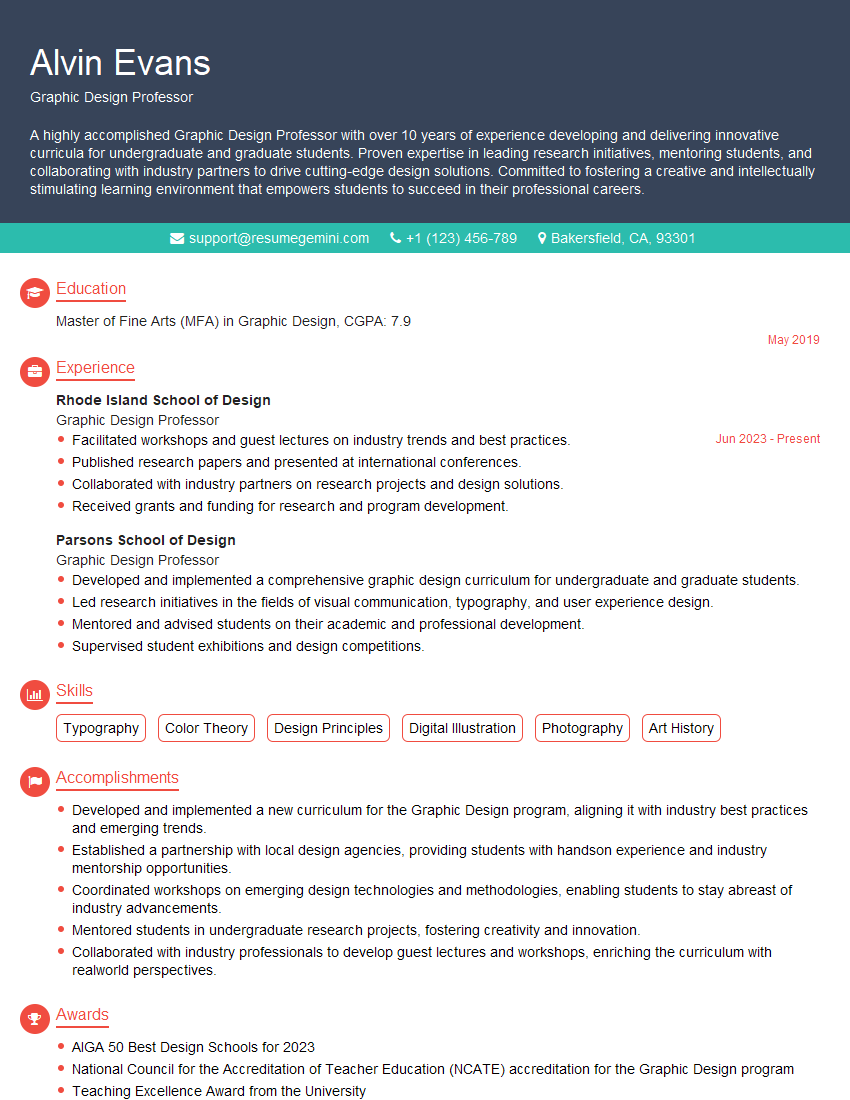
Interviewers often ask about specific skills and experiences. With ResumeGemini‘s customizable templates, you can tailor your resume to showcase the skills most relevant to the position, making a powerful first impression. Also check out Resume Template specially tailored for Graphic Design Professor.
Career Expert Tips:
- Ace those interviews! Prepare effectively by reviewing the Top 50 Most Common Interview Questions on ResumeGemini.
- Navigate your job search with confidence! Explore a wide range of Career Tips on ResumeGemini. Learn about common challenges and recommendations to overcome them.
- Craft the perfect resume! Master the Art of Resume Writing with ResumeGemini’s guide. Showcase your unique qualifications and achievements effectively.
- Great Savings With New Year Deals and Discounts! In 2025, boost your job search and build your dream resume with ResumeGemini’s ATS optimized templates.
Researching the company and tailoring your answers is essential. Once you have a clear understanding of the Graphic Design Professor‘s requirements, you can use ResumeGemini to adjust your resume to perfectly match the job description.
Key Job Responsibilities
Graphic Design Professors are responsible for teaching students the principles and practices of graphic design. They may also conduct research in the field and advise students on their academic and career goals.
1. Teaching
Graphic Design Professors teach a variety of courses, including:
- Introduction to Graphic Design
- Typography
- Layout and Design
- Digital Imaging
- Motion Graphics
2. Research
Graphic Design Professors may conduct research in a variety of areas, such as:
- The history of graphic design
- The psychology of perception
- The use of technology in graphic design
- The impact of graphic design on society
3. Advising
Graphic Design Professors advise students on their academic and career goals. They may help students choose courses, develop portfolios, and find internships. They may also write letters of recommendation for students.
4. Service
Graphic Design Professors may serve on committees, participate in outreach activities, and develop new programs. They may also work with professional organizations to promote the field of graphic design.
Interview Tips
Interviewing for a Graphic Design Professor position can be a competitive process. Here are a few tips to help you ace your interview:
1. Do your research
Before your interview, take some time to research the school and the position you’re applying for. This will help you understand the school’s culture and the specific needs of the position. You should also research the interviewer(s) so that you can tailor your answers to their interests.
2. Prepare your portfolio
Your portfolio is a key part of your interview. It should showcase your best work and demonstrate your skills and abilities. Make sure your portfolio is well-organized and easy to navigate. You should also be prepared to talk about your work in detail.
3. Be prepared to talk about your teaching philosophy
Interviewers will want to know about your teaching philosophy and how you would approach teaching graphic design. Be prepared to discuss your teaching methods and how you would create a positive and engaging learning environment for your students.
4. Be prepared to answer questions about your research interests
If you’re applying for a position that involves research, be prepared to talk about your research interests. Interviewers will want to know about your research agenda and how your research would contribute to the school’s mission.
5. Be prepared to talk about your service experience
If you have any service experience, be prepared to talk about it in your interview. Interviewers will want to know about your commitment to service and how you would contribute to the school community.
Next Step:
Now that you’re armed with interview-winning answers and a deeper understanding of the Graphic Design Professor role, it’s time to take action! Does your resume accurately reflect your skills and experience for this position? If not, head over to ResumeGemini. Here, you’ll find all the tools and tips to craft a resume that gets noticed. Don’t let a weak resume hold you back from landing your dream job. Polish your resume, hit the “Build Your Resume” button, and watch your career take off! Remember, preparation is key, and ResumeGemini is your partner in interview success.