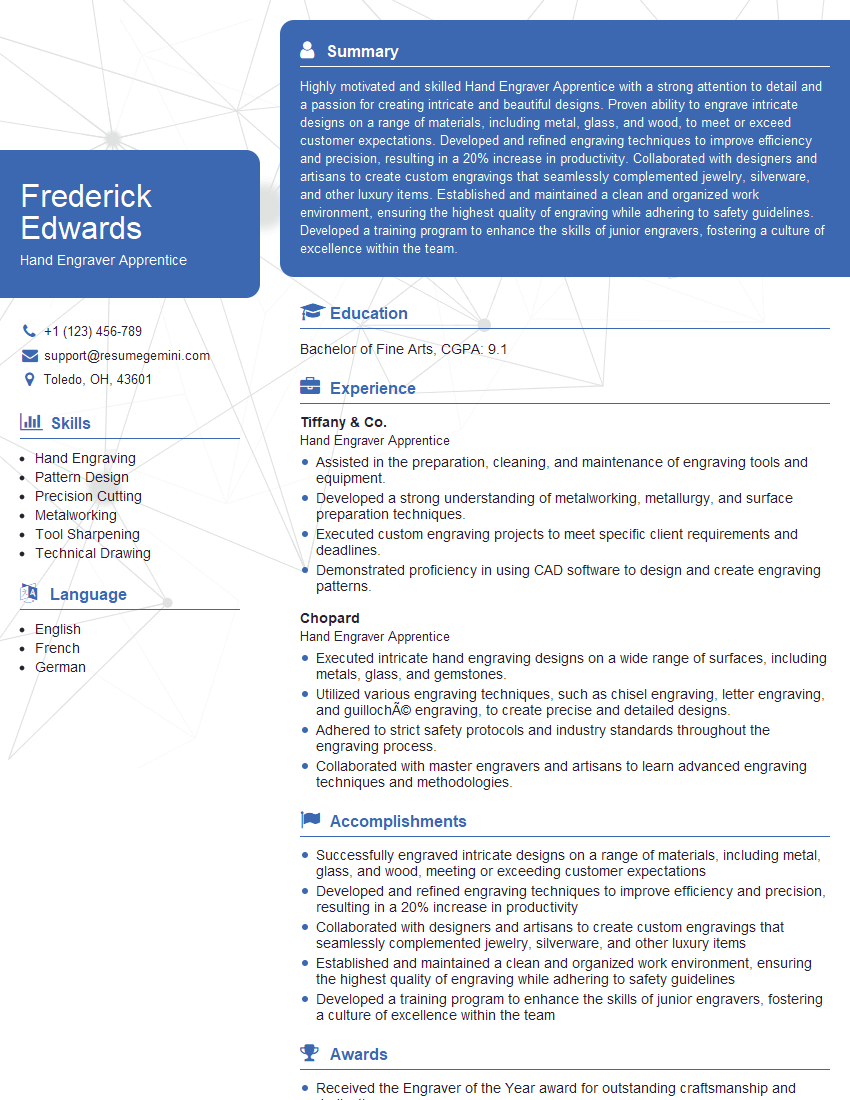
Feeling lost in a sea of interview questions? Landed that dream interview for Hand Engraver Apprentice but worried you might not have the answers? You’re not alone! This blog is your guide for interview success. We’ll break down the most common Hand Engraver Apprentice interview questions, providing insightful answers and tips to leave a lasting impression. Plus, we’ll delve into the key responsibilities of this exciting role, so you can walk into your interview feeling confident and prepared.
Acing the interview is crucial, but landing one requires a compelling resume that gets you noticed. Crafting a professional document that highlights your skills and experience is the first step toward interview success. ResumeGemini can help you build a standout resume that gets you called in for that dream job.






Essential Interview Questions For Hand Engraver Apprentice
1. What are the different types of engraving techniques?
There are various engraving techniques, including:
- Guilloche engraving: Creating repetitive or geometric patterns using a straight or curved line cutter.
- Line engraving: Using a burin to cut precise lines into the metal.
- Stippling engraving: Creating images or patterns using dots and dashes.
- Push engraving: Using a sharp tool to push the metal in a particular direction, creating a raised design.
- Chasing engraving: Using a hammer and chasing tool to create patterns or shapes by hammering directly onto the metal.
2. What are the essential tools used in hand engraving?
Cutting Tools:
- Burin: A sharp, triangular tool used for cutting lines.
- Graver: A tool with a small, hardened tip used for precise cutting.
- Scorper: A tool with a curved cutting edge for creating grooves or rounded shapes.
Finishing Tools:
- Abrasives: Sandpaper, grinding wheels, and polishing compounds for smoothing and finishing.
- Burnisher: A tool for smoothing and hardening the engraved surface.
- Chasing tools: Hammers and punches for shaping or finishing the design.
3. How do you determine the appropriate depth and angle for engraving a specific design?
The depth and angle of engraving depend on:
- Metal type: Harder metals require deeper cuts, while softer metals require shallower cuts.
- Design complexity: Detailed designs may need finer lines and shallower depths, while bolder designs can use wider lines and deeper cuts.
- Purpose and durability: Engravings intended for display may be shallower, while those subjected to wear and tear may require deeper cuts for longevity.
4. What techniques are used to create different textures and finishes on engraved surfaces?
Various techniques can be used, such as:
- Engraving: Cuts lines or shapes into the surface, creating depth and texture.
- Chasing: Using a hammer and punches to shape or define the surface, creating a raised or recessed texture.
- Repoussé: Using hammers and punches to raise the surface from the back, creating a three-dimensional effect.
- Stippling: Creating a dotted texture by hammering small punches into the surface.
5. How do you prepare a metal surface for engraving?
Preparing the metal surface involves:
- Cleaning: Removing dirt, oil, or oxidation to create a clean and receptive surface.
- Annealing: Softening the metal by heating and cooling it, making it easier to engrave.
- Marking or sketching: Transferring the design onto the metal surface using a scribe, pencil, or other marking tools.
6. What are the safety precautions to observe when using engraving tools?
Safety precautions include:
- Eye protection: Always wear safety glasses or a face shield.
- Hand protection: Wear gloves to prevent cuts and abrasions.
- Tool handling: Handle tools carefully and never point them towards anyone.
- Proper ventilation: Ensure adequate ventilation to remove dust and fumes.
- Ergonomics: Maintain a comfortable and ergonomic workspace to prevent strain or injury.
7. How do you maintain the sharpness of engraving tools?
Maintaining tool sharpness is essential and can be done using:
- Sharpening stones: Water stones or diamond stones for grinding and sharpening blades.
- Honing: Regularly honing the tools on a leather strop or honing steel to maintain their edge.
- Lubrication: Applying oil or cutting fluid to tools during sharpening and use to reduce friction and wear.
8. What are the advantages and disadvantages of using a hammer and chisel versus a graver for engraving?
Hammer and Chisel:
Advantages:
- Faster for removing large amounts of metal.
- Can create bold and textured designs.
Disadvantages:
- Less precise and detailed.
- Can be harder to control.
Graver:
Advantages:
- Highly precise and detailed.
- More control over line weight and depth.
Disadvantages:
- Slower and more time-consuming.
- Not ideal for removing large amounts of metal.
9. Explain the process of transferring a design from paper to metal for engraving.
There are several methods:
- Tracing: Placing carbon paper between the design and metal, then tracing the lines.
- Scribing: Using a sharp tool to score the design directly onto the metal.
- Punched dots: Pricking the design onto paper and then transferring the dots to the metal using a sharp tool.
- Photo engraving: Using a photo-sensitive resist to transfer the design to the metal.
10. Describe the types of finishes that can be achieved in engraving and the techniques used to create them.
- Bright cut: A highly polished and reflective finish achieved by burnishing or polishing the engraved surface.
- Matte: A soft and diffused finish created by sandblasting or using abrasives to remove the shine.
- Oxidized: A blackened finish achieved by applying chemicals or heat to create a patina.
- Patina: A natural or artificially induced film that forms on the surface over time, adding color and character.
Interviewers often ask about specific skills and experiences. With ResumeGemini‘s customizable templates, you can tailor your resume to showcase the skills most relevant to the position, making a powerful first impression. Also check out Resume Template specially tailored for Hand Engraver Apprentice.
Career Expert Tips:
- Ace those interviews! Prepare effectively by reviewing the Top 50 Most Common Interview Questions on ResumeGemini.
- Navigate your job search with confidence! Explore a wide range of Career Tips on ResumeGemini. Learn about common challenges and recommendations to overcome them.
- Craft the perfect resume! Master the Art of Resume Writing with ResumeGemini’s guide. Showcase your unique qualifications and achievements effectively.
- Great Savings With New Year Deals and Discounts! In 2025, boost your job search and build your dream resume with ResumeGemini’s ATS optimized templates.
Researching the company and tailoring your answers is essential. Once you have a clear understanding of the Hand Engraver Apprentice‘s requirements, you can use ResumeGemini to adjust your resume to perfectly match the job description.
Key Job Responsibilities
Hand Engraver Apprentices are responsible for assisting experienced engravers in creating intricate designs on metal, wood, glass, and other materials. They perform a variety of tasks under the supervision of a master engraver, including:
1. Preparing materials
Apprentices prepare materials by cleaning, sanding, and polishing surfaces to ensure a smooth and even engraving surface.
- Clean and polish metal, wood, glass, or other materials.
- Apply protective coatings to prevent damage during engraving.
2. Creating designs
Apprentices assist in creating designs by sketching, tracing, or transferring patterns onto materials. They may also use computer-aided design (CAD) software to create digital designs.
- Sketch or trace designs onto materials.
- Use CAD software to create digital designs.
- Transfer designs onto materials using various techniques.
3. Engraving designs
Apprentices use a variety of hand tools and machines to engrave designs into materials. They must be precise and have a steady hand to create intricate and detailed designs.
- Use hand tools and machines to engrave designs into materials.
- Follow design specifications and instructions.
- Inspect engraved designs for quality and accuracy.
4. Finishing and polishing
Apprentices finish and polish engraved designs to remove any burrs or imperfections. They may also apply protective coatings to protect the designs from damage.
- Remove burrs and imperfections from engraved designs.
- Apply protective coatings to protect designs from damage.
- Clean and maintain engraving tools and equipment.
Interview Tips
Preparing for an interview can be daunting, but by following these tips you can increase your chances of success.
1. Research the company and the position
Take the time to learn about the company you are applying to and the specific position you are interviewing for. This will help you to understand the company’s culture, values, and goals, and to tailor your answers to the specific requirements of the job.
- Visit the company’s website.
- Read articles and news stories about the company.
- Review the job description carefully.
2. Practice your answers to common interview questions
There are a number of common interview questions that you are likely to be asked, such as “Tell me about yourself” and “Why are you interested in this position?”.
- Prepare your answers to these questions in advance.
- Practice delivering your answers out loud.
- Get feedback from a friend or family member.
3. Dress appropriately
First impressions matter, so make sure you dress appropriately for your interview. This means wearing clean, pressed clothes that are suitable for a professional setting.
- Consider the company’s culture and dress code.
- Dress in a way that makes you feel confident and professional.
- Avoid wearing clothing that is too revealing or casual.
4. Be on time
Punctuality is important, so make sure you arrive for your interview on time. This shows that you are respectful of the interviewer’s time and that you are serious about the position.
- Give yourself plenty of time to travel to the interview.
- Allow for unexpected delays.
- If you are running late, call or email the interviewer to let them know.
Next Step:
Now that you’re armed with the knowledge of Hand Engraver Apprentice interview questions and responsibilities, it’s time to take the next step. Build or refine your resume to highlight your skills and experiences that align with this role. Don’t be afraid to tailor your resume to each specific job application. Finally, start applying for Hand Engraver Apprentice positions with confidence. Remember, preparation is key, and with the right approach, you’ll be well on your way to landing your dream job. Build an amazing resume with ResumeGemini