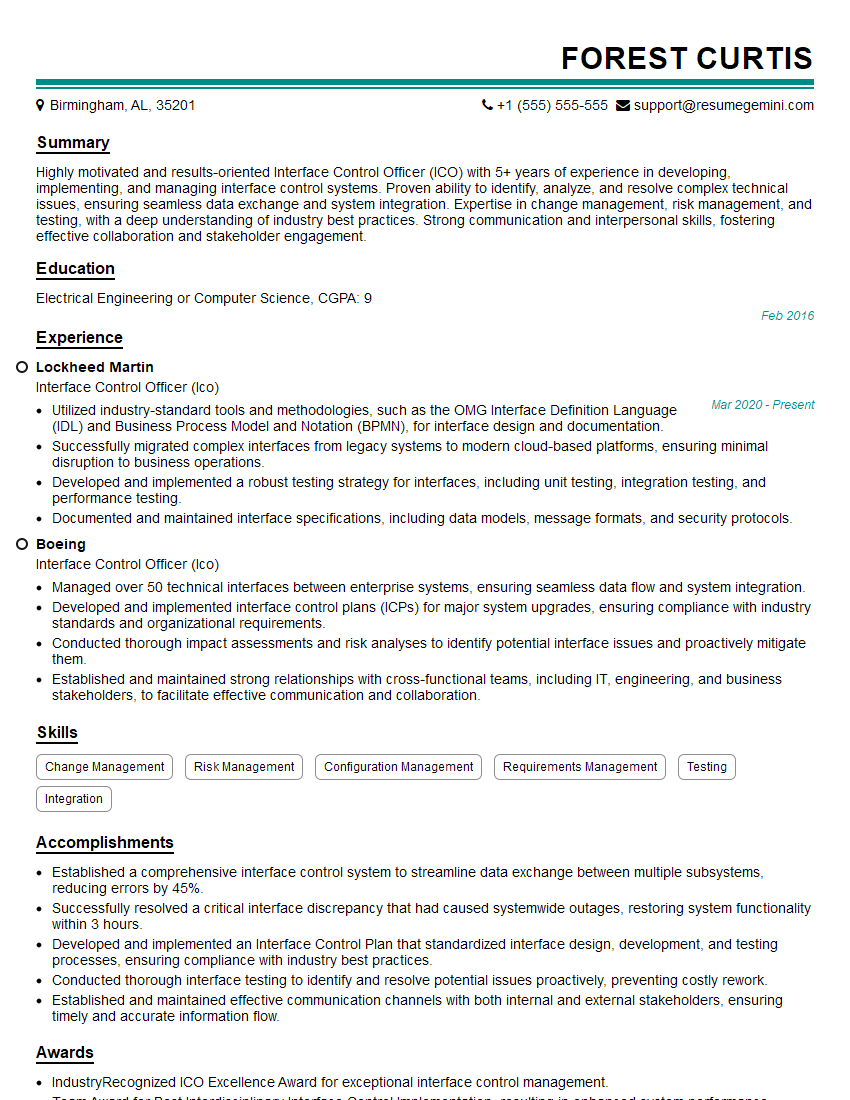
Ever felt underprepared for that crucial job interview? Or perhaps you’ve landed the interview but struggled to articulate your skills and experiences effectively? Fear not! We’ve got you covered. In this blog post, we’re diving deep into the Interface Control Officer (Ico) interview questions that you’re most likely to encounter. But that’s not all. We’ll also provide expert insights into the key responsibilities of a Interface Control Officer (Ico) so you can tailor your answers to impress potential employers.
Acing the interview is crucial, but landing one requires a compelling resume that gets you noticed. Crafting a professional document that highlights your skills and experience is the first step toward interview success. ResumeGemini can help you build a standout resume that gets you called in for that dream job.






Essential Interview Questions For Interface Control Officer (Ico)
1. Explain the key responsibilities of an Interface Control Officer (ICO)?
As an ICO, my key responsibilities would include:
- Managing the interface control process to ensure effective communication and coordination among different interfaces and systems.
- Developing and maintaining interface control documents, including interface specifications, agreements, and change requests.
- Reviewing and approving system changes to ensure they comply with interface requirements.
- Coordinating the resolution of interface issues and disputes.
- Working with stakeholders to identify and prioritize interface requirements.
- Monitoring and tracking interface performance to ensure systems are operating within agreed-upon parameters.
2. Describe the different types of interfaces you have managed in your previous role?
Hardware Interfaces
- Managed the interface between a legacy system and a new ERP system, ensuring seamless data transfer and system compatibility.
- Integrated multiple hardware devices, including sensors, actuators, and controllers, within an industrial automation system.
Software Interfaces
- Developed and implemented an API integration strategy for a web-based application, allowing external systems to access and exchange data.
- Managed the interface between a CRM system and a marketing automation platform, automating lead generation and nurturing processes.
Organizational Interfaces
- Facilitated communication and collaboration between different departments involved in a complex project, ensuring alignment and timely delivery.
- Established and managed relationships with external vendors and partners, coordinating interface requirements and resolving issues.
3. What are the key principles and standards for interface control?
The key principles and standards for interface control include:
- Clarity and Completeness: Interface specifications and agreements must be clear, concise, and complete to avoid misunderstandings.
- Traceability: Interfaces should be traceable to system requirements to ensure they meet business objectives.
- Modularity: Interfaces should be designed to be modular and independent, allowing for easy integration and modification.
- Version Control: Interface specifications should be version-controlled to manage changes and maintain historical records.
- Testing and Validation: Interfaces should be tested and validated to ensure they are functioning as intended.
- Governance: Interface control should be governed by established policies, processes, and committees to ensure compliance and consistency.
4. How do you manage interface changes and ensure their smooth implementation?
I manage interface changes through the following steps:
- Impact Analysis: Assess the impact of proposed changes on the interface and dependent systems.
- Change Request: Submit a formal change request that outlines the proposed change, its rationale, and impact.
- Design and Development: Work with stakeholders to design and develop the necessary modifications to the interface.
- Testing and Validation: Conduct thorough testing and validation to ensure the modified interface meets requirements and functions as expected.
- Implementation: Coordinate the implementation of the interface change, including communication with stakeholders and system downtime management.
- Monitoring and Evaluation: Monitor the performance of the changed interface and evaluate its effectiveness in meeting business objectives.
5. What tools and techniques do you use for interface documentation and management?
I use a combination of tools and techniques for interface documentation and management:
- Documentation Tools: Utilize word processors (e.g., Microsoft Word), spreadsheets (e.g., Excel), and diagramming tools (e.g., Visio) to create interface specifications, agreements, and change documents.
- Version Control Systems: Use version control systems (e.g., Git, SVN) to manage different versions of interface documents, track changes, and facilitate collaboration.
- Interface Management Tools: Leverage dedicated interface management tools to manage interface inventories, track relationships, and automate change processes.
- Communication Channels: Utilize email, collaboration platforms (e.g., Teams, Slack), and meeting tools to communicate with stakeholders, discuss interface requirements, and resolve issues.
6. How do you ensure the quality and accuracy of interface specifications?
I ensure the quality and accuracy of interface specifications through:
- Thorough Reviews: Conduct thorough reviews of interface specifications with stakeholders to identify and resolve any ambiguities, inconsistencies, or omissions.
- Traceability Matrix: Create a traceability matrix that links interface requirements to system requirements, ensuring that all requirements are addressed.
- Validation Testing: Perform validation testing to verify that the interface specifications accurately reflect the intended behavior and functionality.
- Change Management: Establish a change management process to track and control modifications to interface specifications, ensuring that changes are documented, reviewed, and approved.
7. What are the challenges you have faced as an ICO and how did you overcome them?
One challenge I faced was managing a complex interface between multiple legacy systems and a new cloud-based platform. The legacy systems had different data formats and communication protocols, making integration challenging.
To overcome this, I worked closely with the development team to design and implement a data mapping and transformation layer. I also facilitated communication and coordination between different teams involved in the integration process.
8. How do you stay up-to-date with the latest trends and developments in interface control?
I stay up-to-date with the latest trends and developments in interface control through:
- Industry Events and Conferences: Attend industry events and conferences to learn about new technologies, best practices, and case studies.
- Professional Development: Engage in professional development courses, workshops, and webinars to enhance my knowledge and skills.
- Technical Publications: Regularly read technical publications, articles, and white papers related to interface control.
- Networking and Collaboration: Connect with other interface control professionals through online forums, social media groups, and industry organizations.
9. How do you prioritize interface changes when there are multiple requests?
I prioritize interface changes based on the following criteria:
- Business Impact: Assess the potential impact of the change on the business, considering factors such as revenue, customer satisfaction, and operational efficiency.
- Technical Complexity: Evaluate the technical complexity of the change, including the number of systems affected, the level of integration required, and the availability of resources.
- Urgency: Consider the urgency of the change, whether it is required to fix a critical issue or meet a specific deadline.
- Dependencies: Identify any dependencies between interface changes and prioritize those that have the most dependencies to avoid blocking other changes.
10. How do you handle conflicts and disputes that may arise during the interface control process?
I handle conflicts and disputes that may arise during the interface control process through:
- Communication: Facilitate open and transparent communication among stakeholders to identify and understand different perspectives.
- Collaboration: Encourage stakeholders to work together to find mutually acceptable solutions, considering both technical and business requirements.
- Compromise: Seek compromises that meet the needs of all parties involved while ensuring the overall integrity of the interface.
- Escalation: If necessary, escalate conflicts or disputes to higher management for resolution, providing a clear rationale and recommendations.
Interviewers often ask about specific skills and experiences. With ResumeGemini‘s customizable templates, you can tailor your resume to showcase the skills most relevant to the position, making a powerful first impression. Also check out Resume Template specially tailored for Interface Control Officer (Ico).
Career Expert Tips:
- Ace those interviews! Prepare effectively by reviewing the Top 50 Most Common Interview Questions on ResumeGemini.
- Navigate your job search with confidence! Explore a wide range of Career Tips on ResumeGemini. Learn about common challenges and recommendations to overcome them.
- Craft the perfect resume! Master the Art of Resume Writing with ResumeGemini’s guide. Showcase your unique qualifications and achievements effectively.
- Great Savings With New Year Deals and Discounts! In 2025, boost your job search and build your dream resume with ResumeGemini’s ATS optimized templates.
Researching the company and tailoring your answers is essential. Once you have a clear understanding of the Interface Control Officer (Ico)‘s requirements, you can use ResumeGemini to adjust your resume to perfectly match the job description.
Key Job Responsibilities
An Interface Control Officer (ICO) plays a crucial role in managing and coordinating interfaces within an organization. Their primary responsibilities include:
1. Interface Management
Ensuring that all interfaces between different systems or departments are clearly defined, documented, and maintained. This involves identifying, analyzing, and defining functional and technical interfaces.
2. Change Control
Establishing and managing a change control process to ensure that any changes to interfaces are properly authorized, documented, and communicated to all affected parties.
3. Risk Assessment
Conducting risk assessments to identify potential problems or errors that may occur at interfaces and developing mitigation strategies to minimize risks.
4. Testing and Validation
Coordinating and participating in testing and validation activities to verify the functionality and performance of interfaces.
5. Documentation
Maintaining comprehensive documentation of all interface agreements, specifications, and change requests to ensure clear and accurate communication.
Interview Tips
To ace an Interface Control Officer interview, consider these preparation tips:
1. Research the Company and Role
Thoroughly research the organization and the specific role you are applying for. Understanding their industry, products, and interface management practices will give you an edge.
2. Showcase Your Interface Management Skills
Highlight your experience in managing interfaces, including your understanding of different types of interfaces (e.g., technical, functional, organizational), and your ability to effectively coordinate communication between multiple stakeholders.
3. Emphasize Your Change Control Expertise
Explain your knowledge of change control processes and demonstrate your ability to implement and manage them effectively. Emphasize your understanding of the importance of risk assessment and mitigation.
4. Highlight Your Problem-Solving Abilities
Provide examples of how you have successfully identified and resolved interface problems, demonstrating your analytical and problem-solving skills.
5. Practice Your Technical and Soft Skills
Review technical concepts related to interface management, such as data exchange protocols and message formats. Also, practice your communication and interpersonal skills, as effective collaboration is crucial in this role.
6. Be Prepared for Role-Playing
Some interviews may include role-playing scenarios to assess your ability to manage interface issues and communicate effectively with different stakeholders.
7. Ask Insightful Questions
At the end of the interview, ask thoughtful questions that demonstrate your interest in the role and the organization. This shows your engagement and enthusiasm.
Next Step:
Armed with this knowledge, you’re now well-equipped to tackle the Interface Control Officer (Ico) interview with confidence. Remember, preparation is key. So, start crafting your resume, highlighting your relevant skills and experiences. Don’t be afraid to tailor your application to each specific job posting. With the right approach and a bit of practice, you’ll be well on your way to landing your dream job. Build your resume now from scratch or optimize your existing resume with ResumeGemini. Wish you luck in your career journey!