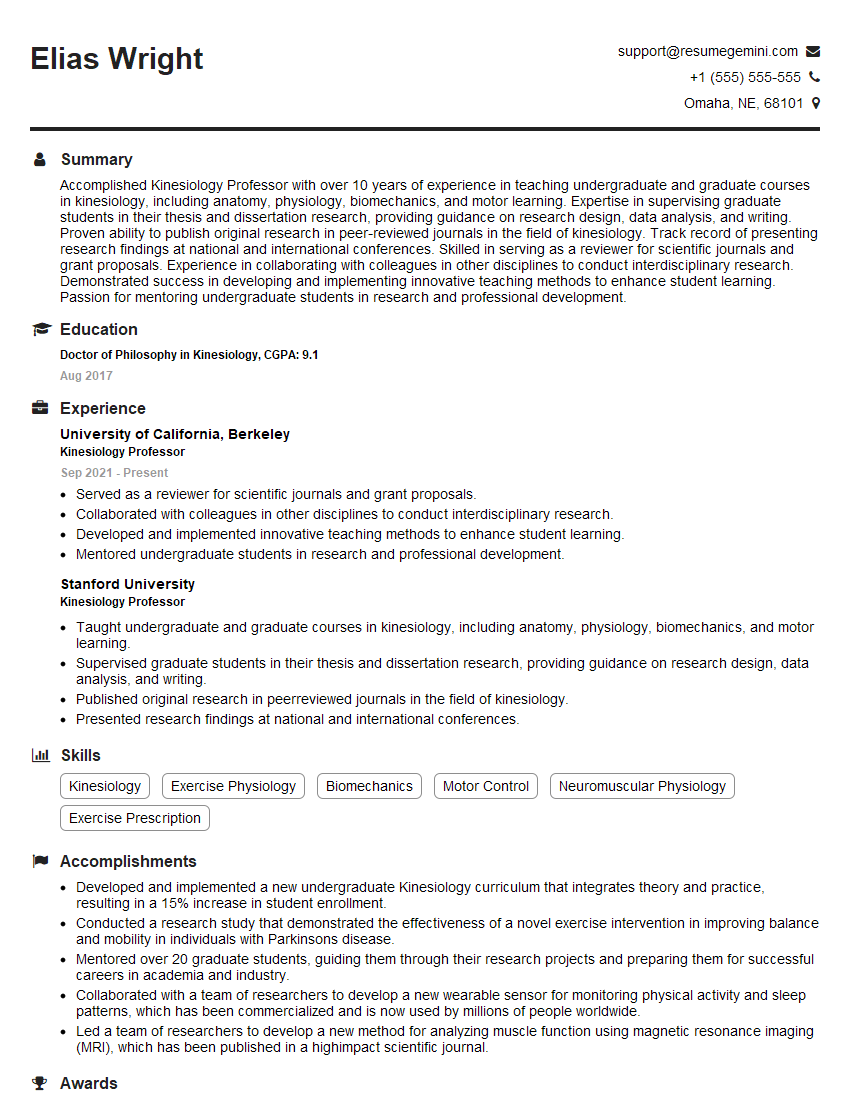
Ever felt underprepared for that crucial job interview? Or perhaps you’ve landed the interview but struggled to articulate your skills and experiences effectively? Fear not! We’ve got you covered. In this blog post, we’re diving deep into the Kinesiology Professor interview questions that you’re most likely to encounter. But that’s not all. We’ll also provide expert insights into the key responsibilities of a Kinesiology Professor so you can tailor your answers to impress potential employers.
Acing the interview is crucial, but landing one requires a compelling resume that gets you noticed. Crafting a professional document that highlights your skills and experience is the first step toward interview success. ResumeGemini can help you build a standout resume that gets you called in for that dream job.






Essential Interview Questions For Kinesiology Professor
1. Describe the role of biomechanics in the field of kinesiology and provide examples of how it is applied in research and practice.
Biomechanics is a key component of the field of kinesiology, which focuses on the study of movement and mechanics of the human body. It explores how anatomical structures and physiological functions interact to generate, control, and resist forces during movement.
- Biomechanics helps researchers and practitioners analyze and understand the body’s complex musculoskeletal system, including bones, muscles, ligaments, and tendons.
- By applying principles of mechanics and engineering to the human body, biomechanics enables researchers to study and simulate joint loading, muscle activation, and tissue deformation during various activities.
- In practical applications, biomechanics aids in the design of ergonomic workplaces, development of rehabilitation protocols, and optimization of sports performance.
- It assists healthcare professionals in analyzing gait disorders, assessing joint stability, and recommending appropriate interventions for individuals with movement impairments.
- Furthermore, biomechanics plays a crucial role in developing and evaluating assistive devices, such as prosthetics and exoskeletons.
2. Explain the principles underlying motor learning and development. How do you incorporate these principles into your teaching and research?
- Motor learning focuses on the acquisition and refinement of new movement patterns, while motor development examines the natural progression of motor skills from infancy through adulthood.
- Key principles include practice variability, error detection and correction, and feedback. Incorporating these principles into teaching involves providing learners with multiple opportunities to practice, encouraging self-assessment, and offering constructive feedback.
- In research, these principles guide experimental designs to investigate factors influencing motor learning and development, such as practice conditions, cognitive processes, and environmental factors.
3. Discuss the different approaches to teaching kinesiology and the factors that influence your choice of teaching methods.
- Various teaching approaches include lectures, tutorials, laboratory experiments, and field experiences.
- Factors influencing the choice of methods include the learning objectives, the level of students, and the availability of resources.
- Effective teaching involves a combination of approaches to cater to diverse learning styles and ensure a comprehensive understanding of the subject matter.
4. How do you keep up with the latest research and advancements in the field of kinesiology?
- Attending conferences, workshops, and seminars.
- Reading peer-reviewed journals and scientific publications.
- Participating in research projects and collaborating with colleagues.
5. Describe your research experience in kinesiology and how it informs your teaching.
- Conducting original research helps develop a deeper understanding of the subject matter.
- Research findings can be incorporated into teaching materials to provide students with up-to-date knowledge and insights.
- Research experience enhances the ability to critically evaluate scientific literature and fosters a spirit of inquiry among students.
6. How do you assess student learning in your kinesiology courses?
- Using a variety of assessment methods, such as exams, assignments, presentations, and practical demonstrations.
- Providing timely and constructive feedback to help students improve their understanding and performance.
- Encouraging self-assessment and peer feedback to promote critical thinking and independent learning.
7. What are the unique challenges and rewards of teaching kinesiology?
- Challenges: The interdisciplinary nature of the field, requiring a strong foundation in multiple sciences.
- Rewards: Witnessing students’ growth and development as they gain a deeper understanding and appreciation for the human body and movement.
8. Describe your contributions to the kinesiology profession beyond teaching.
- Engaging in professional development activities, such as attending workshops and conferences.
- Serving on committees or task forces related to kinesiology education or research.
- Participating in outreach programs or community events to promote the field and its applications.
9. How would you incorporate technology into your kinesiology teaching?
- Using online platforms for course delivery, collaboration, and assessment.
- Incorporating motion capture and analysis systems into the curriculum.
- Enhancing lectures and presentations with interactive simulations and multimedia resources.
10. What are your plans for developing your professional skills and knowledge in the future?
- Continuing to attend professional development opportunities.
- Conducting research and publishing in peer-reviewed journals.
- Seeking collaborations with other professionals in the field.
Interviewers often ask about specific skills and experiences. With ResumeGemini‘s customizable templates, you can tailor your resume to showcase the skills most relevant to the position, making a powerful first impression. Also check out Resume Template specially tailored for Kinesiology Professor.
Career Expert Tips:
- Ace those interviews! Prepare effectively by reviewing the Top 50 Most Common Interview Questions on ResumeGemini.
- Navigate your job search with confidence! Explore a wide range of Career Tips on ResumeGemini. Learn about common challenges and recommendations to overcome them.
- Craft the perfect resume! Master the Art of Resume Writing with ResumeGemini’s guide. Showcase your unique qualifications and achievements effectively.
- Great Savings With New Year Deals and Discounts! In 2025, boost your job search and build your dream resume with ResumeGemini’s ATS optimized templates.
Researching the company and tailoring your answers is essential. Once you have a clear understanding of the Kinesiology Professor‘s requirements, you can use ResumeGemini to adjust your resume to perfectly match the job description.
Key Job Responsibilities
Kinesiology Professors are responsible for teaching, research, and service in the field of kinesiology.
1. Teaching
intro paragraph
- Develop and deliver engaging lectures, labs, and tutorials on topics related to kinesiology.
- Create and maintain course materials, including syllabi, lesson plans, and assignments.
- Evaluate student learning through exams, assignments, and other assessment methods.
- Provide academic advising and guidance to students.
- Stay up-to-date on the latest research and developments in kinesiology and incorporate them into teaching.
2. Research
intro paragraph
- Conduct original research in the field of kinesiology, contributing to the advancement of knowledge.
- Publish research findings in peer-reviewed journals and present at conferences.
- Secure funding for research projects through grants and other sources.
- Collaborate with colleagues and students on research projects.
- Supervise and mentor graduate students in their research.
3. Service
intro paragraph
- Serve on departmental, faculty, and university committees.
- Participate in outreach activities, such as giving guest lectures or workshops.
- Represent the department or university at events and conferences.
- Engage in professional development activities to enhance teaching and research skills.
- Contribute to the community through service activities related to kinesiology.
4. Other Responsibilities
intro paragraph
- Maintain a positive and professional work environment.
- Adhere to university policies and procedures.
- Collaborate with other faculty, staff, and students to achieve departmental and university goals.
Interview Tips
Preparing for an interview for a Kinesiology Professor position requires careful planning and practice. Here are some tips to help you ace the interview:
1. Research the University and Department
Take the time to learn about the university and the kinesiology department. Visit the university’s website, read about the department’s mission and goals, and familiarize yourself with the faculty and their research interests. This will help you understand the university’s culture and the department’s specific needs, which you can then highlight in your interview answers.
- Example: “I was particularly impressed by your department’s emphasis on interdisciplinary research, which aligns perfectly with my own research interests in biomechanics and motor control.”
2. Prepare for Common Interview Questions
Practice answering common interview questions, such as “Tell me about yourself,” “Why are you interested in this position?” and “What are your research interests?” Prepare specific examples from your experience that demonstrate your skills and qualifications. You can also research the university’s strategic plan or recent initiatives to prepare for questions about how your work can contribute to the university’s goals.
- Example: “In my previous role, I developed a new teaching method that significantly improved student engagement and learning outcomes. I believe this approach could be valuable to your department’s commitment to innovative teaching practices.”
3. Highlight Your Research and Teaching Experience
Emphasize your research accomplishments and teaching experience in your interview answers. Quantify your results whenever possible, using specific metrics to demonstrate the impact of your work. For example, you could mention the number of publications you have in peer-reviewed journals, the amount of research funding you have secured, or the teaching awards you have received.
- Example: “In my current position, I secured over \$1 million in research funding from the National Institutes of Health, which allowed me to build a state-of-the-art motion analysis lab and conduct groundbreaking research on the biomechanics of human movement.”
4. Demonstrate Your Commitment to Service and Collaboration
Highlight your commitment to service and collaboration in your interview answers. Mention your experience serving on committees, participating in outreach activities, or collaborating with colleagues on research projects. Explain how your collaborative spirit and dedication to service make you a valuable asset to the department and university.
- Example: “Throughout my career, I have actively participated in professional organizations and served on several university committees. I believe that my collaborative nature and commitment to service can contribute to the department’s success and the broader kinesiology community.”
5. Practice Your Presentation Skills
Practice your presentation skills before the interview, as you may be asked to give a brief presentation on your research or teaching experience. Prepare your presentation in advance and rehearse it thoroughly. Use visual aids to enhance your presentation, and be prepared to answer questions about your work.
- Example: “I have prepared a brief presentation on my research on the effects of exercise on cognitive function in older adults. I would be happy to present my findings and answer any questions you may have.”
6. Be Professional and Enthusiastic
Be professional and enthusiastic throughout the interview. Dress appropriately, arrive on time, and be respectful of the interviewers. Show genuine interest in the position and the department, and be prepared to ask thoughtful questions of your own. Your enthusiasm and passion for kinesiology will shine through and make a positive impression on the interviewers.
- Example: “I am excited about the opportunity to join your department and contribute to its commitment to excellence in kinesiology. I believe my skills and experience would be a valuable asset to your team, and I am eager to learn more about the position and the department’s goals.”
Next Step:
Now that you’re armed with a solid understanding of what it takes to succeed as a Kinesiology Professor, it’s time to turn that knowledge into action. Take a moment to revisit your resume, ensuring it highlights your relevant skills and experiences. Tailor it to reflect the insights you’ve gained from this blog and make it shine with your unique qualifications. Don’t wait for opportunities to come to you—start applying for Kinesiology Professor positions today and take the first step towards your next career milestone. Your dream job is within reach, and with a polished resume and targeted applications, you’ll be well on your way to achieving your career goals! Build your resume now with ResumeGemini.