Are you gearing up for a career shift or aiming to ace your next interview? Look no further! We’ve curated a comprehensive guide to help you crack the interview for the coveted Manuscript Editor position. From understanding the key responsibilities to mastering the most commonly asked questions, this blog has you covered. So, buckle up and let’s embark on this journey together.
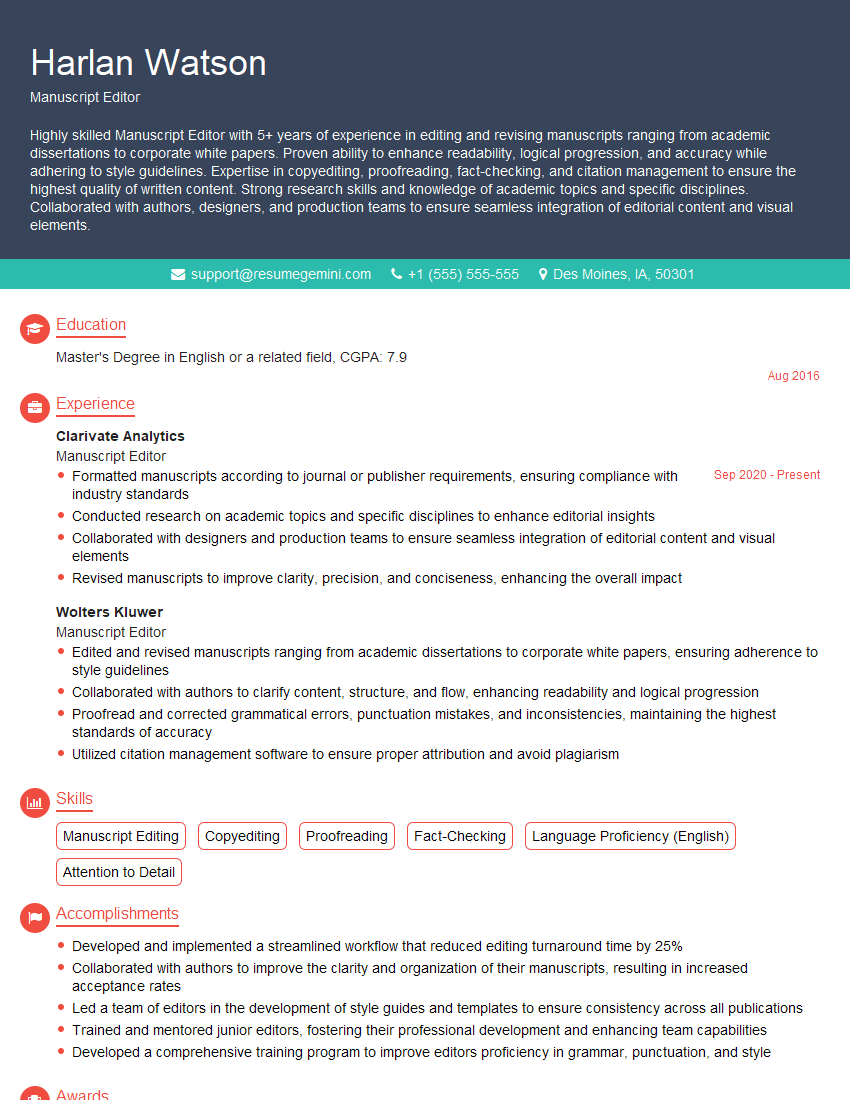
Acing the interview is crucial, but landing one requires a compelling resume that gets you noticed. Crafting a professional document that highlights your skills and experience is the first step toward interview success. ResumeGemini can help you build a standout resume that gets you called in for that dream job.






Essential Interview Questions For Manuscript Editor
1. Describe your experience in editing manuscripts in the social sciences field?
– Comprehensive editing of academic papers, dissertations, and book chapters for various social science disciplines, including psychology, sociology, economics, and education. – Ensuring adherence to specified style guides and publication requirements.
2. How do you ensure accuracy and consistency in your editing?
Proofreading Techniques
- Diligent proofreading of all edited materials, focusing on grammar, spelling, punctuation, and formatting.
- Utilization of professional proofreading tools and resources.
Checking for Consistency
- Cross-checking references, citations, and factual information to maintain consistency throughout the manuscript.
- Ensuring compliance with the author’s intended style and tone.
3. How do you handle complex technical material in manuscripts?
– Thorough research of relevant concepts and terminology in collaboration with subject-matter experts. – Consulting credible sources and authoritative references to ensure accuracy and clarity. – Sensitivity to the author’s expertise and experience in the field.
4. Describe your approach to editing manuscripts with multiple authors.
– Maintaining open communication and establishing clear guidelines with all authors. – Resolving discrepancies in writing styles and ensuring a cohesive narrative. – Facilitating discussions among authors to address any differences in perspectives or approaches.
5. How do you stay updated with the latest editing guidelines and best practices?
– Regular attendance at industry conferences and workshops. – Active participation in professional organizations and editorial communities. – Continuous research and exploration of scholarly resources and publications.
6. Can you elaborate on your experience with editing quantitative and qualitative research manuscripts?
Quantitative Research
- Ensuring accuracy and clarity in statistical analyses and data presentation.
- Checking for adherence to appropriate statistical methods and reporting standards.
Qualitative Research
- Maintaining the integrity and coherence of qualitative data analysis and interpretation.
- Adhering to specific guidelines and ethical considerations for qualitative research reporting.
7. How do you prioritize tasks and manage multiple editing projects simultaneously?
– Utilizing project management tools to track progress and set deadlines. – Communicating effectively with authors to establish clear expectations and timelines. – Prioritizing tasks based on urgency and client requirements.
8. Can you provide an example of a challenging editing project you successfully completed?
– Describe the project, its complexities, and the unique challenges encountered. – Highlight specific strategies and techniques used to address these challenges effectively. – Explain the positive outcomes and impact of your editing efforts on the manuscript’s quality and publication success.
9. How do you incorporate author feedback into your editing process?
– Open and respectful communication with authors throughout the editing process. – Careful consideration of author feedback and revisions. – Collaborative approach to ensure the final manuscript meets both editorial and authorial expectations.
10. What are your ethical responsibilities as a Manuscript Editor?
- Maintaining confidentiality and protecting authors’ intellectual property.
- Promoting transparency and accuracy in research reporting.
- Adhering to industry best practices and ethical guidelines.
Interviewers often ask about specific skills and experiences. With ResumeGemini‘s customizable templates, you can tailor your resume to showcase the skills most relevant to the position, making a powerful first impression. Also check out Resume Template specially tailored for Manuscript Editor.
Career Expert Tips:
- Ace those interviews! Prepare effectively by reviewing the Top 50 Most Common Interview Questions on ResumeGemini.
- Navigate your job search with confidence! Explore a wide range of Career Tips on ResumeGemini. Learn about common challenges and recommendations to overcome them.
- Craft the perfect resume! Master the Art of Resume Writing with ResumeGemini’s guide. Showcase your unique qualifications and achievements effectively.
- Great Savings With New Year Deals and Discounts! In 2025, boost your job search and build your dream resume with ResumeGemini’s ATS optimized templates.
Researching the company and tailoring your answers is essential. Once you have a clear understanding of the Manuscript Editor‘s requirements, you can use ResumeGemini to adjust your resume to perfectly match the job description.
Key Job Responsibilities
A Manuscript Editor is responsible for editing and proofreading manuscripts, ensuring they are error-free and meet the required standards for publication. The key job responsibilities include:
1. Manuscript Editing
A Manuscript Editor thoroughly reviews manuscripts, checking for grammar, punctuation, spelling, and style errors. They also ensure that the manuscript is well-structured, easy to understand, and adheres to the appropriate writing style guide.
- Review manuscripts for clarity, consistency, and accuracy
- Correct grammatical, punctuation, and spelling errors
- Check for adherence to style guidelines (e.g., APA, MLA, Chicago)
2. Fact-Checking and Research
Manuscript Editors often need to verify facts and conduct research to ensure the accuracy and credibility of the manuscript. They may also need to check for plagiarism and ensure that the manuscript is original.
- Verify facts and conduct research to ensure accuracy
- Check for plagiarism and ensure originality
- Consult with experts in specific fields if necessary
3. Manuscript Formatting
Manuscript Editors format manuscripts according to specific requirements, such as page layout, margins, and font size. They ensure that the manuscript is visually appealing and easy to read.
- Format manuscripts according to publisher or journal guidelines
- Create tables, figures, and other visual elements
- Optimize manuscript for readability and accessibility
4. Collaboration with Authors
Manuscript Editors work closely with authors to resolve queries, address concerns, and ensure that the manuscript meets the desired outcome. They provide feedback and guidance to authors throughout the editing process.
- Communicate with authors to address queries and concerns
- Provide feedback and guidance on writing style, structure, and content
- Maintain a professional and collaborative relationship with authors
Interview Tips
To ace an interview for a Manuscript Editor position, it’s crucial to prepare thoroughly. Here are some tips:
1. Research the Organization and Position
Before the interview, take the time to research the organization and the specific position you’re applying for. Understand their mission, values, and the scope of the role. This knowledge will help you tailor your answers to highlight your relevant skills and experience.
- Visit the company’s website and social media pages
- Review the job description and identify key responsibilities
- Learn about the organization’s culture and industry
2. Practice Editing and Proofreading
Demonstrate your editing and proofreading skills by practicing on sample manuscripts or your academic writing. Focus on identifying and correcting errors in grammar, punctuation, spelling, and style. This will showcase your proficiency in core job responsibilities.
- Edit and proofread a sample manuscript
- Identify and correct errors in grammar, punctuation, and style
- Provide constructive feedback on the writing
3. Prepare Examples of Your Work
Bring examples of your editing work to the interview, such as edited manuscripts, published articles, or academic papers. These samples will provide tangible evidence of your skills and attention to detail. Highlight the specific techniques and processes you employed.
- Select examples that showcase your editing and proofreading abilities
- Explain the context and challenges of each project
- Discuss the results and impact of your work
4. Emphasize Your Communication Skills
As a Manuscript Editor, strong communication skills are essential. Be prepared to discuss your ability to effectively communicate with authors, provide constructive feedback, and resolve queries. Share examples where you successfully collaborated with others on writing projects.
- Describe your experience communicating with authors and resolving their concerns
- Explain how you provide constructive feedback while maintaining a positive relationship
- Give examples of successful collaborations on writing projects
Next Step:
Armed with this knowledge, you’re now well-equipped to tackle the Manuscript Editor interview with confidence. Remember, preparation is key. So, start crafting your resume, highlighting your relevant skills and experiences. Don’t be afraid to tailor your application to each specific job posting. With the right approach and a bit of practice, you’ll be well on your way to landing your dream job. Build your resume now from scratch or optimize your existing resume with ResumeGemini. Wish you luck in your career journey!