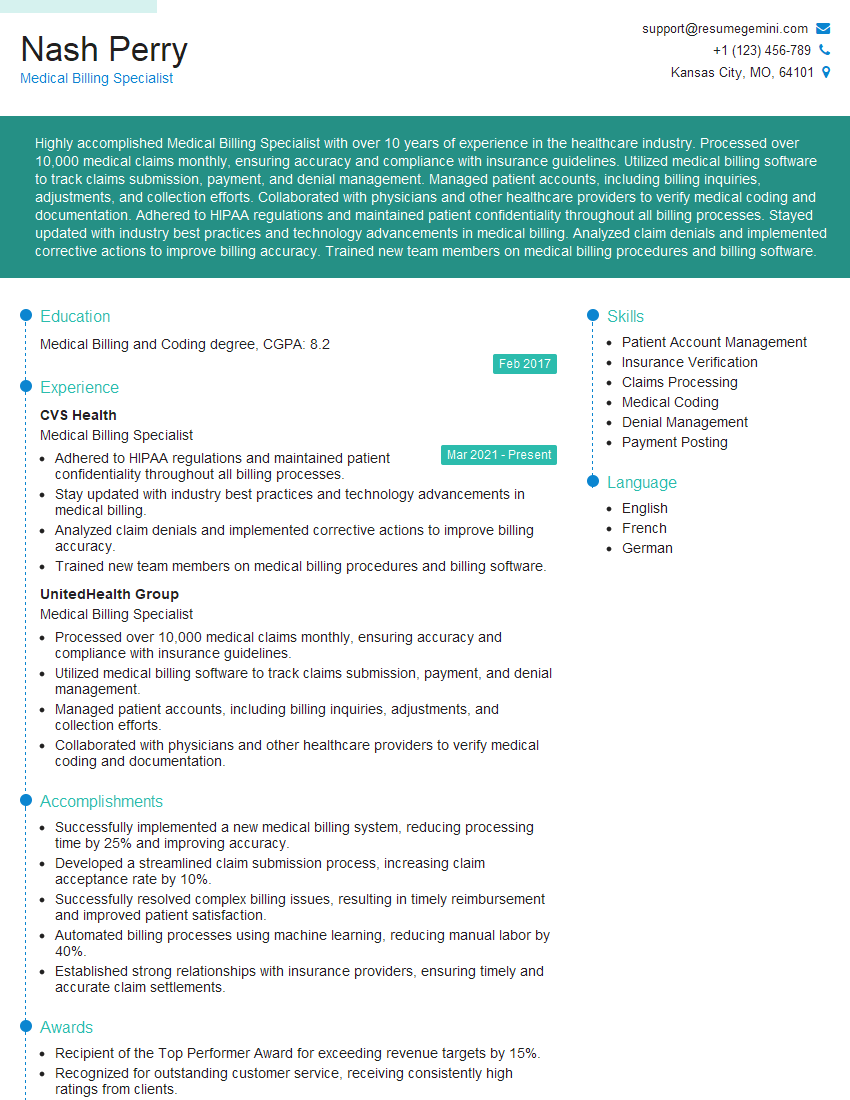
Are you gearing up for a career shift or aiming to ace your next interview? Look no further! We’ve curated a comprehensive guide to help you crack the interview for the coveted Medical Billing Specialist position. From understanding the key responsibilities to mastering the most commonly asked questions, this blog has you covered. So, buckle up and let’s embark on this journey together.
Acing the interview is crucial, but landing one requires a compelling resume that gets you noticed. Crafting a professional document that highlights your skills and experience is the first step toward interview success. ResumeGemini can help you build a standout resume that gets you called in for that dream job.






Essential Interview Questions For Medical Billing Specialist
1. Describe the process of medical billing and coding?
- Begin by registering the patient and gathering relevant information.
- Review medical records to assign appropriate codes using coding systems like ICD-10-CM and CPT.
- Generate claims based on the assigned codes, including patient demographics, diagnosis, and treatment details.
- Submit claims to insurance companies electronically or via mail.
- Follow up on claims, track payments, and resolve any issues or denials.
- Maintain accurate records and ensure compliance with HIPAA regulations.
2. What are the key components of a medical claim?
- Patient demographics: Name, address, insurance information
- Provider information: Name, address, tax ID number
- Dates of service
- Medical codes: ICD-10-CM for diagnosis, CPT for procedures
- Charges for each service or procedure
- Modifiers to indicate specific circumstances (e.g., emergency services)
3. How do you handle denied claims?
- Review the reason for denial and identify any errors or missing information.
- Correct errors, gather additional documentation, or request clarification from the insurance company.
- Re-submit the claim or appeal the denial if necessary.
- Document all communication and follow-up actions.
4. What are the common types of medical coding errors?
- Incorrect or incomplete codes
- Missing or invalid modifiers
- Inaccurate patient or provider information
- Incomplete or missing documentation
- Unbundling or upcoding (billing for unnecessary services)
5. How do you stay up-to-date on changes in medical coding and billing regulations?
- Attend industry conferences and webinars
- Read trade publications and online resources
- Participate in continuing education courses
- Consult with coding experts or professional organizations
6. What are the ethical considerations in medical billing?
- Adhering to HIPAA regulations and protecting patient privacy
- Avoiding fraud and abuse, such as overbilling or billing for unnecessary services
- Maintaining confidentiality and integrity of patient information
- Providing accurate and timely information to patients and insurance companies
7. How do you manage a high volume of claims?
- Use electronic health records (EHR) and billing software to streamline processes
- Automate tasks such as claim scrubbing and coding
- Prioritize claims based on urgency and payment deadlines
- Outsource some tasks to a billing company or third-party vendor
8. What are the key performance indicators (KPIs) for medical billing?
- Claim acceptance rate
- Denial rate
- Average days to payment
- Patient satisfaction
- Revenue generated
9. How do you ensure the accuracy of your billing?
- Implement internal controls and quality assurance measures
- Regularly audit claims and identify any errors
- Train staff on proper coding and billing procedures
- Use technology to automate and cross-check information
10. What is your experience with medical software, such as EHR and billing systems?
- List specific software applications and versions you have used
- Describe your proficiency in using these systems for tasks such as coding, claim submission, and reporting
- Mention any certifications or training related to medical software
Interviewers often ask about specific skills and experiences. With ResumeGemini‘s customizable templates, you can tailor your resume to showcase the skills most relevant to the position, making a powerful first impression. Also check out Resume Template specially tailored for Medical Billing Specialist.
Career Expert Tips:
- Ace those interviews! Prepare effectively by reviewing the Top 50 Most Common Interview Questions on ResumeGemini.
- Navigate your job search with confidence! Explore a wide range of Career Tips on ResumeGemini. Learn about common challenges and recommendations to overcome them.
- Craft the perfect resume! Master the Art of Resume Writing with ResumeGemini’s guide. Showcase your unique qualifications and achievements effectively.
- Great Savings With New Year Deals and Discounts! In 2025, boost your job search and build your dream resume with ResumeGemini’s ATS optimized templates.
Researching the company and tailoring your answers is essential. Once you have a clear understanding of the Medical Billing Specialist‘s requirements, you can use ResumeGemini to adjust your resume to perfectly match the job description.
Key Job Responsibilities
Medical Billing Specialists, play a crucial role in the financial operations of healthcare organizations. Their primary responsibilities include processing and submitting medical claims to insurance companies, ensuring proper reimbursement for services provided to patients.
1. Claims Processing
Efficiently review patient records, diagnoses, and procedures to prepare and submit accurate medical claims to insurance carriers.
- Verify patient insurance coverage and eligibility.
- Gather and code necessary medical information using established medical terminology.
2. Claims Follow-Up
Monitor the status of submitted claims, follow up on outstanding payments, and resolve any billing discrepancies.
- Examine Explanation of Benefits (EOBs) to ensure accurate payment.
- Communicate with insurance companies and patients to resolve billing queries.
3. Data Management
Maintain and update patient and insurance information in medical billing systems.
- Create and maintain patient accounts and insurance profiles.
- Process patient payments and handle adjustments.
4. Compliance and Reporting
Adhere to all regulatory requirements and ethical guidelines related to medical billing.
- Stay updated on industry regulations and best practices.
- Generate reports and provide data for financial analysis and decision-making.
Interview Tips
To ace the interview for a Medical Billing Specialist position, it’s essential to prepare thoroughly and demonstrate your skills and experience. Here are some tips to help you succeed:
1. Know the Industry
Familiarize yourself with the healthcare insurance industry, medical billing regulations, and coding systems. This knowledge will showcase your understanding of the field and your ability to perform the job.
- Read industry publications and attend webinars.
- Obtain industry certifications, such as the Certified Billing and Coding Specialist (CBCS).
2. Highlight Your Experience
Emphasize your experience in medical billing and claims processing. Quantify your accomplishments using specific metrics, such as:
- Volume of claims processed and submitted.
- Accuracy rate for claims submission.
- Average collection rate.
3. Demonstrate Your Attention to Detail
Medical billing requires meticulous attention to detail. Provide examples of situations where you reviewed and verified information thoroughly, ensuring accuracy.
- Explain how you handle discrepancies and resolve them promptly.
- Describe your documentation and record-keeping practices.
4. Express Your Communication Skills
Effective communication is essential for Medical Billing Specialists. Highlight your ability to communicate clearly and professionally with patients, insurance companies, and other healthcare providers.
- Discuss your experience in handling inquiries and resolving disputes amicably.
- Emphasize your strong written communication skills and ability to prepare clear and concise reports.
5. Be Prepared for Common Interview Questions
Research common interview questions for Medical Billing Specialists and prepare your answers accordingly. Here are a few examples:
- Tell me about your experience in medical billing and coding.
- Describe a situation where you identified and corrected a billing error.
- How do you stay updated on industry regulations and best practices?
Next Step:
Now that you’re armed with interview-winning answers and a deeper understanding of the Medical Billing Specialist role, it’s time to take action! Does your resume accurately reflect your skills and experience for this position? If not, head over to ResumeGemini. Here, you’ll find all the tools and tips to craft a resume that gets noticed. Don’t let a weak resume hold you back from landing your dream job. Polish your resume, hit the “Build Your Resume” button, and watch your career take off! Remember, preparation is key, and ResumeGemini is your partner in interview success.