Ever felt underprepared for that crucial job interview? Or perhaps you’ve landed the interview but struggled to articulate your skills and experiences effectively? Fear not! We’ve got you covered. In this blog post, we’re diving deep into the Metallurgy Teacher interview questions that you’re most likely to encounter. But that’s not all. We’ll also provide expert insights into the key responsibilities of a Metallurgy Teacher so you can tailor your answers to impress potential employers.
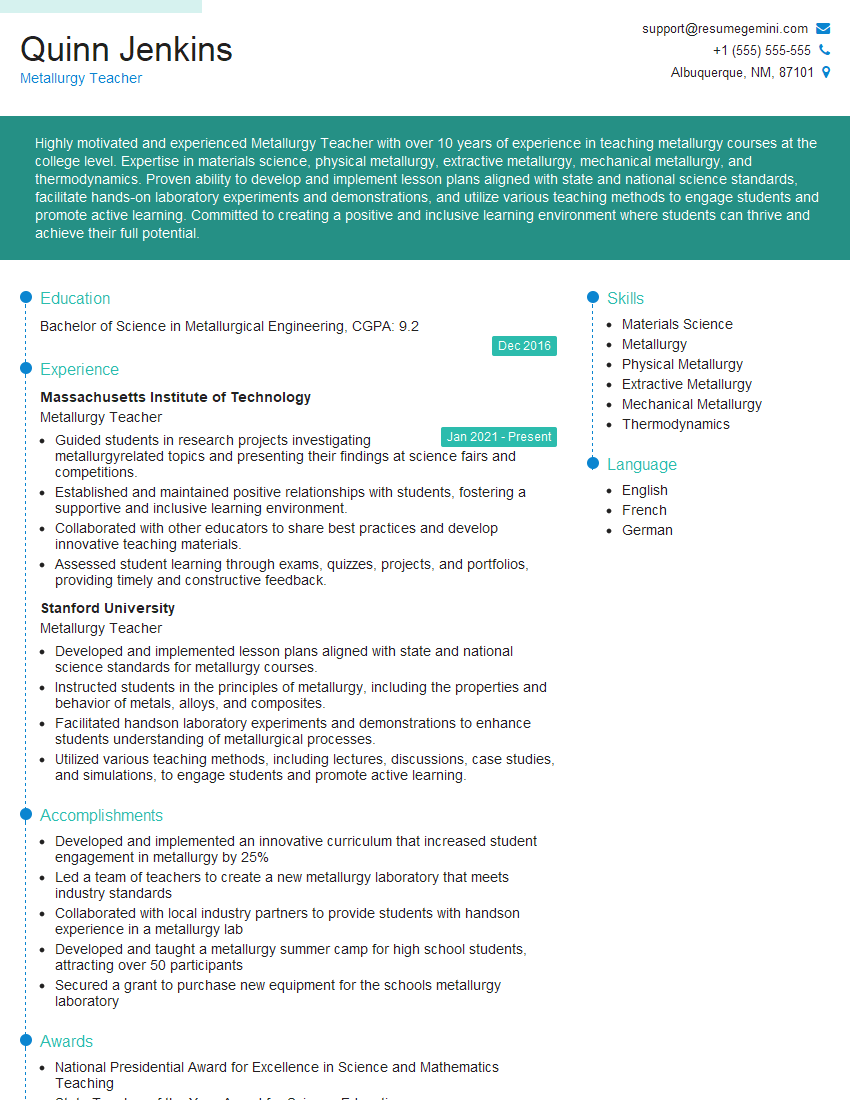
Acing the interview is crucial, but landing one requires a compelling resume that gets you noticed. Crafting a professional document that highlights your skills and experience is the first step toward interview success. ResumeGemini can help you build a standout resume that gets you called in for that dream job.






Essential Interview Questions For Metallurgy Teacher
1. What is the difference between ferrous and non-ferrous metals?
- Ferrous metals contain iron, while non-ferrous metals do not.
- Ferrous metals are magnetic, while non-ferrous metals are not.
- Ferrous metals are stronger than non-ferrous metals.
- Ferrous metals are more resistant to corrosion than non-ferrous metals.
- Ferrous metals are less expensive than non-ferrous metals.
2. What are the different types of steel?
Carbon steel
- Carbon steel is the most common type of steel.
- It contains up to 1.5% carbon.
- It is strong and hard, but brittle.
Alloy steel
- Alloy steel contains other elements in addition to iron and carbon.
- These elements can improve the strength, hardness, toughness, and corrosion resistance of the steel.
Stainless steel
- Stainless steel contains at least 10.5% chromium.
- It is highly resistant to corrosion and staining.
3. What are the different types of non-ferrous metals?
- Aluminum
- Copper
- Nickel
- Titanium
- Zinc
4. What are the properties of the different types of non-ferrous metals?
- Aluminum is lightweight, strong, and corrosion-resistant.
- Copper is an excellent conductor of heat and electricity.
- Nickel is strong, hard, and corrosion-resistant.
- Titanium is lightweight, strong, and corrosion-resistant.
- Zinc is a good conductor of heat and electricity.
5. How are the different types of non-ferrous metals used?
- Aluminum is used in a wide variety of applications, including construction, transportation, and packaging.
- Copper is used in electrical wiring, plumbing, and roofing.
- Nickel is used in coins, batteries, and jewelry.
- Titanium is used in aerospace, medical, and chemical applications.
- Zinc is used in galvanizing, batteries, and roofing.
6. What are the different ways to shape and form metals?
- Casting
- Forging
- Rolling
- Extrusion
- Drawing
7. What are the different types of welding processes?
- Arc welding
- Gas welding
- Resistance welding
- Solid-state welding
8. What are the different types of heat treatment processes?
- Annealing
- Normalizing
- Hardening
- Tempering
9. What are the different types of metalworking machines?
- Lathes
- Mills
- Drills
- Grinders
- Saws
10. What are the different types of metalworking tools?
- Cutting tools
- Forming tools
- Measuring tools
- Finishing tools
Interviewers often ask about specific skills and experiences. With ResumeGemini‘s customizable templates, you can tailor your resume to showcase the skills most relevant to the position, making a powerful first impression. Also check out Resume Template specially tailored for Metallurgy Teacher.
Career Expert Tips:
- Ace those interviews! Prepare effectively by reviewing the Top 50 Most Common Interview Questions on ResumeGemini.
- Navigate your job search with confidence! Explore a wide range of Career Tips on ResumeGemini. Learn about common challenges and recommendations to overcome them.
- Craft the perfect resume! Master the Art of Resume Writing with ResumeGemini’s guide. Showcase your unique qualifications and achievements effectively.
- Great Savings With New Year Deals and Discounts! In 2025, boost your job search and build your dream resume with ResumeGemini’s ATS optimized templates.
Researching the company and tailoring your answers is essential. Once you have a clear understanding of the Metallurgy Teacher‘s requirements, you can use ResumeGemini to adjust your resume to perfectly match the job description.
Key Job Responsibilities
Metallurgy Teachers are responsible for instructing and guiding students in the study of metallurgy, the science and technology of metals. Their key job responsibilities include:1. Classroom Instruction
Plan, prepare, and deliver engaging and informative lessons on various metallurgical topics such as properties of metals, alloy design, and manufacturing processes.
- Utilize various teaching methods and resources (e.g., lectures, demonstrations, hands-on experiments) to cater to diverse learning styles.
- Assess student understanding through regular assignments, quizzes, and exams.
2. Curriculum Development
Collaborate with other teachers and subject matter experts to develop and revise the metallurgy curriculum.
- Incorporate new research advancements and industry best practices to ensure the curriculum is up-to-date and relevant to the field.
- Identify and implement resources to support student learning and engagement.
3. Practical Experience
Provide students with hands-on experiences in metallurgical laboratories and workshops.
- Supervise students in conducting experiments, testing procedures, and using specialized equipment.
- Guide students in applying theoretical knowledge to practical applications.
4. Student Development
Foster a positive and inclusive learning environment that supports student growth and achievement.
- Provide individual guidance and mentorship to students.
- Motivate and inspire students to pursue further education and careers in metallurgy.
Interview Tips
1. Research the School and Position
Thoroughly research the school, its academic offerings, and the specific role you’re applying for. This will help you tailor your responses to the interviewer’s questions and demonstrate your interest in the position.
- Visit the school’s website and social media pages.
- Read the job description carefully and identify key qualifications.
2. Showcase Your Passion for Metallurgy
During the interview, convey your passion for metallurgy and why you’re eager to share your knowledge with students.
- Prepare examples of your research, publications, or teaching experiences that highlight your expertise.
- Emphasize your ability to connect with students and make complex concepts accessible.
3. Highlight Your Teaching Skills
Demonstrate your strong teaching skills and classroom management abilities.
- Provide examples of your effective lesson planning, diverse teaching methods, and assessment techniques.
- Share your strategies for creating a positive learning environment and motivating students.
4. Emphasize Your Communication and Interpersonal Skills
Highlight your strong communication and interpersonal skills, which are essential for effective teaching.
- Demonstrate your ability to clearly convey complex metallurgical concepts to students of varying backgrounds.
- Emphasize your collaborative nature and ability to work well with students, colleagues, and parents.
5. Practice Your Answers
Take time to prepare and practice your answers to potential interview questions. This will help you feel confident and articulate your thoughts clearly during the interview.
- Consider using the STAR method (Situation, Task, Action, Result) to structure your responses.
- Get feedback from a friend, family member, or career counselor on your answers.
Next Step:
Now that you’re armed with interview-winning answers and a deeper understanding of the Metallurgy Teacher role, it’s time to take action! Does your resume accurately reflect your skills and experience for this position? If not, head over to ResumeGemini. Here, you’ll find all the tools and tips to craft a resume that gets noticed. Don’t let a weak resume hold you back from landing your dream job. Polish your resume, hit the “Build Your Resume” button, and watch your career take off! Remember, preparation is key, and ResumeGemini is your partner in interview success.