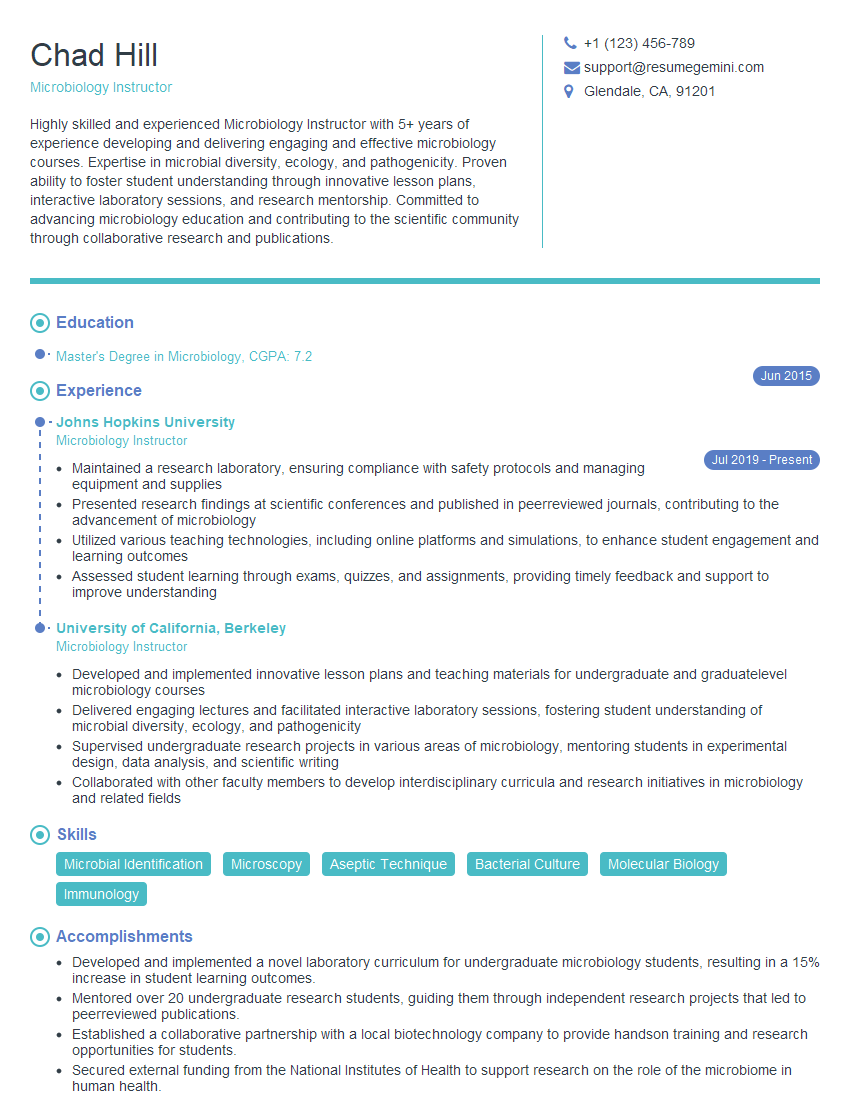
Feeling lost in a sea of interview questions? Landed that dream interview for Microbiology Instructor but worried you might not have the answers? You’re not alone! This blog is your guide for interview success. We’ll break down the most common Microbiology Instructor interview questions, providing insightful answers and tips to leave a lasting impression. Plus, we’ll delve into the key responsibilities of this exciting role, so you can walk into your interview feeling confident and prepared.
Acing the interview is crucial, but landing one requires a compelling resume that gets you noticed. Crafting a professional document that highlights your skills and experience is the first step toward interview success. ResumeGemini can help you build a standout resume that gets you called in for that dream job.






Essential Interview Questions For Microbiology Instructor
1. How would you describe the role of microbial diversity in maintaining ecosystem stability?
Maintain ecosystem stability by:
- Decomposing organic matter and releasing nutrients back into the environment.
- Cycling essential elements, such as carbon, nitrogen, and phosphorus.
- Providing food and habitat for other organisms.
- Regulating the population size of pathogens and pests.
- Producing antibiotics and other antimicrobial compounds that protect against disease.
2. Explain the Gram staining technique and its significance in microbiology.
Principle
- Gram-positive bacteria have a thick peptidoglycan layer and retain the crystal violet-iodine complex.
- Gram-negative bacteria have a thin peptidoglycan layer and do not retain the crystal violet-iodine complex.
Significance
- Differentiate between Gram-positive and Gram-negative bacteria, which have different cell wall structures and antimicrobial susceptibilities.
- Aid in the identification and classification of bacteria.
- Help determine the appropriate antibiotics for treating bacterial infections.
3. Discuss the different methods used for the cultivation and isolation of microorganisms.
- Streak plate method: Isolates pure colonies by streaking a sample onto a sterile agar plate.
- Pour plate method: Mixes the sample with molten agar and pours it into a petri dish, allowing colonies to develop within the agar.
- Spread plate method: Spreads a sample onto the surface of a sterile agar plate.
- Filtration method: Filters the sample through a membrane filter and incubates the filter on a selective agar to isolate specific microorganisms.
- Enrichment culture method: Enriches for specific microorganisms by providing selective growth conditions.
4. Describe the techniques used for the characterization and identification of microorganisms.
- Morphological characterization: Colony morphology, cell shape, and staining properties.
- Biochemical characterization: Tests for the presence or absence of specific enzymes or metabolic pathways.
- Molecular characterization: DNA sequencing, PCR, and genotyping.
- Serological characterization: Use of antibodies to identify specific antigens on the surface of microorganisms.
5. Explain the concept of antimicrobial resistance and discuss the mechanisms by which bacteria develop resistance.
Concept of Antimicrobial Resistance:- Bacteria develop resistance to antimicrobial agents, making them ineffective at treating infections.
- Efflux pumps: Expel antimicrobial agents from the cell.
- Target modification: Alter the target site of the antimicrobial agent, preventing it from binding and inhibiting the target enzyme.
- Enzyme modification: Modify the antimicrobial agent, making it ineffective.
- Bypass mechanisms: Develop alternative pathways or enzymes to bypass the antimicrobial agent’s target.
6. Describe the different types of host-microbe interactions and provide examples of each.
- Mutualism: Both the host and the microbe benefit from the interaction (e.g., nitrogen-fixing bacteria in plant roots).
- Commensalism: The microbe benefits from the interaction, but the host is neither harmed nor benefited (e.g., commensal bacteria on the skin).
- Parasitism: The microbe benefits from the interaction, while the host is harmed (e.g., pathogenic bacteria causing infections).
- Amensalism: The microbe harms the host, but is not affected by the interaction (e.g., antibiotic-producing bacteria inhibiting the growth of other bacteria).
7. Explain the concept of bioremediation and discuss its applications in environmental cleanup.
Concept of Bioremediation:- Using microorganisms to break down and remove pollutants from the environment.
- Cleaning up oil spills.
- Treating wastewater and contaminated soil.
- Degrading toxic chemicals, such as pesticides and heavy metals.
8. Describe the different types of microscopy used in microbiology and discuss their applications.
- Bright-field microscopy: Transmits light through a specimen, providing a two-dimensional image.
- Phase-contrast microscopy: Highlights differences in refractive index within a specimen, enhancing the visibility of unstained cells.
- Fluorescence microscopy: Uses fluorescent dyes to label specific structures or molecules in the cell.
- Confocal microscopy: Scans the specimen layer by layer, providing a three-dimensional image with increased resolution and depth of field.
- Electron microscopy: Uses an electron beam to provide extremely high-resolution images of the cell’s ultrastructure.
9. Discuss the role of microorganisms in the production of antibiotics and other antimicrobial compounds.
- Microorganisms produce a wide range of antimicrobial compounds, including antibiotics, antifungals, and antivirals.
- These compounds are used to treat infections and inhibit the growth of harmful microorganisms.
- Microorganisms can be used in the fermentation process to produce antibiotics on a large scale.
10. Explain the concept of microbial pathogenesis and discuss the different virulence factors associated with microorganisms.
Concept of Microbial Pathogenesis:- Process by which microorganisms cause disease.
- Adhesion factors: Allow microorganisms to attach to host cells.
- Invasion factors: Enable microorganisms to enter host cells.
- Toxins: Damage host cells or tissues.
- Immune evasion factors: Help microorganisms avoid detection and destruction by the host’s immune system.
Interviewers often ask about specific skills and experiences. With ResumeGemini‘s customizable templates, you can tailor your resume to showcase the skills most relevant to the position, making a powerful first impression. Also check out Resume Template specially tailored for Microbiology Instructor.
Career Expert Tips:
- Ace those interviews! Prepare effectively by reviewing the Top 50 Most Common Interview Questions on ResumeGemini.
- Navigate your job search with confidence! Explore a wide range of Career Tips on ResumeGemini. Learn about common challenges and recommendations to overcome them.
- Craft the perfect resume! Master the Art of Resume Writing with ResumeGemini’s guide. Showcase your unique qualifications and achievements effectively.
- Great Savings With New Year Deals and Discounts! In 2025, boost your job search and build your dream resume with ResumeGemini’s ATS optimized templates.
Researching the company and tailoring your answers is essential. Once you have a clear understanding of the Microbiology Instructor‘s requirements, you can use ResumeGemini to adjust your resume to perfectly match the job description.
Key Job Responsibilities
A Microbiology Instructor is responsible for teaching and guiding students in the field of microbiology. Their key responsibilities include:
1. Teaching Microbiology Courses
Develop and deliver engaging lectures, labs, and discussions on various microbiology topics, including microbial structure, function, and diversity.
- Plan and organize course content in accordance with academic standards.
- Utilize effective teaching methods to cater to diverse learning styles.
2. Grading and Assessment
Evaluate student performance through exams, assignments, and presentations.
- Provide timely and constructive feedback to help students improve their understanding.
- Maintain accurate student records and grades.
3. Laboratory Management
Oversee microbiology laboratory operations, ensuring a safe and productive learning environment.
- Supervise students in lab experiments, providing guidance and troubleshooting assistance.
- Maintain and calibrate laboratory equipment.
4. Research and Scholarship
Conduct research in microbiology, staying abreast of the latest scientific advancements.
- Publish research findings in peer-reviewed journals and present at conferences.
- Engage in professional development to enhance teaching skills and knowledge.
Interview Tips
Preparing for a Microbiology Instructor interview requires a multifaceted approach. Here are some tips to help you ace the interview:
1. Research the Institution and Position
Familiarize yourself with the institution’s mission, values, and specific programs in microbiology. This knowledge will help you tailor your answers to demonstrate your alignment with the organization.
- Visit the institution’s website and social media pages for updates and insights.
- Review the job description thoroughly to grasp the exact responsibilities and expectations.
2. Highlight Your Teaching Philosophy and Skills
Emphasize your teaching philosophy, explaining your approach to engaging students and fostering their understanding.
- Provide specific examples of innovative teaching methods you have employed.
- Quantify your teaching success by sharing positive student feedback or evaluation results.
3. Demonstrate Your Laboratory Expertise
Highlight your proficiency in microbiology lab techniques and protocols.
- Describe your experience in handling and troubleshooting laboratory equipment.
- Discuss your knowledge of safety protocols and risk management in the laboratory.
4. Showcase Your Research and Scholarship
If applicable, mention any research or scholarly work you have undertaken in microbiology.
- Explain the significance of your research and its impact on the field.
- Demonstrate your ability to disseminate research findings through publications and presentations.
Next Step:
Armed with this knowledge, you’re now well-equipped to tackle the Microbiology Instructor interview with confidence. Remember, preparation is key. So, start crafting your resume, highlighting your relevant skills and experiences. Don’t be afraid to tailor your application to each specific job posting. With the right approach and a bit of practice, you’ll be well on your way to landing your dream job. Build your resume now from scratch or optimize your existing resume with ResumeGemini. Wish you luck in your career journey!