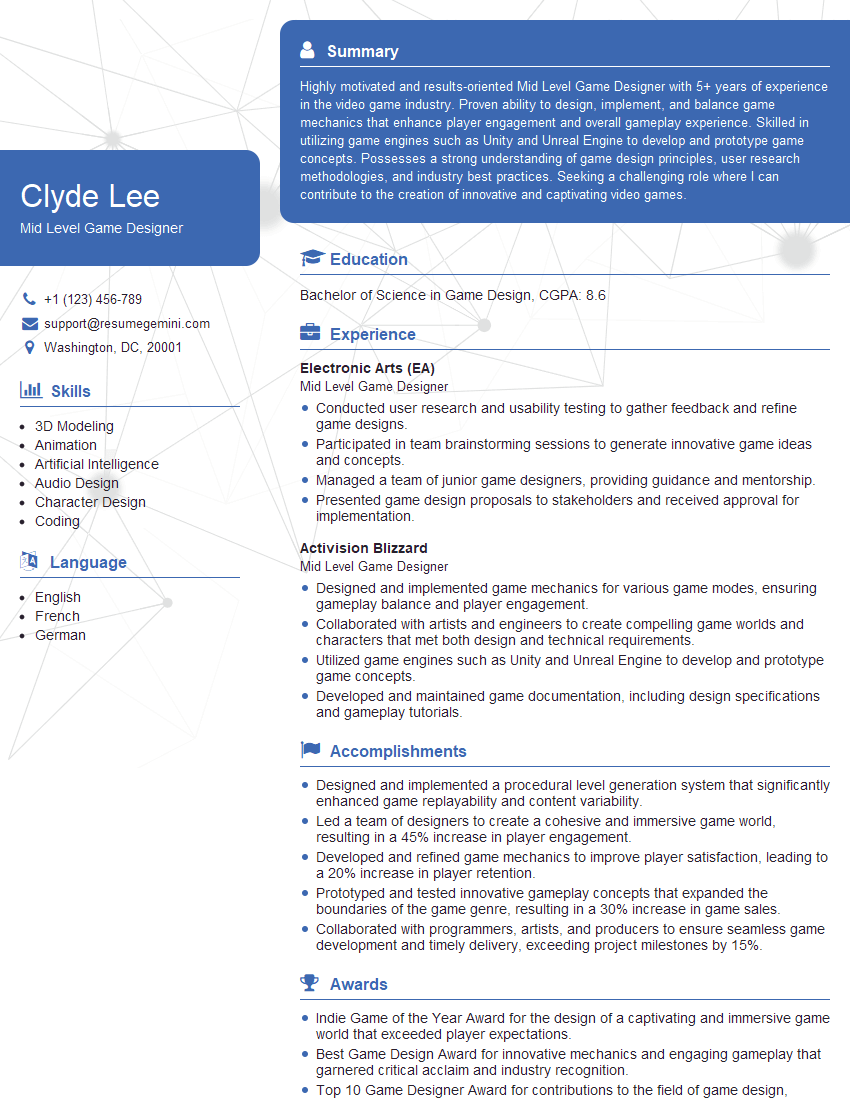
Ever felt underprepared for that crucial job interview? Or perhaps you’ve landed the interview but struggled to articulate your skills and experiences effectively? Fear not! We’ve got you covered. In this blog post, we’re diving deep into the Mid Level Game Designer interview questions that you’re most likely to encounter. But that’s not all. We’ll also provide expert insights into the key responsibilities of a Mid Level Game Designer so you can tailor your answers to impress potential employers.
Acing the interview is crucial, but landing one requires a compelling resume that gets you noticed. Crafting a professional document that highlights your skills and experience is the first step toward interview success. ResumeGemini can help you build a standout resume that gets you called in for that dream job.






Essential Interview Questions For Mid Level Game Designer
1. What are the key principles of game design and how do you apply them in your work?
– Game Design Principles: – Fun and Engaging Gameplay – Clear and Intuitive User Interface – Balanced and Rewarding Progression – Immersive and Thematic Storytelling – Optimization for Target Platform – Application in My Work: – I prioritize user enjoyment by integrating feedback loops and establishing a sense of accomplishment. – I ensure ease of use and clarity by conducting thorough user testing and employing intuitive controls. – I meticulously balance difficulty and reward to foster player engagement and a sense of progression. – I craft compelling narratives and environments that immerse players in the game world. – I optimize game performance across various platforms, ensuring a seamless user experience.
2. How do you approach level design, considering factors such as pacing, variety, and player engagement?
Level Design Methodology
- Establish clear objectives and identify key gameplay elements.
- Create a layout that facilitates player progression and encourages exploration.
- Incorporate environmental storytelling to enhance immersion and provide context.
Pacing and Variety
- Vary level pacing to create a sense of rhythm and prevent monotony.
- Introduce diverse gameplay mechanics and environmental challenges to maintain player engagement.
Player Engagement
- Design puzzles and challenges that stimulate critical thinking and problem-solving.
- Incorporate hidden secrets and collectibles to encourage exploration and reward curiosity.
3. Describe your experience in creating and implementing game mechanics, and how you ensure they align with the overall game design vision.
– Game Mechanics Development: – I possess a deep understanding of game mechanics and their impact on gameplay. – I employ prototyping and iterative design to refine mechanics and ensure they are fun and engaging. – Alignment with Game Vision: – I collaborate closely with the game designer to ensure mechanics align with the overall vision and narrative. – I consider the target audience and their expectations when designing mechanics. – Example: – In a stealth game, I designed a “shadow detection” mechanic that enhanced the gameplay loop by encouraging players to navigate the environment strategically.
4. How do you utilize playtesting and feedback to improve your designs, and what methods have you found most effective?
– Playtesting Methods: – Closed alpha and beta testing – Focus groups and user interviews – Feedback Analysis: – I gather both qualitative (comments) and quantitative (data) feedback. – I categorize and prioritize feedback based on its potential impact on gameplay. – Design Improvements: – I iterate on designs based on feedback, often using agile development methodologies. – I implement changes that enhance gameplay, usability, or other aspects of the design.
5. Discuss your experience with game narrative and how you integrate it into your designs to create immersive and compelling experiences.
– Narrative Design Principles: – Unity of Plot: Maintaining a coherent and logical story arc. – Character Development: Creating relatable and memorable characters. – Worldbuilding: Crafting a believable and engaging setting. – Integration into Game Design: – Incorporating narrative elements into gameplay mechanics (e.g., puzzles, quests). – Using environmental storytelling to convey backstory and lore. – Employing cutscenes and dialogue to advance the narrative. – Example: – I designed a game where players uncover a conspiracy by interacting with environmental clues and solving narrative-driven puzzles.
6. Describe your process for creating and balancing in-game economies, including factors such as resource allocation, pricing, and player incentives.
– Economy Design: – I establish a clear economic system that defines resource allocation and pricing. – I consider factors such as supply and demand, player progression, and in-game rewards. – Balancing: – I monitor player behavior and economic data to identify imbalances. – I adjust resource availability, pricing, and rewards based on analysis to ensure a fair and engaging experience. – Incentives: – I design incentives that encourage players to participate in the economy and achieve game objectives. – I reward players for economic activities, such as resource gathering and trading.
7. How do you approach the design of multiplayer experiences, considering factors such as communication, cooperation, and competition?
– Multiplayer Design Principles: – Player Communication: Implementing voice chat, text messaging, or other communication systems. – Cooperative Gameplay: Fostering teamwork and collaboration among players. – Competitive Gameplay: Creating systems for player-versus-player competition. – Example: – I designed a cooperative multiplayer shooter where players must communicate and work together to defeat enemy hordes.
8. Describe your technical skills and experience in game development tools and technologies, including scripting, level editing, and asset creation.
– Game Development Tools: – Scripting: Familiarity with game scripting languages (e.g., C#, Lua). – Level Editing: Proficiency in level design tools (e.g., Unity, Unreal Engine). – Asset Creation: Experience in creating game assets (e.g., models, textures). – Technical Skills: – Knowledge of game engines (e.g., Unity, Unreal Engine). – Understanding of game physics and AI systems. – Ability to optimize game performance for various platforms.
9. How do you stay up-to-date with the latest trends and best practices in game design?
– Professional Development: – Attendance at game industry conferences and workshops. – Subscription to industry publications and blogs. – Research and Analysis: – Investigation of successful games and their design principles. – Study of emerging technologies and their potential impact on game design. – Networking and Collaboration: – Involvement in online game development communities and forums. – Collaboration with other game designers to exchange ideas and learn from their experiences.
10. Describe a game you have played recently that you found particularly innovative and engaging, and explain what specific aspects of the design impressed you.
– Game Title: [Name of the game] – Innovative Aspects: – Unique gameplay mechanic or feature. – Immersive and memorable narrative or setting. – Innovative use of technology or game engine. – Reasons for Engagement: – How the game mechanics created a sense of fun and challenge. – How the narrative or setting drew you in and kept you engaged. – How the technical aspects enhanced the overall gaming experience.
Interviewers often ask about specific skills and experiences. With ResumeGemini‘s customizable templates, you can tailor your resume to showcase the skills most relevant to the position, making a powerful first impression. Also check out Resume Template specially tailored for Mid Level Game Designer.
Career Expert Tips:
- Ace those interviews! Prepare effectively by reviewing the Top 50 Most Common Interview Questions on ResumeGemini.
- Navigate your job search with confidence! Explore a wide range of Career Tips on ResumeGemini. Learn about common challenges and recommendations to overcome them.
- Craft the perfect resume! Master the Art of Resume Writing with ResumeGemini’s guide. Showcase your unique qualifications and achievements effectively.
- Great Savings With New Year Deals and Discounts! In 2025, boost your job search and build your dream resume with ResumeGemini’s ATS optimized templates.
Researching the company and tailoring your answers is essential. Once you have a clear understanding of the Mid Level Game Designer‘s requirements, you can use ResumeGemini to adjust your resume to perfectly match the job description.
Key Job Responsibilities
A Mid Level Game Designer is responsible for designing and implementing game mechanics, levels, and characters. They work closely with other members of the development team to ensure that the game is fun, engaging, and polished.
1. Designing Game Mechanics
Mid Level Game Designers develop the core mechanics of the game, such as how the player interacts with the world, how enemies behave, and how the game progresses. They also design levels and challenges that are both fun and challenging.
- Design and implement game mechanics that are fun, engaging, and challenging.
- Create levels and challenges that are both enjoyable and difficult.
2. Creating Game Content
Mid Level Game Designers create the game’s content, such as characters, enemies, weapons, and items. They also design the game’s world and environment.
- Design and create game characters, enemies, weapons, and items.
- Design and create the game’s world and environment.
3. Collaborating with Other Developers
Mid Level Game Designers work closely with other members of the development team, such as programmers, artists, and producers. They collaborate to ensure that the game is developed on time and within budget.
- Collaborate with other members of the development team to ensure that the game is developed on time and within budget.
- Work with programmers to implement game mechanics.
- Work with artists to create game content.
- Work with producers to manage the development process.
4. Testing and Iterating
Mid Level Game Designers test the game throughout the development process to ensure that it is fun, engaging, and polished. They also iterate on the game’s design based on feedback from testers and players.
- Test the game throughout the development process to ensure that it is fun, engaging, and polished.
- Iterate on the game’s design based on feedback from testers and players.
Interview Tips
Preparing for an interview for a Mid Level Game Designer position can be daunting, but there are a few things you can do to increase your chances of success.
1. Research the Company and the Position
Before the interview, take some time to research the company and the specific position you are applying for. This will help you understand the company’s culture and values, as well as the specific skills and experience they are looking for in a Mid Level Game Designer.
- Visit the company’s website to learn about their history, products, and services.
- Read the job posting carefully and identify the key skills and experience required for the position.
- Research the company’s recent projects and games to get a sense of their design philosophy.
2. Practice Your Answers to Common Interview Questions
There are a few common questions that you are likely to be asked in an interview for a Mid Level Game Designer position. It is important to practice your answers to these questions so that you can deliver them confidently and concisely.
- Tell me about your experience in game design.
- What are your favorite games and why?
- How do you approach the design of a new game?
- What are your strengths and weaknesses as a game designer?
- Why are you interested in working for this company?
3. Prepare a Portfolio of Your Work
A portfolio is a great way to showcase your skills and experience as a game designer. It should include examples of your work, such as game designs, levels, and characters. Your portfolio should be well-organized and easy to navigate.
- Include examples of your best work in your portfolio.
- Organize your portfolio so that it is easy for the interviewer to find the information they are looking for.
- Be prepared to talk about your work in detail.
4. Dress Professionally and Arrive on Time
First impressions matter, so it is important to dress professionally and arrive on time for your interview. This shows the interviewer that you are serious about the position and that you respect their time.
- Wear a suit or business casual attire to the interview.
- Arrive on time for your interview.
- Be polite and respectful to the interviewer.
Next Step:
Now that you’re armed with interview-winning answers and a deeper understanding of the Mid Level Game Designer role, it’s time to take action! Does your resume accurately reflect your skills and experience for this position? If not, head over to ResumeGemini. Here, you’ll find all the tools and tips to craft a resume that gets noticed. Don’t let a weak resume hold you back from landing your dream job. Polish your resume, hit the “Build Your Resume” button, and watch your career take off! Remember, preparation is key, and ResumeGemini is your partner in interview success.