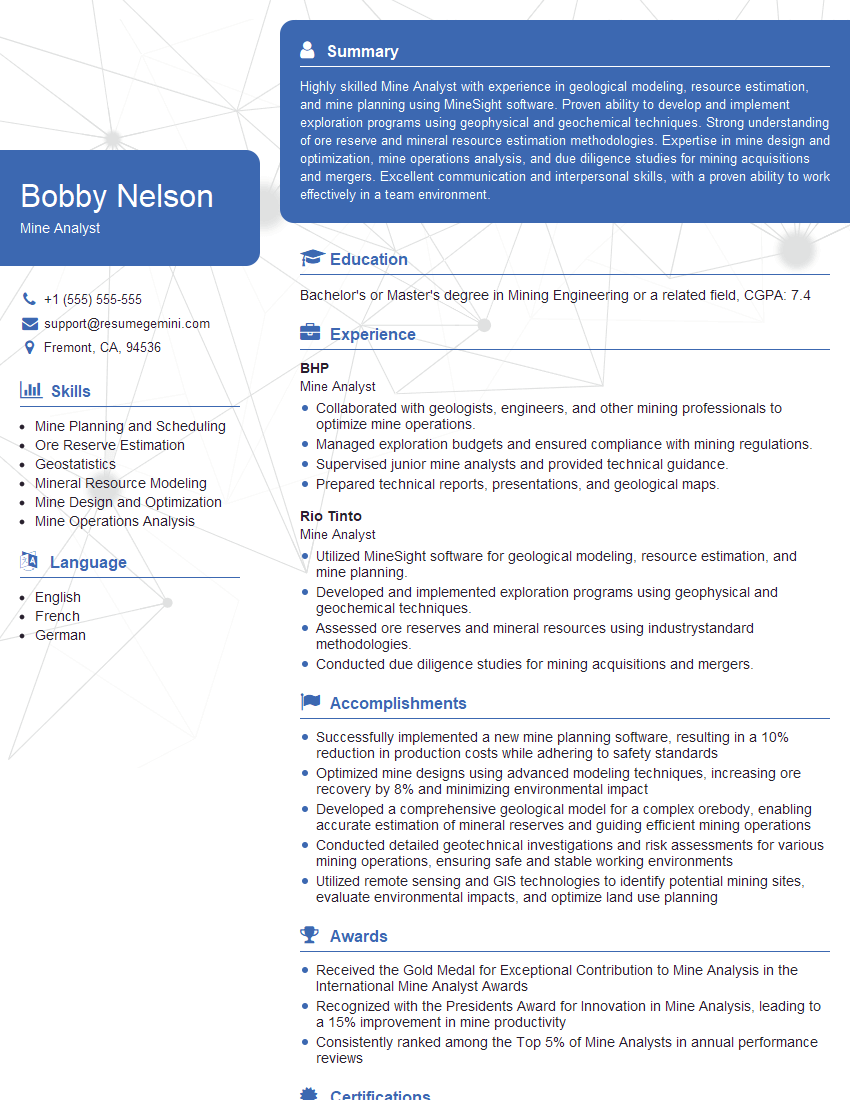
Are you gearing up for a career in Mine Analyst? Feeling nervous about the interview questions that might come your way? Don’t worry, you’re in the right place. In this blog post, we’ll dive deep into the most common interview questions for Mine Analyst and provide you with expert-backed answers. We’ll also explore the key responsibilities of this role so you can tailor your responses to showcase your perfect fit.
Acing the interview is crucial, but landing one requires a compelling resume that gets you noticed. Crafting a professional document that highlights your skills and experience is the first step toward interview success. ResumeGemini can help you build a standout resume that gets you called in for that dream job.






Essential Interview Questions For Mine Analyst
1. What is the difference between a drill hole and a drill core?
A drill hole is the opening made when drilling into the earth. A drill core is the cylindrical sample of rock that is retrieved from the drill hole using a core barrel.
2. What are the different types of drill rigs used in mining?
Rotary drill rigs
- Use a rotating bit to drill into the ground.
- Commonly used for drilling deep holes in hard rock.
Percussion drill rigs
- Use a hammer action to break the rock into small pieces.
- Commonly used for drilling shallow holes in soft rock or soil.
Auger drill rigs
- Use a continuous rotating auger to bore into the ground.
- Commonly used for drilling shallow holes in soft or sandy soils.
3. What is the purpose of a blasthole?
A blasthole is a hole drilled into the rock in order to place explosives. The explosives are used to break the rock into smaller pieces, making it easier to extract.
4. What is the role of a mine analyst?
A mine analyst is responsible for collecting, analyzing, and interpreting data related to the operation of a mine. This data can include information on geology, ore reserves, production, and costs. Mine analysts use this information to make recommendations on the best way to operate the mine and maximize its profitability.
5. What are the different methods used to estimate ore reserves?
Drill hole sampling
- Collects samples of rock from drill holes to determine the concentration of minerals.
- Commonly used for estimating ore reserves in hard rock mines.
Geostatistics
- Uses statistical methods to analyze the spatial distribution of minerals.
- Commonly used for estimating ore reserves in large, complex deposits.
Geological modeling
- Creates a 3D model of the ore deposit based on geological data.
- Commonly used for estimating ore reserves in complex deposits with high geological variability.
6. What are the different types of mining methods?
Open-pit mining
- Extracts ore from the surface of the earth.
- Commonly used for large, shallow deposits.
Underground mining
- Extracts ore from below the surface of the earth.
- Commonly used for deep deposits or deposits that are not suitable for open-pit mining.
Solution mining
- Uses a solvent to dissolve the ore from the rock.
- Commonly used for extracting minerals such as uranium and potash.
7. What are the different types of mining equipment?
Earthmoving equipment
- Used to move large quantities of earth and rock.
- Includes equipment such as bulldozers, excavators, and dump trucks.
Drilling equipment
- Used to drill holes into the rock.
- Includes equipment such as drill rigs, core barrels, and bits.
Blasting equipment
- Used to break rock into smaller pieces.
- Includes equipment such as explosives, detonators, and blasting mats.
8. What are the different types of mining hazards?
Geological hazards
- Include hazards such as rock falls, landslides, and earthquakes.
- Can be difficult to predict and control.
Mechanical hazards
- Include hazards such as equipment failures, electrical shocks, and fires.
- Can be prevented or mitigated through proper maintenance and safety procedures.
Chemical hazards
- Include hazards such as exposure to toxic chemicals, dust, and fumes.
- Can be prevented or mitigated through the use of personal protective equipment and ventilation systems.
9. What are the different types of mining regulations?
Safety regulations
- Focus on protecting the health and safety of miners.
- Include regulations on mine design, equipment, and work practices.
Environmental regulations
- Focus on protecting the environment from the impacts of mining.
- Include regulations on air and water pollution, land reclamation, and waste disposal.
Financial regulations
- Focus on ensuring that mining companies operate in a financially responsible manner.
- Include regulations on accounting, reporting, and taxation.
10. What is the future of mining?
The future of mining is likely to be characterized by several key trends, including:
- Increased automation and mechanization
- Greater use of data and technology
- A focus on sustainability and environmental protection
- Growing demand for critical minerals
Interviewers often ask about specific skills and experiences. With ResumeGemini‘s customizable templates, you can tailor your resume to showcase the skills most relevant to the position, making a powerful first impression. Also check out Resume Template specially tailored for Mine Analyst.
Career Expert Tips:
- Ace those interviews! Prepare effectively by reviewing the Top 50 Most Common Interview Questions on ResumeGemini.
- Navigate your job search with confidence! Explore a wide range of Career Tips on ResumeGemini. Learn about common challenges and recommendations to overcome them.
- Craft the perfect resume! Master the Art of Resume Writing with ResumeGemini’s guide. Showcase your unique qualifications and achievements effectively.
- Great Savings With New Year Deals and Discounts! In 2025, boost your job search and build your dream resume with ResumeGemini’s ATS optimized templates.
Researching the company and tailoring your answers is essential. Once you have a clear understanding of the Mine Analyst‘s requirements, you can use ResumeGemini to adjust your resume to perfectly match the job description.
Key Job Responsibilities
Mine Analysts are responsible for various aspects of mine planning and operations, ensuring efficient and profitable extraction of minerals.
1. Mine Planning and Design
Conduct geological studies and data analysis to assess ore reserves and develop mine plans.
- Interpret geological data to determine the location, size, and quality of ore deposits.
- Design mining methods and equipment to optimize extraction efficiency.
2. Production Monitoring and Optimization
Monitor mining operations and collect data to assess performance and identify areas for improvement.
- Analyze production data to identify bottlenecks and inefficiencies.
- Recommend changes to mining processes to increase output and reduce costs.
3. Financial Analysis and Planning
Conduct financial analysis and develop budgets to ensure the profitability of mining operations.
- Estimate capital and operating costs associated with mining operations.
- Evaluate the economic feasibility of new projects and investments.
4. Environmental Management and Compliance
Ensure compliance with environmental regulations and implement sustainable practices in mining operations.
- Develop and implement environmental management plans.
- Monitor environmental impacts and identify measures to mitigate risks.
Interview Tips
Preparing thoroughly for a Mine Analyst interview can increase your chances of success.
1. Research the Company and Role
Thoroughly research the mining company and the specific role you are applying for.
- Review the company’s website, social media, and industry news to gain insights into its operations and culture.
- Identify the key responsibilities and requirements of the Mine Analyst position and tailor your answers accordingly.
2. Showcase Your Technical Expertise
Demonstrate your understanding of mining principles, data analysis, and financial modeling.
- Provide examples of your work experience or academic projects that highlight your proficiency in these areas.
- Be prepared to discuss your knowledge of mining software and tools.
3. Highlight Your Analytical and Problem-Solving Skills
Emphasize your ability to analyze data, identify trends, and solve problems effectively.
- Describe instances where you successfully analyzed data to find solutions to complex issues.
- Share examples of your creative or innovative approaches to problem-solving.
4. Communicate Your Industry Knowledge and Passion
Demonstrate your enthusiasm for the mining industry and your commitment to safety and sustainability.
- Discuss your understanding of current industry trends and challenges.
- Explain your motivations for pursuing a career as a Mine Analyst.
Next Step:
Armed with this knowledge, you’re now well-equipped to tackle the Mine Analyst interview with confidence. Remember, preparation is key. So, start crafting your resume, highlighting your relevant skills and experiences. Don’t be afraid to tailor your application to each specific job posting. With the right approach and a bit of practice, you’ll be well on your way to landing your dream job. Build your resume now from scratch or optimize your existing resume with ResumeGemini. Wish you luck in your career journey!