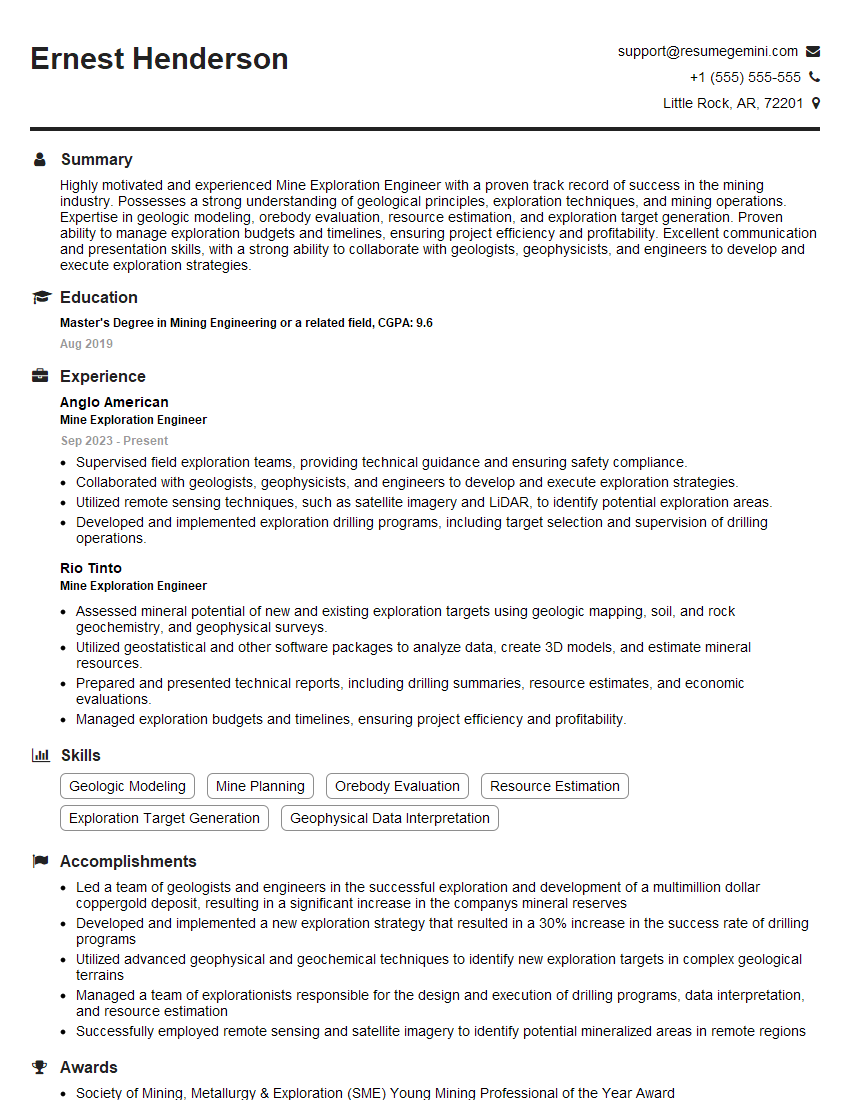
Feeling lost in a sea of interview questions? Landed that dream interview for Mine Exploration Engineer but worried you might not have the answers? You’re not alone! This blog is your guide for interview success. We’ll break down the most common Mine Exploration Engineer interview questions, providing insightful answers and tips to leave a lasting impression. Plus, we’ll delve into the key responsibilities of this exciting role, so you can walk into your interview feeling confident and prepared.
Acing the interview is crucial, but landing one requires a compelling resume that gets you noticed. Crafting a professional document that highlights your skills and experience is the first step toward interview success. ResumeGemini can help you build a standout resume that gets you called in for that dream job.






Essential Interview Questions For Mine Exploration Engineer
1. Describe the process of geological mapping in mineral exploration?
Geological mapping is a fundamental process in mineral exploration as it provides a detailed understanding of the geological context of a potential deposit.
- Data Collection: Geological mapping involves collecting data on rock types, structures, and mineralization through field observations and sample collection.
- Data Interpretation: The collected data is interpreted to determine the geological history, structure, and potential mineralization of the area.
- Map Creation: The interpreted data is presented on a geological map that shows the distribution and relationships of different rock units, structures, and mineral occurrences.
- Exploration Planning: Geological maps serve as a basis for planning and guiding further exploration activities, such as geochemical surveys, geophysical surveys, and drilling.
2. Explain the different methods of geophysical exploration used in mineral exploration?
Seismic Refraction
- Measure the travel time of seismic waves through different layers of rock
- Detect structural features such as faults and folds
Gravity Surveying
- Measure variations in Earth’s gravitational field
- Identify density contrasts associated with mineralized bodies
Magnetic Surveying
- Measure variations in Earth’s magnetic field
- Detect magnetic minerals such as magnetite and pyrrhotite
Electromagnetic Surveying
- Measure the conductivity of the subsurface
- Detect conductive mineralization such as massive sulphides
3. How do you design and implement a geochemical exploration program?
Designing a geochemical exploration program involves several steps:
- Define Exploration Objectives: Clearly identify the target mineralization and geological setting.
- Sample Collection: Select appropriate sample media (e.g., soil, rocks, stream sediments) and determine sampling density and locations.
- Analytical Methods: Choose suitable analytical techniques based on target elements and expected concentrations.
- Data Interpretation: Apply statistical and geochemical techniques to identify anomalous areas and potential mineralization.
- Follow-up Exploration: Based on geochemical results, plan follow-up activities such as geological mapping, geophysical surveys, or drilling.
4. Discuss the challenges and limitations of using geophysical methods in mining exploration?
Geophysical methods have limitations and challenges in mining exploration:
- Subsurface Complexity: Geological structures and mineralization can be complex and difficult to interpret.
- Environmental Factors: Weather, terrain, and cultural noise can interfere with data acquisition.
- Resolution and Depth Penetration: Different methods have varying resolution and depth penetration capabilities.
- Cost and Logistics: Acquiring and interpreting geophysical data can be expensive and logistically challenging.
- Integration with Other Data: Geophysical data needs to be integrated with geological and geochemical information for comprehensive interpretation.
5. Explain the role of drilling in mineral exploration and describe different drilling methods?
Drilling is a crucial technique in mineral exploration as it provides physical samples for analysis and geological information.
- Exploration Drilling: Used to locate and define the extent of mineralized zones.
- Resource Definition Drilling: Provides samples for resource estimation and reserve calculations.
- Geotechnical Drilling: Investigates ground conditions for mine planning and design.
Drilling Methods:
- Rotary Drilling: Uses a rotating drill bit to penetrate rock.
- Percussion Drilling: Employs a hammering action to break rock.
- Core Drilling: Retrieves cylindrical rock samples (cores) for detailed analysis.
- Reverse Circulation Drilling: Circulates drilling fluid in reverse to carry cuttings to the surface.
6. Describe the process of mineral resource estimation and its importance in mining exploration?
Mineral resource estimation is a critical step in mining exploration as it quantifies the economic potential of a mineral deposit.
- Data Collection: Includes geological mapping, drilling data, and assay results.
- Geological Modeling: Creating a geological model of the mineralized zone based on drillhole data and geological interpretation.
- Grade Estimation: Assigning mineral grades to blocks within the geological model using statistical methods.
- Tonnage Calculation: Estimating the volume of each block and multiplying it by its assigned grade to calculate the tonnage of the mineral.
- Classification: Assigning confidence categories to the estimated resources based on data quality and geological uncertainty.
7. Discuss the environmental considerations and regulations relevant to mining exploration activities?
Mining exploration activities can have environmental impacts, and adhering to regulations is crucial.
- Land Use and Permitting: Obtaining necessary permits and managing land use to minimize disturbance.
- Water Management: Minimizing water usage, preventing contamination, and managing wastewater.
- Air Quality: Controlling dust and emissions from drilling and other activities.
- Wildlife Protection: Assessing potential impacts on wildlife and implementing mitigation measures.
- Rehabilitation and Closure: Planning for site restoration and minimizing long-term environmental impacts.
8. Explain the role of technology in advancing mineral exploration techniques?
Technology plays a significant role in enhancing mineral exploration:
- Data Acquisition and Management: Portable devices and software for efficient data collection and management.
- Geophysical Interpretation: Advanced software for processing and interpreting geophysical data.
- Geological Modeling: 3D modeling and visualization tools for creating detailed geological models.
- Grade Estimation: Machine learning algorithms for improving grade estimation accuracy.
- Resource Estimation: Specialized software for calculating mineral resources and reserves.
9. Describe the key responsibilities and skills required for a successful Mine Exploration Engineer?
Responsibilities:
- Plan and execute mineral exploration programs
- Interpret geological data and geophysical surveys
- Design and supervise drilling programs
- Estimate mineral resources and reserves
- Manage exploration budgets and timelines
Skills:
- Excellent geological knowledge
- Strong understanding of mining exploration techniques
- Proficient in data analysis and interpretation
- Effective communication and presentation skills
- Ability to work independently and as part of a team
10. How do you stay updated with the latest advancements in mineral exploration technology?
To stay updated, I actively engage in:
- Attending industry conferences and workshops
- Reading scientific journals and technical papers
- Participating in online forums and discussion groups
- Collaborating with researchers and other professionals
- Exploring emerging technologies through industry publications and online resources
Interviewers often ask about specific skills and experiences. With ResumeGemini‘s customizable templates, you can tailor your resume to showcase the skills most relevant to the position, making a powerful first impression. Also check out Resume Template specially tailored for Mine Exploration Engineer.
Career Expert Tips:
- Ace those interviews! Prepare effectively by reviewing the Top 50 Most Common Interview Questions on ResumeGemini.
- Navigate your job search with confidence! Explore a wide range of Career Tips on ResumeGemini. Learn about common challenges and recommendations to overcome them.
- Craft the perfect resume! Master the Art of Resume Writing with ResumeGemini’s guide. Showcase your unique qualifications and achievements effectively.
- Great Savings With New Year Deals and Discounts! In 2025, boost your job search and build your dream resume with ResumeGemini’s ATS optimized templates.
Researching the company and tailoring your answers is essential. Once you have a clear understanding of the Mine Exploration Engineer‘s requirements, you can use ResumeGemini to adjust your resume to perfectly match the job description.
Key Job Responsibilities
Mine Exploration Engineers play a crucial role in identifying and evaluating potential mineral deposits. Their responsibilities encompass various aspects of mineral exploration, including:
1. Geological Exploration
Conduct geological surveys and mapping to identify prospective areas for mineral deposits.
- Collect and analyze geological data (e.g., rock samples, drill cores) to determine mineral potential.
- Use geophysical and geochemical techniques to enhance geological understanding.
2. Exploration Planning and Design
Develop and execute exploration plans, including budget and timeline.
- Design and oversee exploration programs (e.g., drilling, trenching, sampling).
- Interpret exploration results and make recommendations for further exploration or resource development.
3. Resource Estimation and Modeling
Estimate mineral reserves and resources using geological data and statistical methods.
- Create geological models and apply geostatistical techniques to determine deposit size, grade, and distribution.
- Prepare technical reports summarising exploration findings.
4. Project Management
Manage exploration projects, ensuring timelines and budgets are met.
- Supervise exploration teams and coordinate with contractors and consultants.
- Oversee environmental compliance and safety protocols.
Interview Tips
To ace an interview for a Mine Exploration Engineer position, candidates should:
1. Research the Company and Role
Familiarise themselves with the company’s operations, projects, and values.
- Demonstrate an understanding of the role’s responsibilities and how they align with their skills.
- Prepare questions about the company’s exploration strategies and future plans.
2. Highlight Relevant Experience and Skills
Emphasise their experience in geological exploration, resource estimation, and project management.
- Quantify their accomplishments and provide specific examples of their contributions.
- Discuss their proficiency in geological mapping, data analysis, and exploration software.
3. Showcase Technical Expertise
Demonstrate their understanding of exploration techniques, geological concepts, and resource estimation methodologies.
- Describe their approach to geological data interpretation and model building.
- Discuss recent advancements in exploration technology and how they have applied them.
4. Convey Communication and Collaboration Skills
Emphasise their ability to communicate technical information clearly and effectively.
- Describe their experience working in a team environment and managing stakeholders.
- Highlight their ability to present findings and recommendations to technical and non-technical audiences.
Next Step:
Armed with this knowledge, you’re now well-equipped to tackle the Mine Exploration Engineer interview with confidence. Remember, a well-crafted resume is your first impression. Take the time to tailor your resume to highlight your relevant skills and experiences. And don’t forget to practice your answers to common interview questions. With a little preparation, you’ll be on your way to landing your dream job. So what are you waiting for? Start building your resume and start applying! Build an amazing resume with ResumeGemini.