Feeling lost in a sea of interview questions? Landed that dream interview for Motorcyclist but worried you might not have the answers? You’re not alone! This blog is your guide for interview success. We’ll break down the most common Motorcyclist interview questions, providing insightful answers and tips to leave a lasting impression. Plus, we’ll delve into the key responsibilities of this exciting role, so you can walk into your interview feeling confident and prepared.
Acing the interview is crucial, but landing one requires a compelling resume that gets you noticed. Crafting a professional document that highlights your skills and experience is the first step toward interview success. ResumeGemini can help you build a standout resume that gets you called in for that dream job.






Essential Interview Questions For Motorcyclist
1. What are the key components of a motorcycle engine?
- Cylinder
- Piston
- Connecting rod
- Crankshaft
- Valves
- Camshaft
- Oil pump
- Fuel injection system
- Ignition system
2. How does a motorcycle transmission work?
Manual transmission
- Uses a clutch to disconnect the engine from the transmission.
- The rider selects the gear by moving the shift lever.
- The transmission uses gears to change the speed and torque of the output.
Automatic transmission
- Uses a torque converter to connect the engine to the transmission.
- The torque converter uses hydraulic fluid to transfer power.
- The transmission uses planetary gears to change the speed and torque of the output.
3. What are the different types of motorcycle suspension systems?
- Telescopic forks: Use a spring and damper to absorb bumps.
- Monoshock: Uses a single shock absorber to absorb bumps.
- Dual shock: Uses two shock absorbers to absorb bumps.
- Air suspension: Uses air pressure to absorb bumps.
4. What are the different types of motorcycle brakes?
- Disc brakes: Use a caliper to squeeze a disc rotor.
- Drum brakes: Use shoes to press against a drum.
- Linked brakes: Connect the front and rear brakes to provide increased braking power.
- Anti-lock brakes (ABS): Use sensors to prevent the wheels from locking up during braking.
5. What are the most important safety features on a motorcycle?
- Helmet: Protects the rider’s head in the event of a crash.
- Eye protection: Protects the rider’s eyes from wind, dust, and debris.
- Gloves: Protect the rider’s hands from wind, cold, and road rash.
- Jacket: Protects the rider’s body from wind, cold, and road rash.
- Pants: Protect the rider’s legs from wind, cold, and road rash.
- Boots: Protect the rider’s feet from wind, cold, and road rash.
6. What is the most important thing to keep in mind when riding a motorcycle?
- Be aware of your surroundings: Always be aware of the traffic around you and be prepared to react to unexpected events.
- Ride defensively: Always assume that other drivers do not see you and ride accordingly.
- Obey the speed limit: Speeding is one of the leading causes of motorcycle accidents.
- Avoid riding under the influence of alcohol or drugs: Alcohol and drugs impair your judgment and reaction time.
- Wear proper safety gear: Always wear a helmet and other protective gear when riding a motorcycle.
7. What is the difference between a sportbike and a cruiser?
Sportbike
- Designed for speed and performance.
- Has a powerful engine.
- Has a lightweight frame.
- Has a low center of gravity.
- Has a high seat height.
- Has clip-on handlebars.
Cruiser
- Designed for comfort and style.
- Has a less powerful engine.
- Has a heavier frame.
- Has a higher center of gravity.
- Has a lower seat height.
- Has upright handlebars.
8. What are some of the common problems that motorcycles can experience?
- Engine problems: These can include problems with the spark plugs, fuel injector, carburetor, or valves.
- Transmission problems: These can include problems with the clutch, gears, or drive chain.
- Suspension problems: These can include problems with the forks, shocks, or tires.
- Brake problems: These can include problems with the brake pads, rotors, or calipers.
- Electrical problems: These can include problems with the battery, starter, or wiring.
9. How do you maintain a motorcycle?
- Regularly check the oil level and change the oil and filter.
- Check the tire pressure and tread.
- Clean the air filter.
- Inspect the brakes.
- Check the battery.
- Lubricate the chain or drive belt.
- Wash and wax the motorcycle.
10. What is the best way to learn how to ride a motorcycle?
- Take a motorcycle safety course.
- Practice riding in a controlled environment, such as a parking lot or empty field.
- Gradually increase your speed and the distance you ride.
- Always wear a helmet and other protective gear.
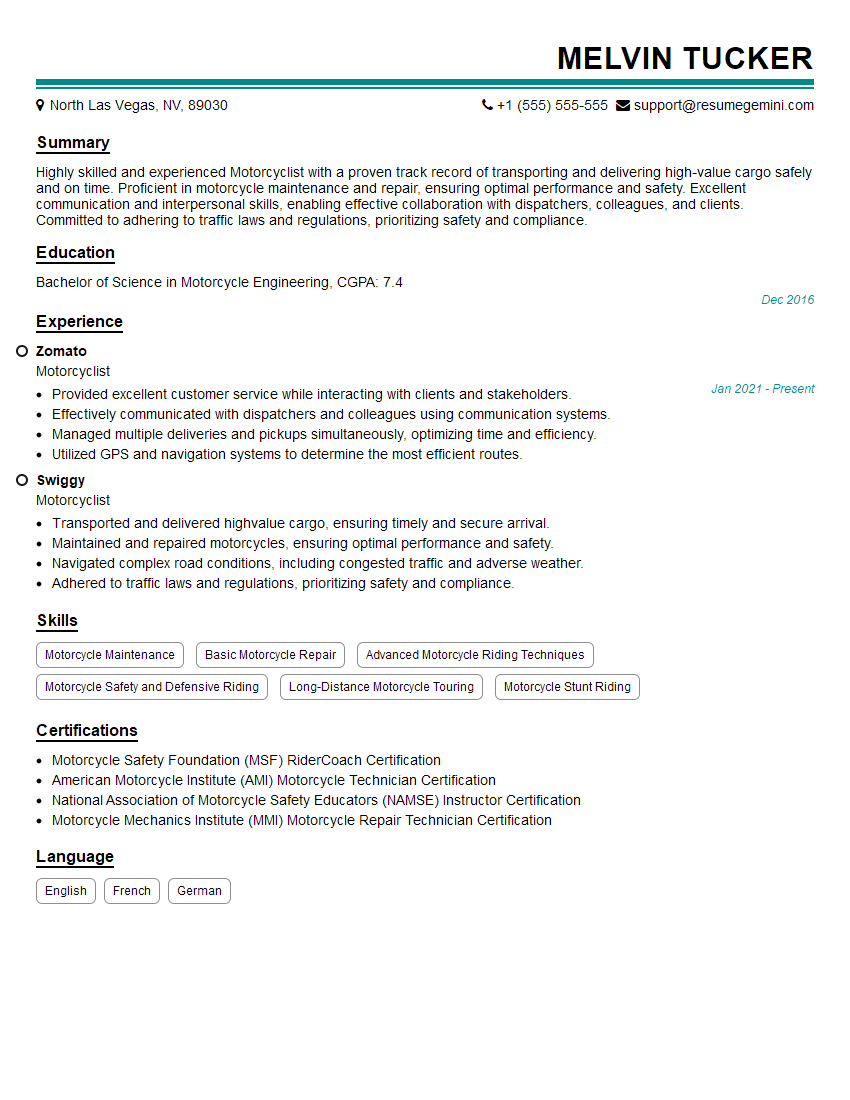
Interviewers often ask about specific skills and experiences. With ResumeGemini‘s customizable templates, you can tailor your resume to showcase the skills most relevant to the position, making a powerful first impression. Also check out Resume Template specially tailored for Motorcyclist.
Career Expert Tips:
- Ace those interviews! Prepare effectively by reviewing the Top 50 Most Common Interview Questions on ResumeGemini.
- Navigate your job search with confidence! Explore a wide range of Career Tips on ResumeGemini. Learn about common challenges and recommendations to overcome them.
- Craft the perfect resume! Master the Art of Resume Writing with ResumeGemini’s guide. Showcase your unique qualifications and achievements effectively.
- Great Savings With New Year Deals and Discounts! In 2025, boost your job search and build your dream resume with ResumeGemini’s ATS optimized templates.
Researching the company and tailoring your answers is essential. Once you have a clear understanding of the Motorcyclist‘s requirements, you can use ResumeGemini to adjust your resume to perfectly match the job description.
Key Job Responsibilities
Motorcyclists play a vital role in various industries, from law enforcement and security to transportation and delivery services. Their primary responsibilities include:
1. Safe and Efficient Operation of Motorcycles
Expertly handling motorcycles in various road conditions and traffic situations to ensure safety and efficiency.
- Maintaining a safe following distance and adhering to traffic regulations.
- Anticipating and responding to potential hazards promptly.
2. Transportation of Goods and Passengers
Responsibilities vary based on the industry sector:
- In delivery services, transporting packages and parcels as per instructions.
- In law enforcement and security, escorting vehicles or individuals and patrolling designated areas.
3. Motorcycle Maintenance
Ensuring the motorcycle is in optimal condition for safe and reliable operation:
- Performing regular checks on tires, fluids, and other components.
- Reporting any maintenance issues to supervisors promptly.
4. Communication and Reporting
Maintaining clear communication with supervisors, dispatchers, and colleagues:
- Providing updates on progress, any incidents, or delays encountered.
- Submitting reports or logging information as required.
Interview Tips
Preparing thoroughly for a motorcycle interview can significantly improve your chances of success. Here are some essential tips:
1. Research the Company and Industry
Demonstrating knowledge about the company and the industry shows initiative and interest.
- Visit the company website to understand their services, values, and recent projects.
- Research industry trends and regulations related to motorcycles.
2. Highlight Your Skills and Experience
Emphasize your relevant skills and experience that align with the job requirements.
- Quantify your accomplishments using specific metrics whenever possible.
- Provide examples that showcase your problem-solving abilities and commitment to safety.
3. Practice Your Motorcycle Knowledge
Be prepared to discuss your motorcycle knowledge and experience in detail.
- Review motorcycle safety protocols and best practices.
- Anticipate questions about different motorcycle types and their handling characteristics.
4. Dress Appropriately and Arrive on Time
First impressions matter. Dress professionally and arrive for your interview on time to demonstrate your respect for the opportunity.
- Wear clean, closed-toe shoes and clothing that allows for comfortable movement.
- Plan your route in advance to avoid any potential delays.
Next Step:
Now that you’re armed with the knowledge of Motorcyclist interview questions and responsibilities, it’s time to take the next step. Build or refine your resume to highlight your skills and experiences that align with this role. Don’t be afraid to tailor your resume to each specific job application. Finally, start applying for Motorcyclist positions with confidence. Remember, preparation is key, and with the right approach, you’ll be well on your way to landing your dream job. Build an amazing resume with ResumeGemini