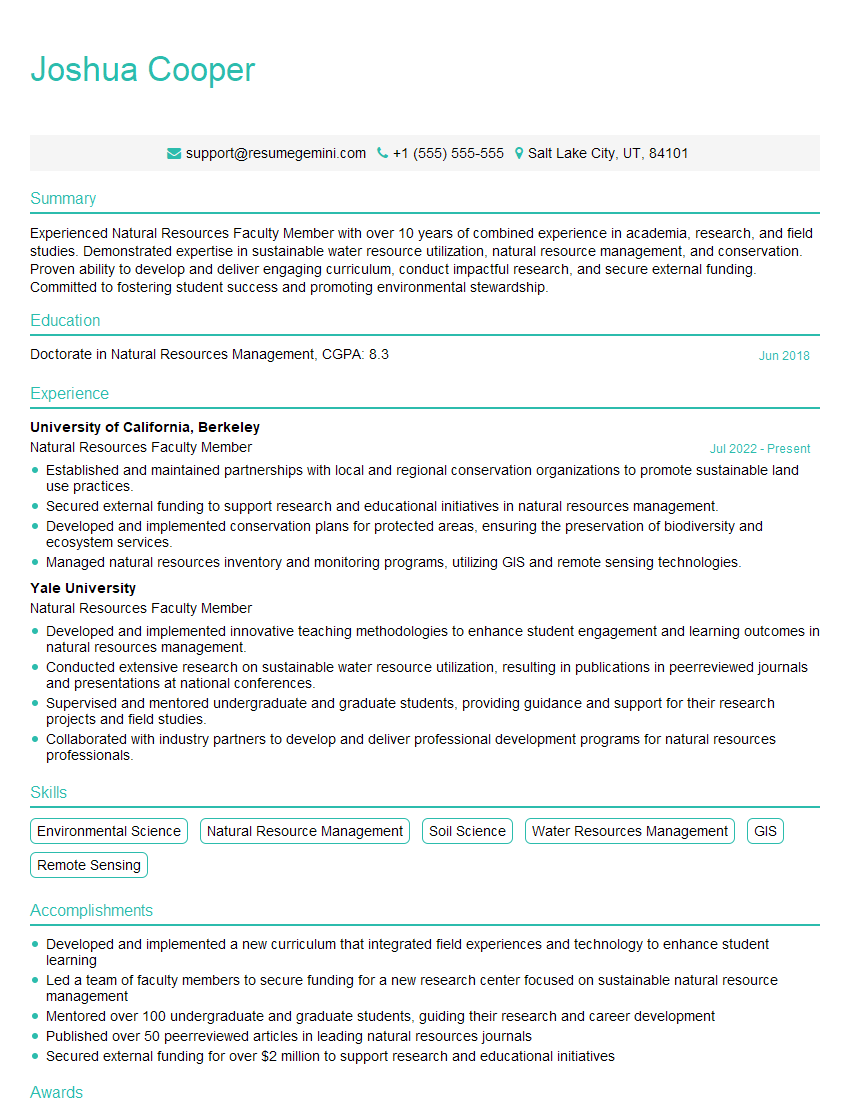
Ever felt underprepared for that crucial job interview? Or perhaps you’ve landed the interview but struggled to articulate your skills and experiences effectively? Fear not! We’ve got you covered. In this blog post, we’re diving deep into the Natural Resources Faculty Member interview questions that you’re most likely to encounter. But that’s not all. We’ll also provide expert insights into the key responsibilities of a Natural Resources Faculty Member so you can tailor your answers to impress potential employers.
Acing the interview is crucial, but landing one requires a compelling resume that gets you noticed. Crafting a professional document that highlights your skills and experience is the first step toward interview success. ResumeGemini can help you build a standout resume that gets you called in for that dream job.






Essential Interview Questions For Natural Resources Faculty Member
1. How would you develop an interdisciplinary natural resources curriculum that integrates principles from ecology, economics, and social sciences?
To develop an interdisciplinary natural resources curriculum, I would begin by identifying the core concepts and principles from each discipline that are essential for students to understand. I would then work with faculty from each discipline to develop a curriculum that integrates these concepts in a meaningful way.
- For example, I would include modules that explore the ecological principles of natural resource management, the economic principles of sustainable development, and the social dimensions of natural resource use.
- I would also include case studies and experiential learning opportunities that allow students to apply their knowledge to real-world problems.
2. Describe how you would incorporate student-centered learning into your teaching.
Active Learning
- I believe that student-centered learning is essential for effective teaching. I use a variety of active learning techniques in my teaching, such as discussions, simulations, and role-playing exercises.
- These techniques allow students to engage with the material in a more meaningful way and to develop critical thinking and problem-solving skills.
Collaborative Learning
- I also incorporate collaborative learning into my teaching. I assign students to work in groups on projects and assignments.
- This allows students to learn from each other and to develop teamwork skills.
3. What methods would you use to assess student learning in your natural resources courses?
I use a variety of methods to assess student learning in my natural resources courses. These methods include:
- Exams: I give exams to assess students’ understanding of the course material. Exams can be in a variety of formats, such as multiple-choice, short answer, and essay.
- Projects: I assign projects to allow students to apply their knowledge to real-world problems. Projects can be individual or group projects.
- Presentations: I have students give presentations on their research or on other topics related to the course material. Presentations allow students to develop their communication and presentation skills.
- Class participation: I assess students’ class participation on a regular basis. Class participation allows students to demonstrate their understanding of the course material and to contribute to the learning environment.
4. How would you develop and maintain effective relationships with stakeholders in the natural resources field?
I believe that it is important to develop and maintain effective relationships with stakeholders in the natural resources field. These relationships can help to ensure that my research and teaching are relevant to the needs of the community.
- I would develop relationships with stakeholders by attending industry events, volunteering with natural resources organizations, and serving on advisory boards.
- I would also make myself available to speak to stakeholders about my research and teaching.
5. What is your experience with grant writing and fundraising for natural resources research?
I have extensive experience with grant writing and fundraising for natural resources research. I have successfully secured funding from a variety of sources, including the National Science Foundation, the Environmental Protection Agency, and the United States Forest Service.
- In my previous position, I was responsible for developing and submitting grant proposals for a variety of research projects.
- I also worked with donors to raise funds for natural resources research.
6. How would you use technology to enhance student learning in your natural resources courses?
I believe that technology can be a powerful tool for enhancing student learning. I use a variety of technology tools in my teaching, such as:
- Online learning platforms: I use online learning platforms to deliver course content, post assignments, and facilitate discussions.
- Interactive simulations: I use interactive simulations to allow students to explore complex natural resources concepts in a hands-on way.
- Data analysis software: I use data analysis software to teach students how to analyze and interpret natural resources data.
7. How would you promote diversity and inclusion in your natural resources courses and research?
I am committed to promoting diversity and inclusion in my natural resources courses and research.
- In my teaching, I strive to create a welcoming and inclusive environment for all students.
- I use a variety of teaching methods to accommodate different learning styles.
- I also make an effort to include diverse perspectives in my course materials.
- In my research, I am committed to working with diverse teams of researchers and to addressing issues of environmental justice.
8. How would you contribute to the broader natural resources community beyond your teaching and research?
I am committed to contributing to the broader natural resources community beyond my teaching and research.
- I am a member of several professional organizations, including the Society for Natural Resources and the American Fisheries Society.
- I regularly present my research at conferences and workshops.
- I also serve on the board of directors for a local land trust.
9. What are your research interests in the field of natural resources?
My research interests lie in the area of natural resources management. I am particularly interested in developing sustainable management practices for forests and fisheries.
- My current research focuses on the development of decision-support tools for forest managers.
- I am also working on a project to develop sustainable fisheries management plans for the Gulf of Mexico.
10. What are the biggest challenges facing natural resources management today?
I believe that the biggest challenges facing natural resources management today are:
- Climate change: Climate change is a major threat to natural resources, as it can lead to changes in species distribution, habitat loss, and extreme weather events.
- Population growth: Population growth is putting increasing pressure on natural resources, as more people need food, water, and other resources.
- Pollution: Pollution is a major threat to natural resources, as it can damage air, water, and soil quality.
Interviewers often ask about specific skills and experiences. With ResumeGemini‘s customizable templates, you can tailor your resume to showcase the skills most relevant to the position, making a powerful first impression. Also check out Resume Template specially tailored for Natural Resources Faculty Member.
Career Expert Tips:
- Ace those interviews! Prepare effectively by reviewing the Top 50 Most Common Interview Questions on ResumeGemini.
- Navigate your job search with confidence! Explore a wide range of Career Tips on ResumeGemini. Learn about common challenges and recommendations to overcome them.
- Craft the perfect resume! Master the Art of Resume Writing with ResumeGemini’s guide. Showcase your unique qualifications and achievements effectively.
- Great Savings With New Year Deals and Discounts! In 2025, boost your job search and build your dream resume with ResumeGemini’s ATS optimized templates.
Researching the company and tailoring your answers is essential. Once you have a clear understanding of the Natural Resources Faculty Member‘s requirements, you can use ResumeGemini to adjust your resume to perfectly match the job description.
Key Job Responsibilities
A Natural Resources Faculty Member is a highly skilled professional responsible for educating students in the field of natural resources management. They play a vital role in shaping the future of natural resource management by providing students with a strong foundation in the principles and practices of sustainable resource use.
1. Teaching
The primary responsibility of a Natural Resources Faculty Member is to teach courses in natural resources management. This may include courses in:
- Forestry
- Wildlife management
- Fisheries management
- Soil and water conservation
- Environmental policy
2. Research
Natural Resources Faculty Members are also expected to conduct research in their field of expertise. This research may focus on:
- Developing new methods for managing natural resources
- Assessing the impacts of human activities on natural resources
- Finding ways to restore degraded natural resources
3. Service
In addition to teaching and research, Natural Resources Faculty Members are also expected to provide service to the university and the broader community. This may include:
- Serving on committees
- Advising students
- Participating in outreach programs
- Working with government agencies and non-profit organizations
4. Professional Development
Natural Resources Faculty Members are expected to stay up-to-date on the latest developments in their field. This may involve:
- Attending conferences
- Reading journals and books
- Conducting research
Interview Tips
If you’re preparing for an interview for a Natural Resources Faculty Member position, here are a few tips to help you ace it:
1. Do your research
Before your interview, take some time to learn about the university and the department you’re applying to. This will help you understand the institution’s mission and values, and how your work could fit into that context.
2. Practice your answers to common interview questions
There are a few common interview questions that you’re likely to be asked, such as:
- Tell me about your experience in natural resources management.
- What are your research interests?
- How do you approach teaching?
- What are your strengths and weaknesses?
- Why are you interested in this position?
It’s a good idea to practice your answers to these questions in advance so that you can deliver them clearly and confidently in your interview.
3. Be prepared to talk about your teaching philosophy
As a Natural Resources Faculty Member, you’ll be expected to teach a variety of courses. Be prepared to talk about your teaching philosophy and how you would approach teaching different types of courses.
4. Be able to discuss your research interests
Research is an important part of the job of a Natural Resources Faculty Member. Be prepared to talk about your research interests and how they align with the university’s research priorities.
5. Be enthusiastic about your work
Natural Resources Faculty Members are passionate about their work. Be sure to convey your enthusiasm for natural resources management and your desire to make a difference in the world.
Next Step:
Armed with this knowledge, you’re now well-equipped to tackle the Natural Resources Faculty Member interview with confidence. Remember, preparation is key. So, start crafting your resume, highlighting your relevant skills and experiences. Don’t be afraid to tailor your application to each specific job posting. With the right approach and a bit of practice, you’ll be well on your way to landing your dream job. Build your resume now from scratch or optimize your existing resume with ResumeGemini. Wish you luck in your career journey!