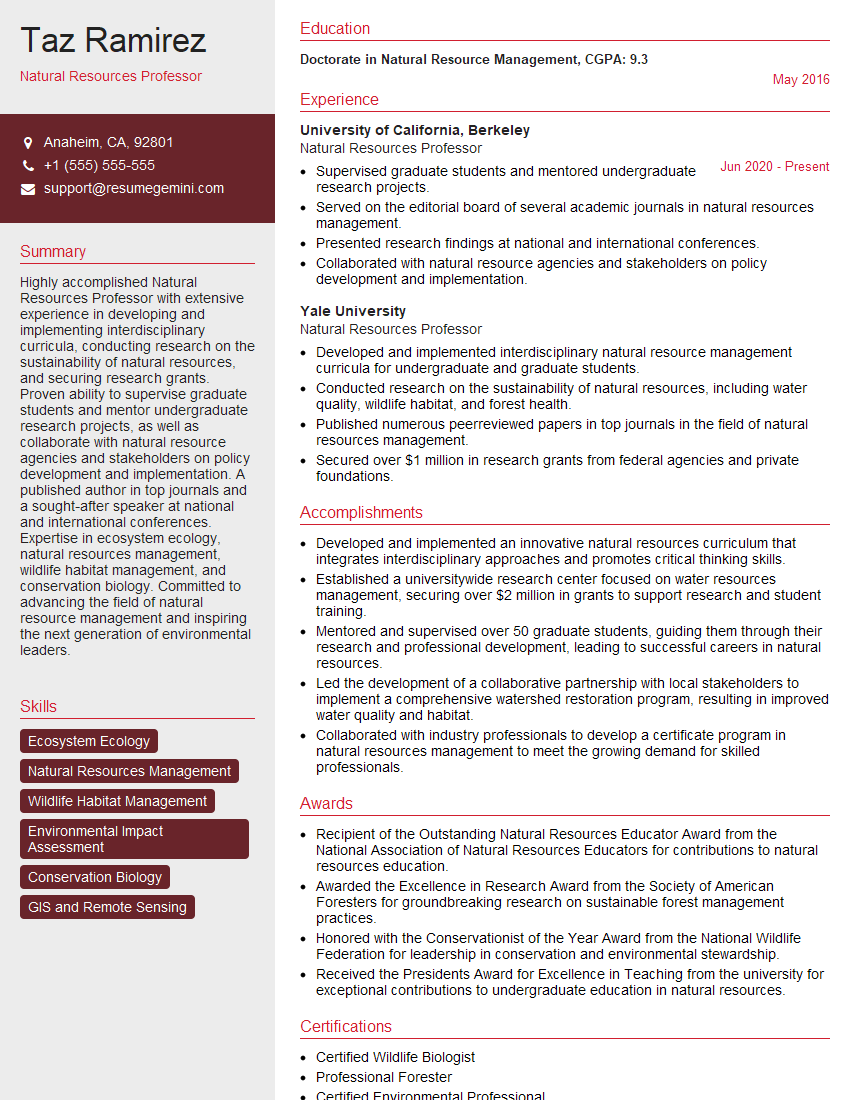
Are you gearing up for an interview for a Natural Resources Professor position? Whether you’re a seasoned professional or just stepping into the role, understanding what’s expected can make all the difference. In this blog, we dive deep into the essential interview questions for Natural Resources Professor and break down the key responsibilities of the role. By exploring these insights, you’ll gain a clearer picture of what employers are looking for and how you can stand out. Read on to equip yourself with the knowledge and confidence needed to ace your next interview and land your dream job!
Acing the interview is crucial, but landing one requires a compelling resume that gets you noticed. Crafting a professional document that highlights your skills and experience is the first step toward interview success. ResumeGemini can help you build a standout resume that gets you called in for that dream job.






Essential Interview Questions For Natural Resources Professor
1. Describe the major principles of sustainable natural resource management and how they can be applied to a specific resource, such as water?
Sample Answer:
- Define sustainable natural resource management. Emphasize the balance between resource use, environmental protection, and social equity.
- Explain major principles:
- Ecosystem integrity: Maintaining healthy ecosystems that support natural resource availability.
- Intergenerational equity: Ensuring resource availability for future generations.
- Precautionary principle: Taking proactive measures to prevent environmental degradation.
- Application to water resources:
- Conservation and efficient water use.
- Protection of watersheds and water quality.
- Integrated water resource planning involving multiple stakeholders.
2. How would you design a curriculum for a natural resources management degree program?
Course Structure and Content
- Core courses in natural resource sciences, including geology, hydrology, ecology, and environmental science.
- Specialized courses in specific areas such as forestry, wildlife management, and water resource management.
- Practical field experiences and research projects to develop hands-on skills.
Teaching Methods and Learning Objectives
- Combination of lectures, discussions, field trips, and laboratory exercises.
- Emphasis on problem-solving, critical thinking, and communication skills.
- Learning objectives aligned with industry standards and professional accreditation requirements.
3. Explain the role of GIS in natural resource management and how you would incorporate it into your teaching?
Sample Answer:
- Explain the benefits of GIS:
- Spatial data analysis and visualization.
- Identify patterns and relationships in natural resources.
- Support decision-making and planning.
- Incorporation into teaching:
- Hands-on exercises using GIS software.
- Case studies demonstrating real-world applications.
- Collaboration with GIS professionals for guest lectures and projects.
4. Describe your research experience in natural resources and how it has influenced your teaching?
Sample Answer:
- Provide an overview of research:
- Topic and methodologies used.
- Key findings and contributions to the field.
- Influence on teaching:
- Integration of research findings into course content.
- Use of case studies and examples to illustrate real-world applications.
- Enthusiasm for research and its importance in advancing natural resources management.
5. How would you assess student learning in a natural resources management course?
Sample Answer:
- Assessment methods:
- Exams and quizzes.
- Research papers and presentations.
- Fieldwork reports and assignments.
- Peer evaluations and self-reflections.
- Alignment with learning objectives: Ensure assessments measure specific knowledge, skills, and attitudes expected.
- Variety of assessments: Provide multiple opportunities for students to demonstrate their understanding.
6. Discuss your understanding of the role of natural resources in sustainable development?
Sample Answer:
- Define sustainable development: Emphasize the interdependence of economic growth, social equity, and environmental protection.
- Role of natural resources:
- Provide raw materials for economic activities.
- Support livelihoods and food security.
- Regulate ecosystem services and climate.
- Need for sustainable management: Avoid resource depletion, environmental degradation, and social conflicts.
7. Describe your approach to fostering diversity and inclusion in a natural resources management classroom?
Sample Answer:
- Create a welcoming environment: Respect and value diverse perspectives and backgrounds.
- Promote inclusive language: Use non-discriminatory and gender-neutral language.
- Highlight diverse voices: Feature examples and case studies that showcase contributions from underrepresented groups.
- Encourage participation and collaboration: Facilitate discussions and activities that encourage students to share their experiences and perspectives.
8. How would you engage students in critical thinking and problem-solving in natural resources management?
Sample Answer:
- Use real-world case studies: Present complex environmental challenges to stimulate discussion and analysis.
- Facilitate group projects: Encourage collaboration and exchange of ideas to solve natural resources problems.
- Incorporate role-playing exercises: Allow students to simulate different stakeholder perspectives and negotiate solutions.
- Provide opportunities for independent research: Assign projects that require students to apply critical thinking skills to investigate natural resources issues.
9. Explain your approach to integrating technology into your natural resources management courses?
Sample Answer:
- Incorporate interactive simulations: Use online platforms to allow students to simulate natural resource management scenarios.
- Utilize data visualization tools: Introduce students to software that facilitates the analysis and interpretation of environmental data.
- Facilitate online discussions: Create virtual forums for students to discuss current natural resources issues and share perspectives.
- Promote the use of mobile apps: Encourage students to use field data collection and analysis applications.
10. How would you prepare students for careers in natural resources management?
Sample Answer:
- Develop industry partnerships: Establish collaborations with natural resources organizations to provide internships and networking opportunities.
- Incorporate guest speakers: Invite professionals from the field to share their experiences and insights.
- Offer career guidance: Provide individualized guidance and support to help students identify and pursue career paths.
- Emphasize experiential learning: Design courses that include field trips, research projects, and community-based initiatives.
Interviewers often ask about specific skills and experiences. With ResumeGemini‘s customizable templates, you can tailor your resume to showcase the skills most relevant to the position, making a powerful first impression. Also check out Resume Template specially tailored for Natural Resources Professor.
Career Expert Tips:
- Ace those interviews! Prepare effectively by reviewing the Top 50 Most Common Interview Questions on ResumeGemini.
- Navigate your job search with confidence! Explore a wide range of Career Tips on ResumeGemini. Learn about common challenges and recommendations to overcome them.
- Craft the perfect resume! Master the Art of Resume Writing with ResumeGemini’s guide. Showcase your unique qualifications and achievements effectively.
- Great Savings With New Year Deals and Discounts! In 2025, boost your job search and build your dream resume with ResumeGemini’s ATS optimized templates.
Researching the company and tailoring your answers is essential. Once you have a clear understanding of the Natural Resources Professor‘s requirements, you can use ResumeGemini to adjust your resume to perfectly match the job description.
Key Job Responsibilities
A Natural Resources Professor is a highly educated and experienced professional who teaches and conducts research in the field of natural resources. They are responsible for educating students about the principles of natural resource management, including the sustainable use of natural resources, the conservation of natural ecosystems, and the impact of human activities on the environment. Natural Resources Professors also conduct research to advance the field of natural resource management. They may also provide consulting services to government agencies, businesses, and non-profit organizations.
1. Teaching
Natural Resources Professors are responsible for teaching a variety of courses in natural resources, including courses in natural resource management, environmental science, ecology, and conservation biology.
- Develop and deliver course curricula
- Prepare and deliver lectures
- Lead discussions and activities
- Grade students’ work
2. Research
Natural Resources Professors conduct research to advance the field of natural resource management. Their research may focus on a variety of topics, such as the sustainable use of natural resources, the conservation of natural ecosystems, and the impact of human activities on the environment.
- Identify and develop research topics
- Conduct research studies
- Publish research findings
- Present research findings at conferences and workshops
3. Service
Natural Resources Professors provide service to their profession and to the community. They may serve on committees, give presentations to the public, and consult with government agencies, businesses, and non-profit organizations.
- Serve on department, college, and university committees
- Give presentations to the public about natural resources issues
- Consult with government agencies, businesses, and non-profit organizations on natural resources issues
- Participate in outreach programs
Interview Tips
Preparing for an interview for a Natural Resources Professor position can be a daunting task, but with the right preparation, you can increase your chances of success. Here are a few tips to help you prepare for your interview:
1. Research the position and the university
Before your interview, take some time to research the position and the university. This will help you to understand the specific requirements of the position and the culture of the university. You can find information about the position on the university’s website or in the job posting. You can also learn more about the university by visiting the website or talking to current or former students or faculty members.
2. Practice your answers to common interview questions
There are a few common interview questions that you are likely to be asked, such as “Tell me about yourself” and “Why are you interested in this position?”. It is helpful to practice your answers to these questions in advance so that you can deliver them confidently and concisely.
3. Prepare questions to ask the interviewer
Asking questions at the end of the interview shows that you are interested in the position and that you have done your research. It is also an opportunity for you to learn more about the position and the university. Some good questions to ask include: “What are the biggest challenges facing the natural resources field today?”, “What are the university’s priorities for natural resources research?”, and “What are the opportunities for professional development for faculty members?”
4. Be yourself
The most important thing is to be yourself during your interview. The interviewer wants to get to know the real you, so don’t try to be someone you’re not. Just relax, be confident, and let your personality shine through.
Next Step:
Armed with this knowledge, you’re now well-equipped to tackle the Natural Resources Professor interview with confidence. Remember, preparation is key. So, start crafting your resume, highlighting your relevant skills and experiences. Don’t be afraid to tailor your application to each specific job posting. With the right approach and a bit of practice, you’ll be well on your way to landing your dream job. Build your resume now from scratch or optimize your existing resume with ResumeGemini. Wish you luck in your career journey!