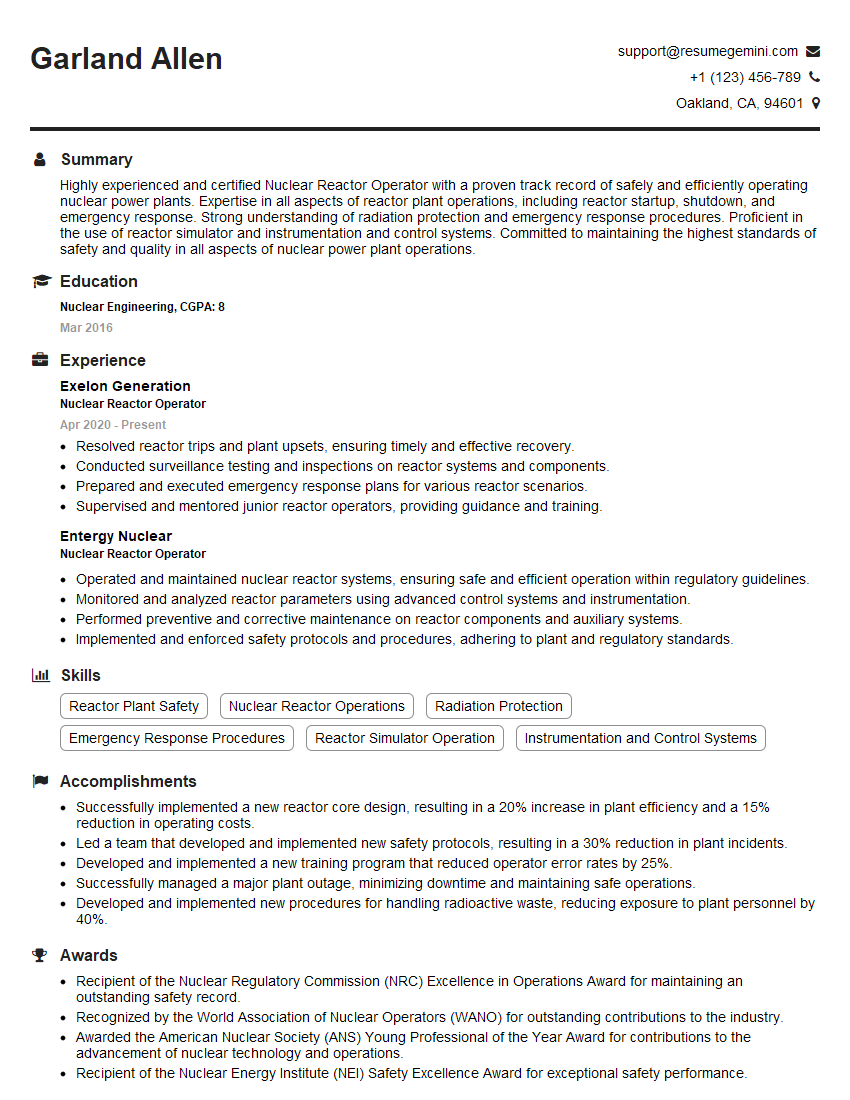
Are you gearing up for a career in Nuclear Reactor Operator? Feeling nervous about the interview questions that might come your way? Don’t worry, you’re in the right place. In this blog post, we’ll dive deep into the most common interview questions for Nuclear Reactor Operator and provide you with expert-backed answers. We’ll also explore the key responsibilities of this role so you can tailor your responses to showcase your perfect fit.
Acing the interview is crucial, but landing one requires a compelling resume that gets you noticed. Crafting a professional document that highlights your skills and experience is the first step toward interview success. ResumeGemini can help you build a standout resume that gets you called in for that dream job.






Essential Interview Questions For Nuclear Reactor Operator
1. What are the key components of a nuclear reactor?
- Reactor core
- Control rods
- Coolant system
- Moderator
- Reflector
2. Explain the process of nuclear fission. How is it controlled in a nuclear reactor?
Nuclear Fission
- Splitting of a heavy nucleus into two lighter nuclei
- Releases a large amount of energy
Control in Nuclear Reactor
- Control rods absorb neutrons, slowing down the rate of fission
- Boron and cadmium are commonly used materials for control rods
3. Describe the different types of nuclear reactors. What are their advantages and disadvantages?
- Pressurized Water Reactor (PWR): Uses pressurized water as coolant, efficient but complex
- Boiling Water Reactor (BWR): Water boils in the reactor core, simpler design but less efficient than PWR
- Gas-Cooled Reactor (GCR): Uses carbon dioxide or helium as coolant, high-temperature operation
- Fast Neutron Reactor (FNR): Uses fast neutrons, potential for breeding plutonium
4. Explain the safety systems used in nuclear reactors. How do they prevent or mitigate accidents?
- Emergency Core Cooling System (ECCS): Injects water into the reactor core to prevent overheating
- Containment Building: Encloses the reactor and contains radioactive materials in case of an accident
- Safety Relief Valves: Release pressure from the reactor in case of a steam buildup
- Backup Power Systems: Provide power to safety systems in case of a grid failure
5. What are the potential risks and benefits of nuclear power?
Risks
- Radioactive waste disposal
- Nuclear accidents
Benefits
- Low-carbon energy source
- Reliable and continuous power generation
6. Describe the role of a Nuclear Reactor Operator. What are the key responsibilities and skills required?
Responsibilities
- Operate and maintain nuclear reactors
- Monitor reactor systems and respond to alarms
- Follow emergency procedures
Skills
- Strong technical knowledge of nuclear reactor systems
- Ability to read and interpret technical manuals and procedures
- Excellent communication and teamwork skills
7. How do you ensure the safety of a nuclear reactor during operation?
- Follow established operating procedures
- Monitor reactor systems closely
- Respond promptly to alarms and abnormal conditions
- Participate in safety training and drills
8. Describe the procedures for starting up and shutting down a nuclear reactor.
Starting Up
- Check reactor systems
- Insert control rods to criticality
- Increase power gradually
Shutting Down
- Insert control rods
- Reduce power to zero
- Remove fuel rods from reactor core
9. What are the different types of emergencies that can occur at a nuclear reactor? How are they handled?
- Loss of Coolant Accident (LOCA): Loss of coolant from the reactor core
- Fuel Rod Failure: Failure of fuel rods, releasing radioactive materials
- Control Rod Failure: Failure of control rods, leading to uncontrolled fission
- Earthquake or Natural Disaster: Damage to reactor systems or containment
10. What are the latest advancements in nuclear reactor technology?
- Small Modular Reactors (SMRs): Smaller, more flexible reactors
- Molten Salt Reactors (MSRs): Uses molten salt as coolant, potential for higher efficiency
- Thorium-Based Reactors: Uses thorium instead of uranium, reduces nuclear waste
Interviewers often ask about specific skills and experiences. With ResumeGemini‘s customizable templates, you can tailor your resume to showcase the skills most relevant to the position, making a powerful first impression. Also check out Resume Template specially tailored for Nuclear Reactor Operator.
Career Expert Tips:
- Ace those interviews! Prepare effectively by reviewing the Top 50 Most Common Interview Questions on ResumeGemini.
- Navigate your job search with confidence! Explore a wide range of Career Tips on ResumeGemini. Learn about common challenges and recommendations to overcome them.
- Craft the perfect resume! Master the Art of Resume Writing with ResumeGemini’s guide. Showcase your unique qualifications and achievements effectively.
- Great Savings With New Year Deals and Discounts! In 2025, boost your job search and build your dream resume with ResumeGemini’s ATS optimized templates.
Researching the company and tailoring your answers is essential. Once you have a clear understanding of the Nuclear Reactor Operator‘s requirements, you can use ResumeGemini to adjust your resume to perfectly match the job description.
Key Job Responsibilities
Nuclear Reactor Operators are responsible for the safe and efficient operation of nuclear reactors, which generate electricity for millions of homes and businesses.
1. Monitor and control nuclear reactors
Operators monitor and control the reactor’s power output, temperature, and pressure. They also make adjustments to the reactor’s systems to ensure that it is operating safely and efficiently.
2. Perform maintenance and repairs
Operators perform maintenance and repairs on the reactor’s systems, including the reactor core, the cooling system, and the electrical systems.
3. Respond to emergencies
Operators are trained to respond to emergencies, such as reactor leaks, power outages, and fires. They work to mitigate the effects of the emergency and protect the public and the environment.
4. Maintain records and documentation
Operators maintain records and documentation of the reactor’s operation and maintenance. These records are used to track the reactor’s performance and to ensure that it is operating safely and efficiently.
Interview Tips
Preparing for a nuclear reactor operator interview can be daunting, but with the right preparation, you can increase your chances of success.
1. Research the company and the position
Take some time to learn about the company you are applying to and the specific position you are interested in. This will help you understand the company’s culture and values, and the specific skills and experience they are looking for in a nuclear reactor operator.
2. Practice your answers to common interview questions
There are a number of common interview questions that you are likely to be asked, such as “Why are you interested in this position?” and “What are your strengths and weaknesses?”. Practice your answers to these questions in advance so that you can deliver them confidently and concisely.
3. Be prepared to discuss your experience and qualifications
The interviewer will want to know about your experience and qualifications as a nuclear reactor operator. Be prepared to discuss your education, training, and work experience. Highlight your skills and experience that are relevant to the position you are applying for.
4. Dress professionally and arrive on time
First impressions matter, so make sure you dress professionally for your interview. Arrive on time for your interview and be prepared to introduce yourself confidently.
5. Be enthusiastic and positive
The interviewer will be looking for someone who is enthusiastic and positive about the position. Be sure to express your interest in the position and the company, and be prepared to answer questions about why you are passionate about working in the nuclear industry.
Next Step:
Now that you’re armed with the knowledge of Nuclear Reactor Operator interview questions and responsibilities, it’s time to take the next step. Build or refine your resume to highlight your skills and experiences that align with this role. Don’t be afraid to tailor your resume to each specific job application. Finally, start applying for Nuclear Reactor Operator positions with confidence. Remember, preparation is key, and with the right approach, you’ll be well on your way to landing your dream job. Build an amazing resume with ResumeGemini