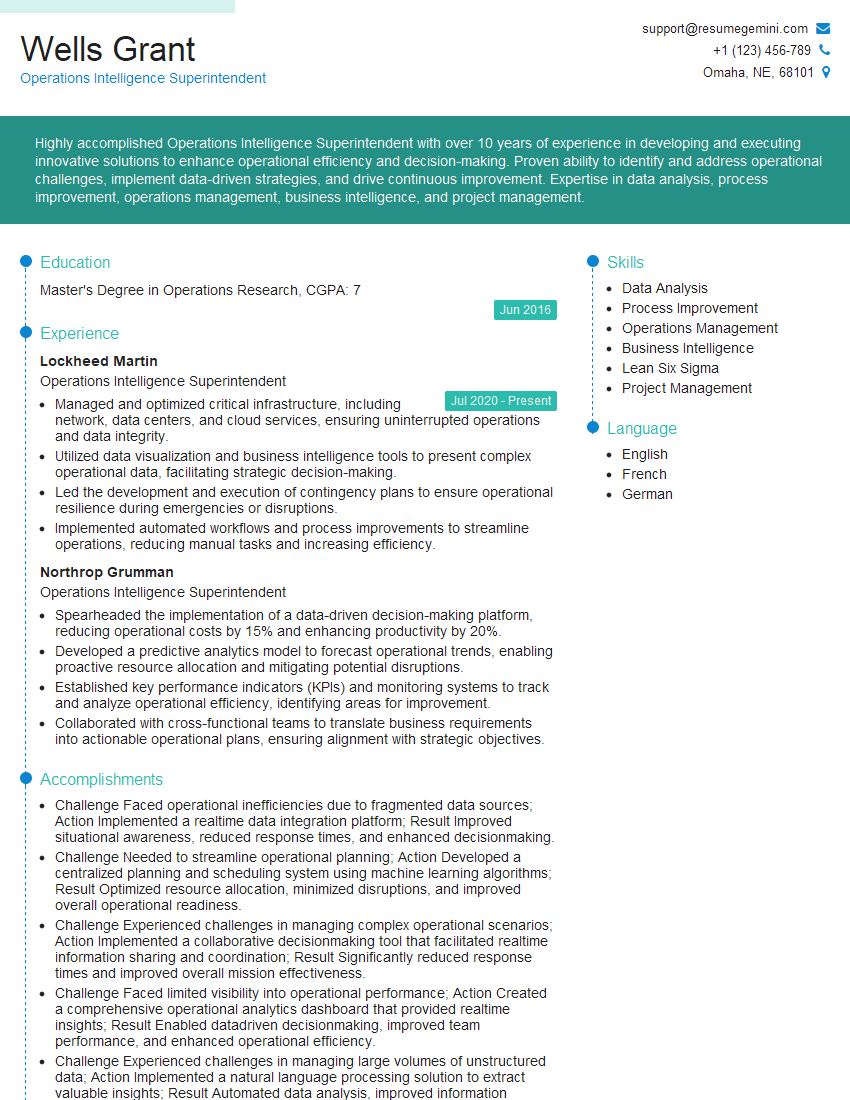
Feeling lost in a sea of interview questions? Landed that dream interview for Operations Intelligence Superintendent but worried you might not have the answers? You’re not alone! This blog is your guide for interview success. We’ll break down the most common Operations Intelligence Superintendent interview questions, providing insightful answers and tips to leave a lasting impression. Plus, we’ll delve into the key responsibilities of this exciting role, so you can walk into your interview feeling confident and prepared.
Acing the interview is crucial, but landing one requires a compelling resume that gets you noticed. Crafting a professional document that highlights your skills and experience is the first step toward interview success. ResumeGemini can help you build a standout resume that gets you called in for that dream job.






Essential Interview Questions For Operations Intelligence Superintendent
1. How do you establish and maintain effective relationships with law enforcement and intelligence agencies?
To build and sustain productive collaborations with law enforcement and intelligence organizations, I employ the following strategies:
- Regular Communication: Engage in frequent and transparent communication through scheduled meetings, phone calls, and email exchanges to foster open dialogue and information sharing.
- Trust-Building: Establish a foundation of trust by demonstrating reliability, confidentiality, and a commitment to mutual goals. Cultivate personal relationships with key contacts to strengthen collaboration.
- Collaborative Initiatives: Identify opportunities for joint initiatives that leverage complementary resources and expertise. Participate in task forces, working groups, and joint operations to foster a sense of partnership.
- Information Sharing: Establish secure and efficient mechanisms for sharing intelligence and operational data. Ensure adherence to legal and ethical guidelines to maintain the integrity and confidentiality of information.
2. How do you implement and evaluate the effectiveness of intelligence operations?
Planning and Implementation
- Establish Clear Objectives: Define specific, measurable, achievable, relevant, and time-bound objectives for each intelligence operation.
- Develop Operational Plan: Create a comprehensive plan outlining the methods, resources, and timelines for conducting the operation.
- Secure Resources: Acquire necessary personnel, equipment, and funding to support the operation effectively.
Evaluation and Improvement
- Performance Metrics: Establish performance metrics aligned with the operation’s objectives to measure its effectiveness.
- Data Analysis: Collect, analyze, and interpret data to assess the operation’s progress and identify areas for improvement.
- Stakeholder Feedback: Seek feedback from stakeholders, including law enforcement and intelligence partners, to gather diverse perspectives and improve outcomes.
3. How do you ensure the accuracy and reliability of intelligence information?
To guarantee the accuracy and reliability of intelligence information, I adhere to the following principles:
- Source Validation: Evaluate the credibility and reliability of sources by considering their motives, access to information, and past performance.
- Information Corroboration: Verify information by cross-referencing it with multiple sources and applying analytical techniques to identify discrepancies or inconsistencies.
- Contextual Analysis: Examine information within its context to understand its significance and relevance to the operational objectives.
- Bias Mitigation: Recognize and mitigate potential biases that may influence the interpretation and analysis of information.
4. How do you manage and protect classified information?
To effectively manage and protect classified information, I implement the following measures:
- Access Control: Restrict access to classified information to individuals with a valid need-to-know based on their role and responsibilities.
- Physical Security: Maintain physical security measures, such as secure storage facilities, encryption devices, and controlled access to sensitive areas.
- Cybersecurity: Utilize robust cybersecurity protocols, including firewalls, intrusion detection systems, and encryption technologies, to protect classified information from unauthorized access and cyber threats.
- Personnel Security: Conduct thorough background investigations and security screenings to ensure the trustworthiness and reliability of personnel handling classified information.
5. How do you communicate intelligence findings effectively to decision-makers?
To effectively communicate intelligence findings to decision-makers, I employ the following techniques:
- Tailor Communication: Adapt the format and language of intelligence reports to suit the specific needs and understanding of the intended audience.
- Visual Aids: Use visual aids, such as charts, maps, and diagrams, to present complex information clearly and concisely.
- Timely Delivery: Ensure that intelligence findings are communicated in a timely manner to inform decision-making processes effectively.
- Actionable Recommendations: Provide actionable recommendations based on intelligence analysis to guide decision-makers and support operational planning.
6. How do you stay abreast of emerging intelligence trends and technologies?
To stay abreast of emerging intelligence trends and technologies, I engage in the following practices:
- Continuing Education: Actively participate in training programs, workshops, and conferences to enhance knowledge and skills in intelligence analysis and emerging technologies.
- Professional Networks: Connect with intelligence professionals, researchers, and industry experts to exchange insights and stay informed about advancements.
- Technology Monitoring: Regularly monitor emerging technologies, such as artificial intelligence, data mining, and cyber analytics, to understand their potential impact on intelligence operations.
- Innovative Thinking: Encourage and support innovative thinking within the intelligence team to explore new approaches and leverage emerging technologies to improve operational effectiveness.
7. How do you ensure the ethical and legal use of intelligence information?
To ensure the ethical and legal use of intelligence information, I adhere to the following principles:
- Legal Compliance: Comply with all applicable laws and regulations governing the collection, analysis, and dissemination of intelligence information.
- Privacy Protection: Respect the privacy rights of individuals and avoid the collection or use of information that is not necessary for intelligence purposes.
- Accountability: Establish clear lines of accountability for the use of intelligence information to ensure transparency and prevent misuse.
- Ethics Review: Involve ethics review boards or independent oversight mechanisms to assess the ethical implications of intelligence operations and provide guidance on responsible practices.
8. How do you prioritize intelligence collection and analysis based on operational needs?
To prioritize intelligence collection and analysis based on operational needs, I employ the following strategies:
- Operational Assessments: Conduct regular operational assessments to identify current and emerging threats, risks, and vulnerabilities.
- Intelligence Requirements: Develop intelligence requirements that align with operational objectives and guide intelligence collection efforts.
- Resource Allocation: Allocate resources strategically to prioritize intelligence collection and analysis activities that are most critical to meeting operational needs.
- Adaptive Adjustments: Regularly review and adjust intelligence priorities based on changes in the operational environment and the availability of new information.
9. How do you foster a collaborative and innovative intelligence team environment?
To foster a collaborative and innovative intelligence team environment, I implement the following strategies:
- Open Communication: Encourage open communication and information sharing among team members to facilitate knowledge transfer and cross-functional collaboration.
- Diversity and Inclusion: Promote diversity and inclusion within the team to encourage diverse perspectives and innovative thinking.
- Training and Development: Provide training and development opportunities to enhance team members’ skills and knowledge, fostering a culture of continuous learning.
- Recognition and Rewards: Recognize and reward team members for their contributions and innovative ideas to encourage motivation and engagement.
10. How do you measure and evaluate the effectiveness of intelligence operations?
To measure and evaluate the effectiveness of intelligence operations, I employ the following methods:
- Performance Metrics: Establish performance metrics aligned with operational objectives to assess the impact and value of intelligence activities.
- Stakeholder Feedback: Seek feedback from internal and external stakeholders, such as law enforcement partners and intelligence consumers, to gather diverse perspectives on the effectiveness of intelligence operations.
- Case Studies: Conduct case studies of successful and unsuccessful intelligence operations to identify best practices and areas for improvement.
- Continuous Improvement: Utilize evaluation findings to drive continuous improvement initiatives and enhance the effectiveness of intelligence operations.
Interviewers often ask about specific skills and experiences. With ResumeGemini‘s customizable templates, you can tailor your resume to showcase the skills most relevant to the position, making a powerful first impression. Also check out Resume Template specially tailored for Operations Intelligence Superintendent.
Career Expert Tips:
- Ace those interviews! Prepare effectively by reviewing the Top 50 Most Common Interview Questions on ResumeGemini.
- Navigate your job search with confidence! Explore a wide range of Career Tips on ResumeGemini. Learn about common challenges and recommendations to overcome them.
- Craft the perfect resume! Master the Art of Resume Writing with ResumeGemini’s guide. Showcase your unique qualifications and achievements effectively.
- Great Savings With New Year Deals and Discounts! In 2025, boost your job search and build your dream resume with ResumeGemini’s ATS optimized templates.
Researching the company and tailoring your answers is essential. Once you have a clear understanding of the Operations Intelligence Superintendent‘s requirements, you can use ResumeGemini to adjust your resume to perfectly match the job description.
Key Job Responsibilities
The Operations Intelligence Superintendent is a critical role responsible for leading and managing the organization’s intelligence operations. The primary objective of this position is to gather, analyze, and disseminate actionable intelligence to support strategic decision-making and enhance operational effectiveness.
1. Intelligence Management
Oversee the collection, analysis, and dissemination of intelligence information from various sources, including human intelligence, technical intelligence, and open-source intelligence.
- Develop and implement intelligence collection strategies.
- Analyze and interpret intelligence data to identify trends, patterns, and threats.
2. Risk Assessment and Mitigation
Conduct risk assessments to identify potential threats and vulnerabilities.
- Develop and implement risk mitigation plans.
- Monitor and track intelligence information to identify and respond to emerging threats.
3. Strategic Planning and Decision Support
Provide intelligence-driven insights to support strategic planning and decision-making.
- Develop and execute strategic intelligence plans.
- Brief senior leadership on intelligence findings and recommendations.
4. Operations Coordination and Support
Coordinate with other operational units to ensure seamless intelligence sharing and support.
- Provide intelligence support to field operations.
- Develop and maintain intelligence databases and systems.
Interview Tips
Preparing for an Operations Intelligence Superintendent interview requires a comprehensive understanding of the role and the industry. Here are some tips to help you excel:
1. Research the Organization and Industry
Gather in-depth knowledge about the organization’s mission, values, and industry landscape. This will allow you to tailor your answers to the specific context of the role.
- Visit the organization’s website and social media pages.
- Read industry publications and reports.
2. Practice Your Storytelling Skills
Operations Intelligence Superintendents are required to communicate complex intelligence findings to various stakeholders. Therefore, it is crucial to practice articulating your thoughts clearly and effectively.
- Use the STAR method to structure your answers (Situation, Task, Action, Result).
- Quantify your accomplishments and provide specific examples.
3. Highlight Your Analytical and Problem-Solving Abilities
This role demands a strong analytical mindset and the ability to solve complex problems. Emphasize your skills in identifying patterns, drawing inferences, and developing actionable solutions.
- Describe projects where you applied analytical techniques to solve intelligence problems.
- Share examples of successful risk assessments you have conducted.
4. Showcase Your Leadership and Communication Skills
Operations Intelligence Superintendents are often required to lead teams and communicate with senior management. Highlight your leadership experience and ability to build consensus among stakeholders.
- Provide examples of times you have successfully led or influenced a team.
- Emphasize your ability to present complex intelligence findings in a clear and compelling manner.
Next Step:
Armed with this knowledge, you’re now well-equipped to tackle the Operations Intelligence Superintendent interview with confidence. Remember, preparation is key. So, start crafting your resume, highlighting your relevant skills and experiences. Don’t be afraid to tailor your application to each specific job posting. With the right approach and a bit of practice, you’ll be well on your way to landing your dream job. Build your resume now from scratch or optimize your existing resume with ResumeGemini. Wish you luck in your career journey!