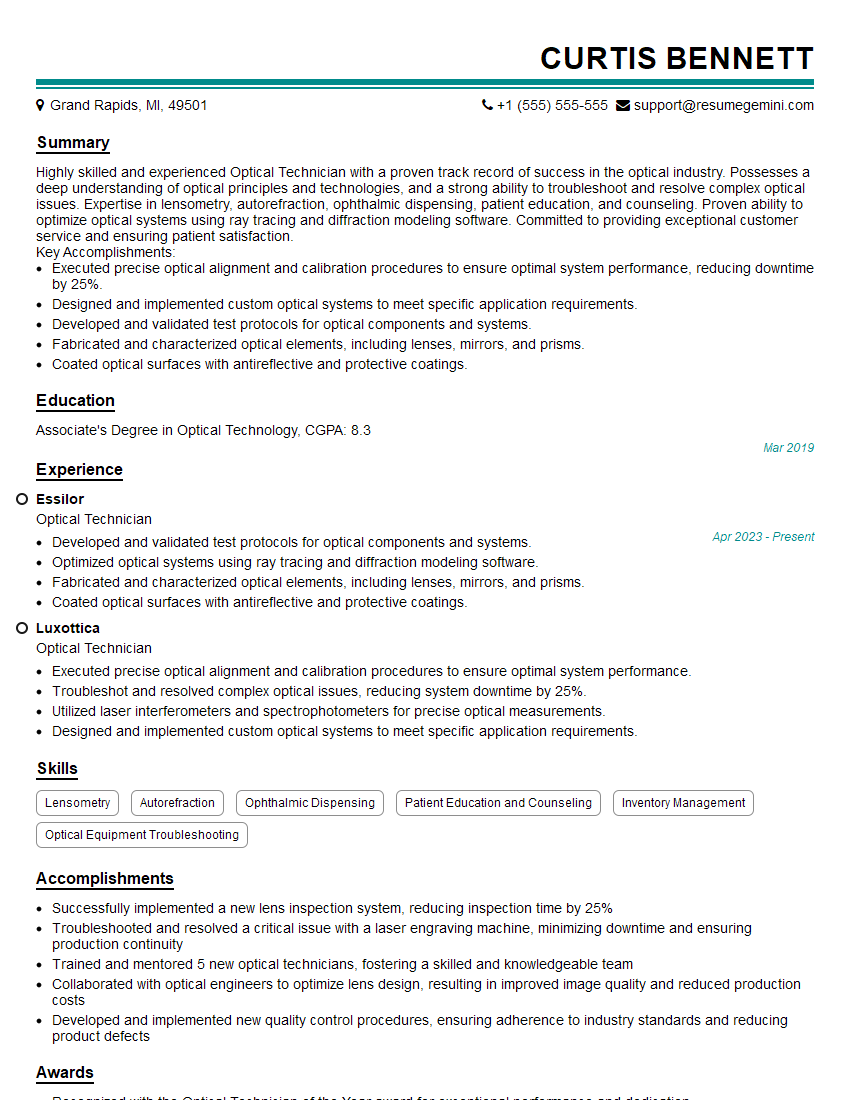
Are you gearing up for a career shift or aiming to ace your next interview? Look no further! We’ve curated a comprehensive guide to help you crack the interview for the coveted Optical Technician position. From understanding the key responsibilities to mastering the most commonly asked questions, this blog has you covered. So, buckle up and let’s embark on this journey together.
Acing the interview is crucial, but landing one requires a compelling resume that gets you noticed. Crafting a professional document that highlights your skills and experience is the first step toward interview success. ResumeGemini can help you build a standout resume that gets you called in for that dream job.






Essential Interview Questions For Optical Technician
1. What are the different types of optical lenses?
- Single-vision lenses: These lenses correct for nearsightedness or farsightedness, and they have the same prescription throughout the lens.
- Multifocal lenses: These lenses correct for both nearsightedness and farsightedness, and they have different prescriptions for different parts of the lens.
- Progressive lenses: These lenses provide a gradual transition between different prescriptions, so that you don’t have to switch between different pairs of glasses.
- Specialty lenses: These lenses are designed for specific purposes, such as correcting for certain eye conditions or providing protection from the sun.
2. What are the different types of optical frames?
Metal frames
- Pros: Durable, stylish, and can be customized.
- Cons: Can be expensive, and may not be suitable for people with sensitive skin.
Plastic frames
- Pros: Lightweight, affordable, and available in a variety of colors and styles.
- Cons: Not as durable as metal frames, and may be more likely to break.
Combination frames
- Pros: Combine the advantages of both metal and plastic frames.
- Cons: May be more expensive than either metal or plastic frames.
3. What are the different types of optical lens coatings?
- Anti-reflective coating: This coating reduces glare and reflections, which can improve vision and make lenses more comfortable to wear.
- Scratch-resistant coating: This coating protects lenses from scratches, which can damage the lenses and reduce their lifespan.
- Ultraviolet (UV) coating: This coating protects the eyes from harmful UV rays.
- Hydrophobic coating: This coating repels water and oil, which makes lenses easier to clean.
4. How do you measure the pupillary distance (PD)?
- Use a PD ruler. This is a specialized ruler that measures the distance between the pupils.
- Use a PD meter. This is a digital device that measures the PD more accurately.
- Measure the distance manually. This can be done using a ruler or a piece of string.
5. How do you adjust the fit of glasses?
- Adjust the temples. The temples are the arms of the glasses, and they can be adjusted to fit the width of the head.
- Adjust the nose pads. The nose pads are the small pads that rest on the bridge of the nose, and they can be adjusted to fit the height of the nose.
- Adjust the bridge. The bridge is the part of the glasses that connects the lenses, and it can be adjusted to fit the width of the nose.
6. What are the different types of optical equipment?
- Ophthalmoscope: This instrument is used to examine the inside of the eye.
- Retinoscope: This instrument is used to measure the refractive error of the eye.
- Autorefractor: This instrument is used to automatically measure the refractive error of the eye.
- Phoropter: This instrument is used to determine the correct prescription for glasses or contact lenses.
- Lensometer: This instrument is used to measure the power of lenses.
7. What are the different types of optical tests?
- Visual acuity test: This test measures the sharpness of vision.
- Refraction test: This test measures the refractive error of the eye.
- Glaucoma test: This test measures the pressure inside the eye.
- Retinal exam: This test examines the inside of the eye for any abnormalities.
8. What are the different types of contact lenses?
- Soft contact lenses: These lenses are made of a soft, flexible material, and they are the most common type of contact lenses.
- Hard contact lenses: These lenses are made of a hard, rigid material, and they are less common than soft contact lenses.
- Gas permeable contact lenses: These lenses are made of a rigid material that allows oxygen to pass through, and they are a good option for people who have dry eyes.
- Extended wear contact lenses: These lenses can be worn for longer periods of time, such as overnight or for several days at a time.
9. What are the different types of contact lens solutions?
- Saline solution: This solution is used to rinse and store contact lenses.
- Disinfecting solution: This solution is used to kill bacteria and other microorganisms on contact lenses.
- Rewetting solution: This solution is used to moisten contact lenses and make them more comfortable to wear.
- Protein remover: This solution is used to remove protein deposits from contact lenses.
10. How do you troubleshoot common contact lens problems?
- Blurry vision: This can be caused by a number of factors, such as the wrong prescription, dirty contact lenses, or dry eyes.
- Discomfort: This can be caused by a number of factors, such as the wrong fit, dirty contact lenses, or dry eyes.
- Redness: This can be caused by a number of factors, such as an infection, allergies, or dry eyes.
- Tearing: This can be caused by a number of factors, such as an infection, allergies, or dry eyes.
Interviewers often ask about specific skills and experiences. With ResumeGemini‘s customizable templates, you can tailor your resume to showcase the skills most relevant to the position, making a powerful first impression. Also check out Resume Template specially tailored for Optical Technician.
Career Expert Tips:
- Ace those interviews! Prepare effectively by reviewing the Top 50 Most Common Interview Questions on ResumeGemini.
- Navigate your job search with confidence! Explore a wide range of Career Tips on ResumeGemini. Learn about common challenges and recommendations to overcome them.
- Craft the perfect resume! Master the Art of Resume Writing with ResumeGemini’s guide. Showcase your unique qualifications and achievements effectively.
- Great Savings With New Year Deals and Discounts! In 2025, boost your job search and build your dream resume with ResumeGemini’s ATS optimized templates.
Researching the company and tailoring your answers is essential. Once you have a clear understanding of the Optical Technician‘s requirements, you can use ResumeGemini to adjust your resume to perfectly match the job description.
Key Job Responsibilities
Optical Technicians play a vital role in ensuring the accurate and precise production of optical components that drive the field of optics. Here are some key job responsibilities that an Optical Technician is expected to fulfill:
1. Fabrication and Assembly
Optical Technicians are responsible for fabricating and assembling optical components using various techniques, including grinding, polishing, coating, and bonding. They ensure that the components meet precise specifications and are of high quality.
- Grind and polish optical materials to create lenses, mirrors, and other optical elements
- Coat optical components with specialized materials to enhance their performance and durability
- Assemble optical components into complex systems, such as telescopes, microscopes, and lasers
2. Testing and Inspection
Optical Technicians perform meticulous testing and inspection procedures to ensure that optical components meet the required standards of accuracy and precision. They use specialized equipment to measure and analyze optical properties, such as surface roughness, wavefront distortion, and transmittance.
- Conduct optical testing using interferometers, spectrophotometers, and other instruments
- Analyze test results to determine compliance with specifications
- Identify and correct any defects or nonconformances
3. Equipment Maintenance and Calibration
To ensure the accuracy and reliability of their work, Optical Technicians are responsible for maintaining and calibrating the equipment they use. They have a thorough understanding of the principles of optics and the functionality of optical equipment.
- Maintain and calibrate optical equipment, such as microscopes, lasers, and spectrometers
- Troubleshoot and repair equipment malfunctions
- Stay up-to-date on advancements in optical technology and equipment
4. Documentation and Reporting
Optical Technicians meticulously document their work and report on test results and quality control measures. They maintain detailed records and provide reports to supervisors and clients, ensuring transparency and accountability.
- Document all steps of the fabrication and testing process
- Prepare reports on test results, equipment maintenance, and quality control
- Communicate effectively with supervisors, clients, and other stakeholders
Interview Tips
To help candidates ace an interview for an Optical Technician position, here are some valuable tips and preparation hacks:
1. Research the Company and Position
Thoroughly research the company you’re applying to and the specific Optical Technician position. Understand their products, services, and mission. Tailoring your answers to the company’s needs and the requirements of the role will demonstrate your genuine interest and preparation.
- Visit the company website and read about their history, products, and industry involvement
- Review the job description and identify the key skills and experience required
- Look for news articles or industry reports about the company to gain insights into their recent developments
2. Highlight Your Technical Expertise
In the interview, emphasize your technical expertise and proficiency in optical fabrication, testing, and equipment maintenance. Provide specific examples of your work, quantifying your accomplishments whenever possible.
- Describe your experience with specific optical fabrication techniques, such as grinding, polishing, and coating
- Explain your knowledge of optical testing methods and equipment, such as interferometers and spectrophotometers
- Share examples of how you have successfully maintained and calibrated optical equipment
3. Demonstrate Your Problem-Solving Skills
Optical Technicians often face complex problems in their daily work. Highlight your problem-solving abilities by describing situations where you analyzed a problem, identified potential solutions, and implemented effective strategies.
- Provide an example of a time when you encountered a problem with optical equipment and how you resolved it
- Describe a situation where you identified a defect in an optical component and developed a solution to correct it
- Explain how you have used your analytical skills to optimize optical systems
4. Emphasize Your Attention to Detail
Optical Technicians must possess a meticulous eye for detail. In the interview, emphasize your precision and accuracy by highlighting your attention to detail. Provide examples of how you have consistently met or exceeded quality standards.
- Describe your process for ensuring the accuracy of your measurements and test results
- Share an example of a time when you identified a small defect that others had missed
- Explain how you maintain a clean and organized workspace
Next Step:
Now that you’re armed with the knowledge of Optical Technician interview questions and responsibilities, it’s time to take the next step. Build or refine your resume to highlight your skills and experiences that align with this role. Don’t be afraid to tailor your resume to each specific job application. Finally, start applying for Optical Technician positions with confidence. Remember, preparation is key, and with the right approach, you’ll be well on your way to landing your dream job. Build an amazing resume with ResumeGemini