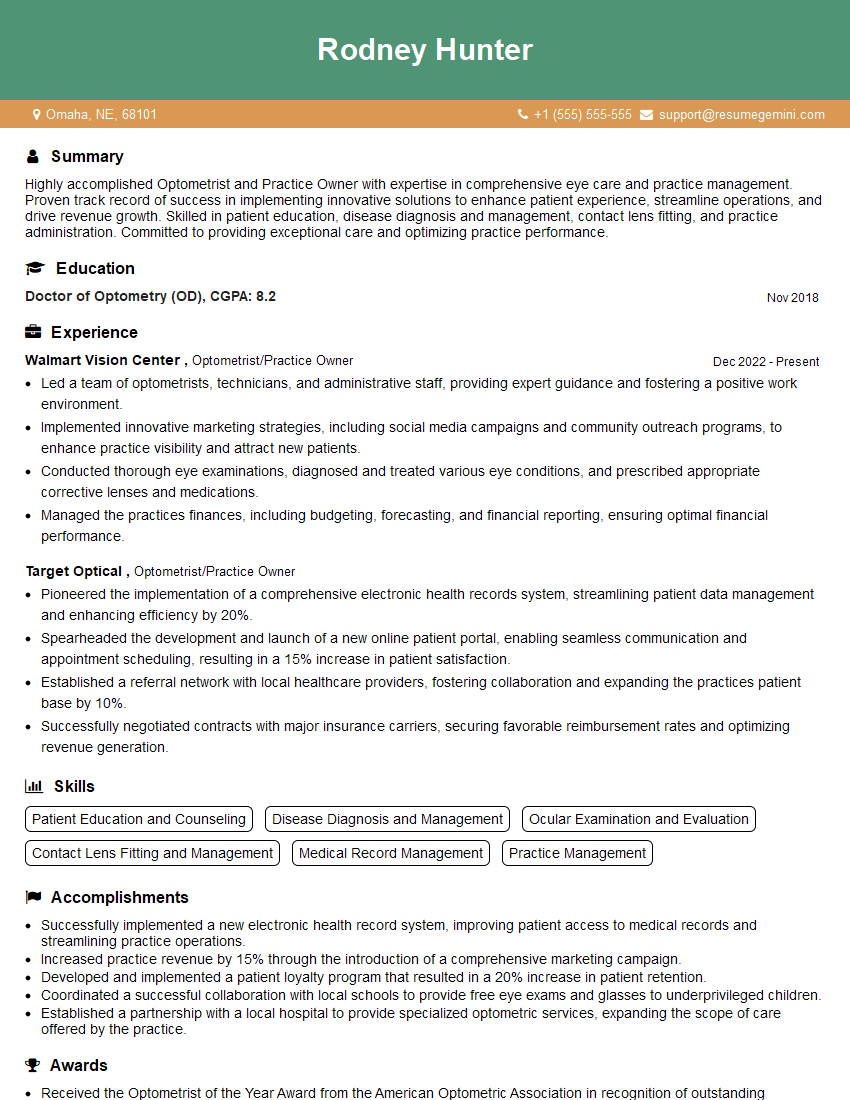
Ever felt underprepared for that crucial job interview? Or perhaps you’ve landed the interview but struggled to articulate your skills and experiences effectively? Fear not! We’ve got you covered. In this blog post, we’re diving deep into the Optometrist/Practice Owner interview questions that you’re most likely to encounter. But that’s not all. We’ll also provide expert insights into the key responsibilities of a Optometrist/Practice Owner so you can tailor your answers to impress potential employers.
Acing the interview is crucial, but landing one requires a compelling resume that gets you noticed. Crafting a professional document that highlights your skills and experience is the first step toward interview success. ResumeGemini can help you build a standout resume that gets you called in for that dream job.






Essential Interview Questions For Optometrist/Practice Owner
1. What are the different types of refractive errors and how do you diagnose them?
There are three main types of refractive errors: myopia (nearsightedness), hyperopia (farsightedness), and astigmatism. Myopia occurs when the eyeball is too long or the cornea is too curved, causing light to focus in front of the retina instead of on it. Hyperopia occurs when the eyeball is too short or the cornea is too flat, causing light to focus behind the retina instead of on it. Astigmatism occurs when the cornea is not perfectly round, causing light to focus in two different lines instead of one. I diagnose these errors using a variety of tests, including a visual acuity test, a refraction test, and an astigmatism test.
2. What are the different types of contact lenses and how do you fit them?
There are two main types of contact lenses: soft contact lenses and hard contact lenses. Soft contact lenses are made from a soft, flexible material that conforms to the shape of the eye, while hard contact lenses are made from a rigid material that rests on the cornea. I fit contact lenses by measuring the curvature of the cornea, the diameter of the eye, and the tear film thickness. I also take into account the patient’s visual needs and preferences.
3. What are the different types of eye diseases and how do you treat them?
There are many different types of eye diseases, including cataracts, glaucoma, macular degeneration, and diabetic retinopathy. Cataracts are a clouding of the lens of the eye that can cause blurred vision and sensitivity to light. Glaucoma is a condition in which the pressure inside the eye is too high, which can damage the optic nerve and lead to blindness. Macular degeneration is a condition in which the central part of the retina deteriorates, causing loss of central vision. Diabetic retinopathy is a condition in which the blood vessels in the retina are damaged due to diabetes, which can lead to vision loss. I treat these diseases using a variety of methods, including surgery, medication, and laser therapy.
4. What are the different types of eye surgeries and how do you perform them?
There are many different types of eye surgeries, including cataract surgery, glaucoma surgery, macular degeneration surgery, and diabetic retinopathy surgery. Cataract surgery involves removing the clouded lens of the eye and replacing it with an artificial lens. Glaucoma surgery involves creating a new pathway for fluid to drain from the eye, reducing the pressure inside the eye. Macular degeneration surgery involves removing the damaged part of the retina and replacing it with a healthy piece of retina from a donor. Diabetic retinopathy surgery involves repairing the damaged blood vessels in the retina.
5. What are the latest advancements in eye care and how do you stay up-to-date on them?
Some of the latest advancements in eye care include laser eye surgery, implantable contact lenses, and gene therapy for eye diseases. Laser eye surgery uses a laser to reshape the cornea, correcting refractive errors. Implantable contact lenses are lenses that are surgically implanted into the eye, providing a long-term vision correction solution. Gene therapy for eye diseases involves injecting genes into the eye to treat or prevent eye diseases. I stay up-to-date on the latest advancements in eye care by attending conferences, reading journals, and participating in continuing education courses.
6. What are the challenges of owning and operating an optometry practice?
One of the challenges of owning and operating an optometry practice is the high cost of equipment and supplies. Optometry equipment, such as autorefractors, phoropters, and fundus cameras, can be very expensive. Additionally, optometry supplies, such as contact lenses, glasses, and eye drops, can also be expensive. Another challenge is the competition from other optometry practices and from online retailers. Many patients now choose to purchase their glasses and contact lenses online, which can make it difficult for optometry practices to compete. Finally, optometry practices are also subject to the same regulatory requirements as other healthcare businesses, which can be complex and time-consuming to comply with.
7. How do you market your optometry practice and attract new patients?
I market my optometry practice in a variety of ways, including online marketing, print marketing, and word-of-mouth marketing. I have a website and social media pages that I use to promote my practice and provide information about eye care. I also place ads in local newspapers and magazines. Additionally, I participate in community events and offer discounts to new patients. I find that word-of-mouth marketing is the most effective way to attract new patients, so I encourage my patients to refer their friends and family to my practice.
8. What are your goals for the future of your optometry practice?
My goals for the future of my optometry practice include expanding my patient base, adding new services, and improving the patient experience. I plan to expand my patient base by increasing my marketing efforts and by offering new services, such as laser eye surgery and implantable contact lenses. I also plan to improve the patient experience by providing a more comfortable and convenient environment and by using the latest technology.
9. What are your strengths and weaknesses as an optometrist?
My strengths as an optometrist include my clinical skills, my communication skills, and my passion for helping people. I am proficient in all aspects of optometry, including refraction, contact lens fitting, and eye disease diagnosis and management. I am also a good communicator and I am able to explain complex medical concepts to patients in a clear and concise way. Additionally, I am passionate about helping people and I am committed to providing the best possible care to my patients.
My weaknesses as an optometrist include my lack of experience in certain areas, such as laser eye surgery and implantable contact lenses. However, I am eager to learn and I am confident that I can overcome my weaknesses with additional training and experience.
10. Why are you interested in working in our optometry practice?
I am interested in working in your optometry practice because I am impressed by your commitment to providing high-quality eye care to your patients. I am also impressed by your team of experienced optometrists and staff. I believe that my skills and experience would be a valuable asset to your practice and I am confident that I can contribute to your continued success.
Interviewers often ask about specific skills and experiences. With ResumeGemini‘s customizable templates, you can tailor your resume to showcase the skills most relevant to the position, making a powerful first impression. Also check out Resume Template specially tailored for Optometrist/Practice Owner.
Career Expert Tips:
- Ace those interviews! Prepare effectively by reviewing the Top 50 Most Common Interview Questions on ResumeGemini.
- Navigate your job search with confidence! Explore a wide range of Career Tips on ResumeGemini. Learn about common challenges and recommendations to overcome them.
- Craft the perfect resume! Master the Art of Resume Writing with ResumeGemini’s guide. Showcase your unique qualifications and achievements effectively.
- Great Savings With New Year Deals and Discounts! In 2025, boost your job search and build your dream resume with ResumeGemini’s ATS optimized templates.
Researching the company and tailoring your answers is essential. Once you have a clear understanding of the Optometrist/Practice Owner‘s requirements, you can use ResumeGemini to adjust your resume to perfectly match the job description.
Key Job Responsibilities
As an Optometrist/Practice Owner, you will be responsible for a wide range of duties, including but not limited to the following:
1. Clinical Responsibilities
Providing comprehensive eye examinations, including vision testing, refractive error assessment, and ocular health evaluation
- Prescribing and fitting eyeglasses and contact lenses
- Diagnosing and managing ocular diseases and conditions, such as glaucoma, macular degeneration, and cataracts
- Performing minor surgical procedures, such as laser vision correction and cataract surgery
2. Business Management Responsibilities
Establishing and maintaining a successful optometry practice, including:
- Setting fees and managing billing
- Purchasing equipment and supplies
- Hiring and managing staff
- Marketing and promoting the practice
3. Relationship Management Responsibilities
Building and maintaining relationships with patients, referral sources, and other healthcare professionals
- Providing excellent customer service
- Educating patients about their eye health
- Collaborating with other healthcare professionals to provide comprehensive patient care
4. Professional Development Responsibilities
Staying up-to-date on the latest advances in optometry through continuing education
- Attending conferences and workshops
- Reading journals and books
- Conducting research
Interview Tips
To ace your interview for an Optometrist/Practice Owner position, it is important to:
1. Research the Company and the Position
Take the time to learn about the optometry practice, its mission, values, and services
- Visit the practice’s website and social media pages
- Read patient reviews
- Contact the practice and ask to speak to a current employee
2. Practice Answering Common Interview Questions
Prepare for common interview questions, such as:
- Tell me about your experience as an optometrist.
- Why are you interested in this position?
- What are your strengths and weaknesses?
- What are your goals for the future?
- What is your experience managing a business?
3. Be Prepared to Talk About Your Accomplishments
Highlight your accomplishments as an optometrist and as a business owner
- Quantify your results whenever possible
- Use specific examples to illustrate your skills and experience
- Be prepared to talk about how your accomplishments have benefited patients and the practice
4. Dress Professionally and Be Punctual
First impressions matter, so make sure you dress professionally and arrive on time for your interview
- Wear a suit or business casual attire
- Be well-groomed
- Arrive at the interview location 10-15 minutes early
5. Be Yourself and Be Enthusiastic
Be authentic and let your personality shine through
- Share your passion for optometry and for helping patients
- Be enthusiastic about the opportunity to join the practice
- Ask questions about the practice and the position
Next Step:
Armed with this knowledge, you’re now well-equipped to tackle the Optometrist/Practice Owner interview with confidence. Remember, a well-crafted resume is your first impression. Take the time to tailor your resume to highlight your relevant skills and experiences. And don’t forget to practice your answers to common interview questions. With a little preparation, you’ll be on your way to landing your dream job. So what are you waiting for? Start building your resume and start applying! Build an amazing resume with ResumeGemini.