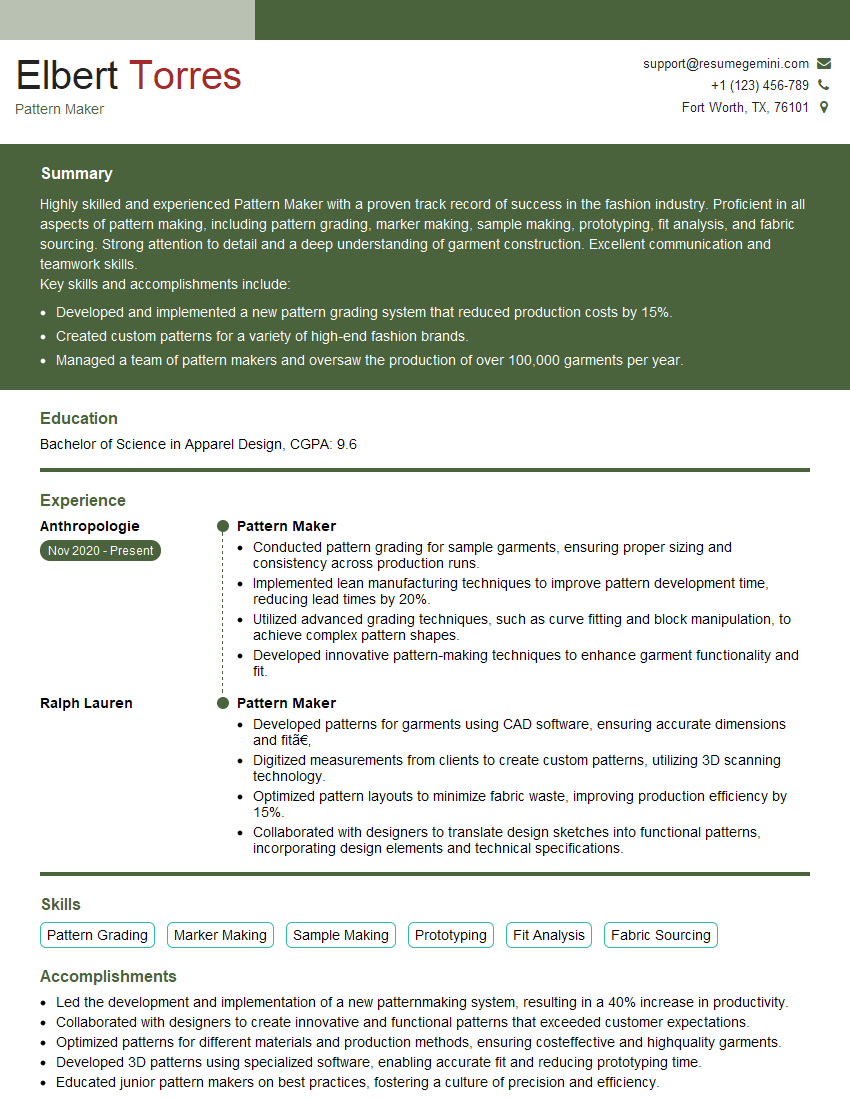
Are you gearing up for a career in Pattern Maker? Feeling nervous about the interview questions that might come your way? Don’t worry, you’re in the right place. In this blog post, we’ll dive deep into the most common interview questions for Pattern Maker and provide you with expert-backed answers. We’ll also explore the key responsibilities of this role so you can tailor your responses to showcase your perfect fit.
Acing the interview is crucial, but landing one requires a compelling resume that gets you noticed. Crafting a professional document that highlights your skills and experience is the first step toward interview success. ResumeGemini can help you build a standout resume that gets you called in for that dream job.






Essential Interview Questions For Pattern Maker
1. What is your experience and knowledge in pattern making software?
I have extensive experience working with pattern making software, including Lectra Modaris, Optitex, and Gerber Accumark. I am proficient in using these software programs to create 2D and 3D patterns, grade patterns, and generate markers.
2. What are the different types of patterns used in garment manufacturing?
Pattern Types
- Flat patterns: These are 2D patterns that are used to cut out fabric pieces for garments.
- Nested patterns: These are 2D patterns that are arranged in a way that maximizes the use of fabric.
- Block patterns: These are basic patterns that are used as a starting point for creating patterns for specific garments.
- Graded patterns: These are patterns that have been modified to fit different sizes.
- 3D patterns: These are patterns that are created using 3D modeling software. They can be used to visualize garments in a more realistic way.
3. What are the challenges of pattern making and how do you overcome them?
The challenges of pattern making include ensuring that the patterns are accurate, that they fit well, and that they can be produced efficiently. I overcome these challenges by using my knowledge of pattern making techniques and software, and by working closely with designers and production staff.
4. What is the role of a pattern maker in the garment manufacturing process?
The role of a pattern maker is to create patterns that are used to cut out fabric pieces for garments. Pattern makers work closely with designers and production staff to ensure that the patterns are accurate, that they fit well, and that they can be produced efficiently.
5. What are the different types of fabrics and how do they affect pattern making?
Fabric Types
- Woven fabrics: These fabrics are made by interlacing two sets of threads at right angles to each other.
- Knitted fabrics: These fabrics are made by looping yarn together in a series of rows.
- Stretch fabrics: These fabrics contain elastic fibers that allow them to stretch.
- Non-stretch fabrics: These fabrics do not contain elastic fibers and cannot stretch.
Effect on Pattern Making
- Woven fabrics: Woven fabrics are relatively stable and easy to pattern. However, they can be difficult to stretch.
- Knitted fabrics: Knitted fabrics are more stretchy than woven fabrics. This can make them more difficult to pattern, but it can also allow for more creative designs.
- Stretch fabrics: Stretch fabrics can be very stretchy. This can make them difficult to pattern, but it can also allow for garments that are very comfortable to wear.
- Non-stretch fabrics: Non-stretch fabrics are not very stretchy. This can make them difficult to fit, but it can also make them more durable.
6. What is grading and why is it important in pattern making?
Grading is the process of modifying patterns to fit different sizes. It is important in pattern making because it ensures that garments fit well on people of all sizes.
7. What are the different methods of grading patterns?
Grading Methods
- Manual grading: This method involves manually modifying patterns by adding or removing darts and seams.
- Computer-aided grading: This method involves using software to modify patterns. Computer-aided grading is more accurate than manual grading, and it can be used to grade patterns for a wider range of sizes.
8. What are the different types of markers used in garment manufacturing?
Marker Types
- Single markers: These markers are used to cut out a single layer of fabric.
- Multiple markers: These markers are used to cut out multiple layers of fabric at the same time.
- Computer-aided markers: These markers are generated using software. Computer-aided markers are more efficient than manual markers, and they can be used to maximize the use of fabric.
9. What are the different factors that affect the accuracy of a pattern?
Accuracy Factors
- The skill of the pattern maker
- The quality of the fabric
- The accuracy of the measuring tools
- The accuracy of the cutting equipment
10. What are the different types of pattern defects and how can they be avoided?
Pattern Defects
- Distortion: This defect occurs when the pattern is stretched or shrunk during cutting or sewing.
- Puckering: This defect occurs when the fabric is not cut or sewn evenly.
- Wrinkles: This defect occurs when the fabric is not pressed properly.
- Holes: This defect occurs when the fabric is cut or torn.
Prevention
- Use high-quality fabric.
- Use accurate measuring tools.
- Use sharp cutting equipment.
- Press the fabric properly.
- Handle the fabric carefully.
11. What software applications do you find most beneficial in your work?
I find the following software applications to be most beneficial in my work as a pattern maker:
- Lectra Modaris
- Optitex
- Gerber Accumark
- Adobe Illustrator
- Microsoft Excel
12. How do you stay up-to-date on the latest industry trends and techniques?
I stay up-to-date on the latest industry trends and techniques by reading trade publications, attending industry events, and taking online courses. I also network with other pattern makers and designers to learn about new developments.
13. Describe your experience in working with a team of designers and production staff.
In my previous role, I worked closely with a team of designers and production staff to create patterns for a variety of garments. I was responsible for ensuring that the patterns were accurate, that they fit well, and that they could be produced efficiently. I also worked with the production staff to develop new and innovative ways to produce garments.
14. What is your favorite part of the pattern making process?
My favorite part of the pattern making process is seeing my designs come to life. I enjoy the challenge of creating patterns that are both accurate and stylish. I also enjoy working with different fabrics and seeing how they can be used to create different looks.
15. What are your career goals?
My career goal is to become a lead pattern maker for a major fashion brand. I want to use my skills to create beautiful and innovative garments that will inspire and empower people.
Interviewers often ask about specific skills and experiences. With ResumeGemini‘s customizable templates, you can tailor your resume to showcase the skills most relevant to the position, making a powerful first impression. Also check out Resume Template specially tailored for Pattern Maker.
Career Expert Tips:
- Ace those interviews! Prepare effectively by reviewing the Top 50 Most Common Interview Questions on ResumeGemini.
- Navigate your job search with confidence! Explore a wide range of Career Tips on ResumeGemini. Learn about common challenges and recommendations to overcome them.
- Craft the perfect resume! Master the Art of Resume Writing with ResumeGemini’s guide. Showcase your unique qualifications and achievements effectively.
- Great Savings With New Year Deals and Discounts! In 2025, boost your job search and build your dream resume with ResumeGemini’s ATS optimized templates.
Researching the company and tailoring your answers is essential. Once you have a clear understanding of the Pattern Maker‘s requirements, you can use ResumeGemini to adjust your resume to perfectly match the job description.
Key Job Responsibilities
Pattern makers play a crucial role in the garment industry, transforming design concepts into functional patterns that guide the production of garments. Their responsibilities encompass a wide range of tasks, including:
1. Interpreting Design Sketches and Specifications
Pattern makers meticulously analyze design sketches and specifications to grasp the designer’s vision and translate it into precise technical patterns.
2. Developing Pattern Layouts
Using specialized software or manual techniques, pattern makers create pattern layouts that specify the dimensions, shapes, and placement of garment pieces. These layouts optimize fabric usage and ensure efficient cutting.
3. Creating Prototypes
To evaluate the functionality and fit of patterns, pattern makers produce prototypes by sewing sample garments. These prototypes undergo thorough testing and revisions until the desired outcome is achieved.
4. Grading Patterns
Pattern makers adjust patterns to fit different sizes by grading them. This involves scaling the pattern while maintaining its proportions and fit characteristics.
5. Collaborating with Designers and Production Teams
Pattern makers work closely with designers to refine and finalize patterns. They also collaborate with production teams to ensure seamless translation of patterns into garment manufacturing.
Interview Tips
Preparing thoroughly for a pattern maker interview is essential to showcase your skills and impress the hiring panel. Here are some valuable tips:
1. Research the Company and Position
Familiarize yourself with the company’s background, industry reputation, and the specific requirements of the pattern maker position. This will enable you to tailor your answers and demonstrate your understanding of the role.
2. Highlight Your Technical Expertise
Emphasize your proficiency in industry-standard pattern-making software and techniques. Showcase your ability to create precise and functional patterns that meet design specifications.
3. Present a Portfolio of Your Work
Bring a portfolio that showcases your best pattern-making projects. High-quality images or physical samples of your work can provide tangible evidence of your skills and attention to detail.
4. Prepare for Technical Questions
Be prepared to answer questions related to pattern grading, fabric properties, cutting techniques, and production processes. Demonstrate your knowledge and understanding of these technical aspects.
5. Practice Your Problem-Solving Skills
Pattern makers often encounter challenges during the design and production process. Prepare examples of how you have creatively solved problems related to pattern fitting, fabric shrinkage, or other technical issues.
6. Show Your Passion for Pattern Making
Express your enthusiasm for pattern making and explain why you are passionate about this field. Conveying your genuine interest and dedication can make a positive impression on interviewers.
Next Step:
Armed with this knowledge, you’re now well-equipped to tackle the Pattern Maker interview with confidence. Remember, preparation is key. So, start crafting your resume, highlighting your relevant skills and experiences. Don’t be afraid to tailor your application to each specific job posting. With the right approach and a bit of practice, you’ll be well on your way to landing your dream job. Build your resume now from scratch or optimize your existing resume with ResumeGemini. Wish you luck in your career journey!