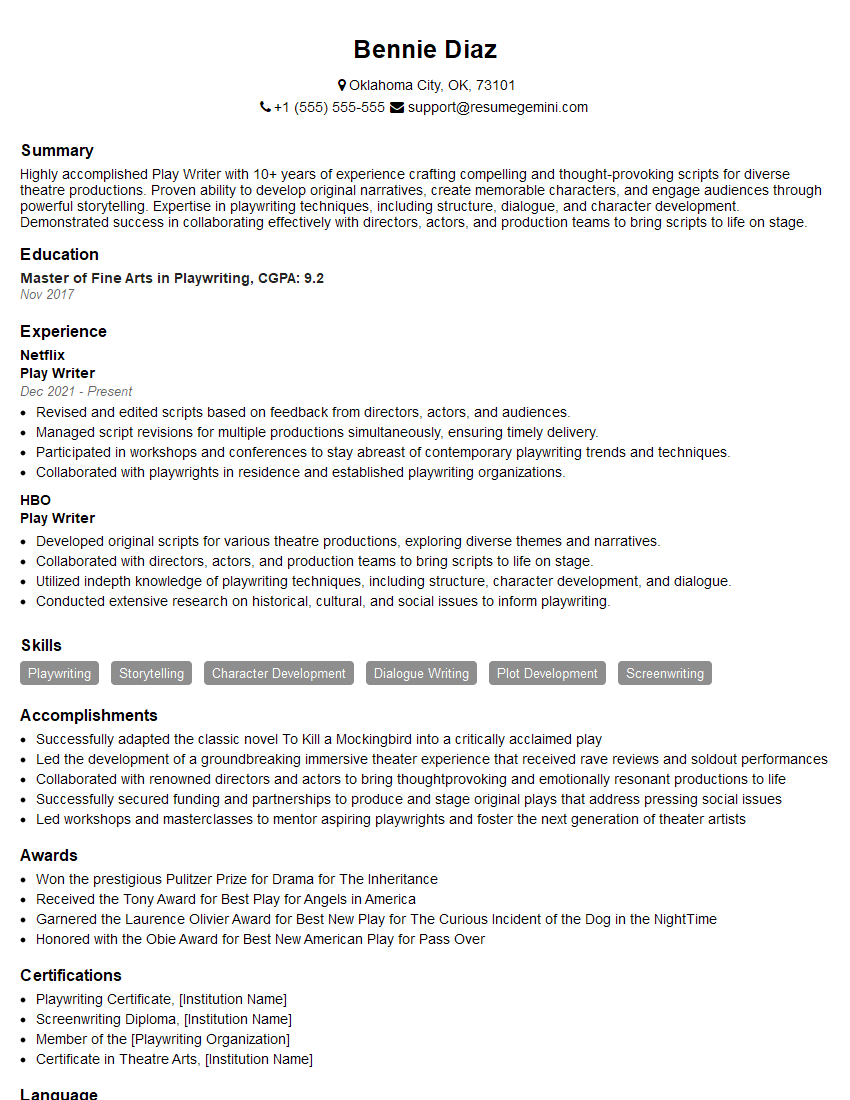
Feeling lost in a sea of interview questions? Landed that dream interview for Play Writer but worried you might not have the answers? You’re not alone! This blog is your guide for interview success. We’ll break down the most common Play Writer interview questions, providing insightful answers and tips to leave a lasting impression. Plus, we’ll delve into the key responsibilities of this exciting role, so you can walk into your interview feeling confident and prepared.
Acing the interview is crucial, but landing one requires a compelling resume that gets you noticed. Crafting a professional document that highlights your skills and experience is the first step toward interview success. ResumeGemini can help you build a standout resume that gets you called in for that dream job.






Essential Interview Questions For Play Writer
1. Walk me through your process for developing a new play.
- I start by brainstorming ideas and researching potential topics.
- Once I have a few ideas, I develop a brief synopsis and outline for each one.
- I then write a first draft of the play, focusing on getting the story and characters down on paper.
- Once I have a first draft, I revise and edit it multiple times, working to improve the plot, dialogue, and character development.
- I also get feedback from other playwrights, directors, and actors to help me refine the play.
- Once I am satisfied with the play, I submit it to theaters and production companies.
2. What are some of the challenges you have faced in your career as a playwright?
Challenges in Research
- Finding accurate and reliable information about historical events or specific topics.
- Balancing the need for detail with the need to keep the play concise.
Challenges in Writing
- Creating believable and relatable characters.
- Writing dialogue that is both natural and effective.
- Structuring the play in a way that is both engaging and satisfying.
Challenges in Production
- Working with directors and actors to bring the play to life.
- Dealing with the financial and logistical challenges of producing a play.
- Coping with the inevitable setbacks and disappointments that come with any creative endeavor.
3. What are some of the most important qualities for a successful playwright?
- Creativity and imagination
- Strong writing skills
- Knowledge of dramatic structure
- Ability to develop complex and believable characters
- Understanding of the production process
4. What are your thoughts on the current state of theater?
- The theater is a vibrant and ever-changing art form.
- It is constantly evolving to reflect the changing needs and interests of society.
- There are many challenges facing the theater today, including rising production costs and the decline of traditional audiences.
- Despite these challenges, the theater remains a powerful and important art form.
- It has the ability to entertain, educate, and inspire audiences.
5. What are your goals as a playwright?
- To write plays that are both entertaining and thought-provoking.
- To create characters that are complex and relatable.
- To explore important social and political issues.
- To make a difference in the world through my work.
6. What are some of the most influential plays that you have read?
- Hamlet by William Shakespeare
- Death of a Salesman by Arthur Miller
- The Glass Menagerie by Tennessee Williams
- Waiting for Godot by Samuel Beckett
- Angels in America by Tony Kushner
7. What are some of your favorite plays that you have seen performed?
- Hamilton by Lin-Manuel Miranda
- The Book of Mormon by Trey Parker, Matt Stone, and Robert Lopez
- Fun Home by Jeanine Tesori and Lisa Kron
- The Curious Incident of the Dog in the Night-Time by Simon Stephens
- Harry Potter and the Cursed Child by J.K. Rowling, John Tiffany, and Jack Thorne
8. What is your favorite part of the playwriting process?
- Coming up with the initial idea for the play.
- Developing the characters and their relationships.
- Writing the first draft of the play.
- Seeing the play performed for the first time.
9. What is your least favorite part of the playwriting process?
- The rewriting process.
- Dealing with rejection from theaters and production companies.
- The financial challenges of being a playwright.
- The long hours and hard work that go into writing a play.
10. What advice would you give to aspiring playwrights?
- Write as much as possible.
- Read plays by other playwrights.
- Attend plays and workshops.
- Get feedback on your work from other playwrights, directors, and actors.
- Don’t give up on your dreams.
Interviewers often ask about specific skills and experiences. With ResumeGemini‘s customizable templates, you can tailor your resume to showcase the skills most relevant to the position, making a powerful first impression. Also check out Resume Template specially tailored for Play Writer.
Career Expert Tips:
- Ace those interviews! Prepare effectively by reviewing the Top 50 Most Common Interview Questions on ResumeGemini.
- Navigate your job search with confidence! Explore a wide range of Career Tips on ResumeGemini. Learn about common challenges and recommendations to overcome them.
- Craft the perfect resume! Master the Art of Resume Writing with ResumeGemini’s guide. Showcase your unique qualifications and achievements effectively.
- Great Savings With New Year Deals and Discounts! In 2025, boost your job search and build your dream resume with ResumeGemini’s ATS optimized templates.
Researching the company and tailoring your answers is essential. Once you have a clear understanding of the Play Writer‘s requirements, you can use ResumeGemini to adjust your resume to perfectly match the job description.
Key Job Responsibilities
A Play Writer is a creative professional responsible for writing original plays for stage, film or television. Their primary task is to craft compelling narratives, develop characters, and create dialogue that resonates with audiences. Here are some key job responsibilities of a Play Writer:
1. Scriptwriting
Developing original scripts for various platforms, including stage productions, films, and television shows.
- Conducting extensive research, including reading plays, attending performances, and interviewing experts, to develop well-informed and engaging content.
- Creating compelling storylines, developing three-dimensional characters, and writing dialogue that is both naturalistic and dramatic.
2. Collaboration and Adaptation
Collaborating with directors, actors, and production teams to bring their scripts to life.
- Adapting existing works, such as novels or short stories, into stage or screenplays while maintaining the integrity and essence of the original material.
- Working with actors to ensure that their performances align with the character development and dialogue intended by the script.
- Making revisions and adjustments to scripts based on feedback from directors, producers, and other stakeholders involved in the production process.
3. Creative Vision and Innovation
Possessing a strong creative vision and the ability to generate original ideas for plays.
- Exploring new and innovative storytelling techniques to captivate audiences and push the boundaries of theatrical expression.
- Keeping up with industry trends, attending workshops, and networking with other playwrights to stay informed and expand their creative horizons.
- Seeking inspiration from various sources, such as classic literature, current events, and personal experiences, to create relatable and thought-provoking plays.
4. Project Management and Timelines
Managing the production process of their plays, ensuring that deadlines are met and that the project stays within budget.
- Working closely with production teams to coordinate rehearsals, set design, costume design, and other aspects of the production.
- Monitoring the progress of the production and making necessary adjustments to the script and production schedule to ensure a successful outcome.
- Managing the financial aspects of their projects, including budgeting, fundraising, and royalty negotiations.
Interview Tips
Preparing for an interview as a Play Writer requires a combination of technical knowledge, creative abilities, and presentation skills. Here are some interview tips to help you ace the interview:
1. Research the Company and Position
Thoroughly research the theatre company or production house you are applying to. Familiarize yourself with their past productions, artistic philosophy, and the specific role you are interviewing for.
- Visit their website, read reviews of their plays, and attend performances if possible to gain insights into their artistic style and audience preferences.
- Study the job description carefully and identify the key responsibilities and qualifications required for the position.
- Prepare questions to ask the interviewer that demonstrate your interest in the company and your understanding of the role.
2. Showcase Your Portfolio and Writing Samples
Bring a portfolio of your best writing samples to the interview. This could include excerpts from plays, short stories, or screenplays that demonstrate your storytelling abilities, character development, and dialogue writing skills.
- Select samples that are relevant to the position you are applying for and that highlight your strengths as a Play Writer.
- Prepare a brief presentation or pitch to introduce your writing samples and explain the inspiration behind your work.
- Be prepared to discuss your writing process, influences, and aspirations as a Play Writer.
3. Emphasize Your Creative Vision and Passion
In the interview, articulate your creative vision and passion for playwriting. Explain what drives you to write and what kind of stories you are interested in telling.
- Share your thoughts on current trends in theatre and discuss how your writing fits into or challenges the contemporary landscape.
- Describe your approach to character development, storytelling, and dialogue writing, highlighting your strengths and unique style.
- Convey your enthusiasm for collaborating with directors, actors, and production teams to bring your plays to life.
4. Prepare for Common Interview Questions
In addition to showcasing your portfolio and creative vision, be prepared to answer common interview questions. These may include:
- “Tell me about your experience as a Play Writer.”
- “What are your favorite plays and why?”
- “How do you approach adapting existing works for the stage or screen?”
- “What are your thoughts on the future of theatre?”
- “Why are you interested in working for our company?”
Practice answering these questions concisely and thoughtfully, highlighting your skills, experience, and passion for playwriting.
Next Step:
Now that you’re armed with interview-winning answers and a deeper understanding of the Play Writer role, it’s time to take action! Does your resume accurately reflect your skills and experience for this position? If not, head over to ResumeGemini. Here, you’ll find all the tools and tips to craft a resume that gets noticed. Don’t let a weak resume hold you back from landing your dream job. Polish your resume, hit the “Build Your Resume” button, and watch your career take off! Remember, preparation is key, and ResumeGemini is your partner in interview success.