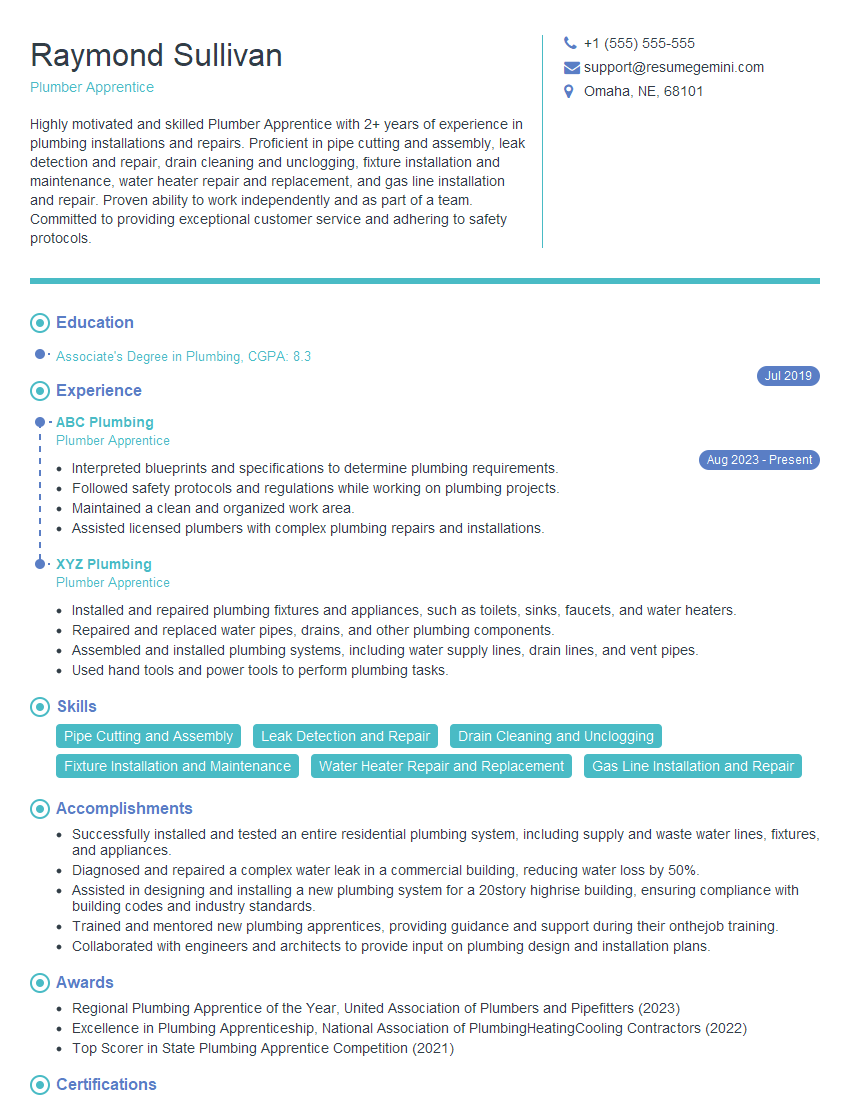
Are you gearing up for a career shift or aiming to ace your next interview? Look no further! We’ve curated a comprehensive guide to help you crack the interview for the coveted Plumber Apprentice position. From understanding the key responsibilities to mastering the most commonly asked questions, this blog has you covered. So, buckle up and let’s embark on this journey together
Acing the interview is crucial, but landing one requires a compelling resume that gets you noticed. Crafting a professional document that highlights your skills and experience is the first step toward interview success. ResumeGemini can help you build a standout resume that gets you called in for that dream job.






Essential Interview Questions For Plumber Apprentice
1. What are the different types of plumbing materials and their uses?
There are various types of plumbing materials used for different purposes in plumbing systems. Some common materials include:
- Copper pipes: Used for hot and cold water distribution due to their durability, corrosion resistance, and ability to withstand high temperatures.
- CPVC (Chlorinated Polyvinyl Chloride): Used for cold water distribution, as it is resistant to chemicals and corrosion.
- PEX (Polyethylene): A flexible and versatile tubing used for hot and cold water distribution, as well as radiant floor heating.
- PVC (Polyvinyl Chloride): Used for drain, waste, and vent (DWV) systems, as it is resistant to chemicals and corrosion.
- Cast iron: Used for drain and sewer lines, as it is durable and can handle heavy waste.
2. What are the different types of plumbing fixtures and their functions?
Plumbing fixtures are devices that control the flow of water in a plumbing system. Some common types include:
- Faucets: Used to control the flow of water from sinks, showers, and bathtubs.
- Toilets: Used to dispose of human waste and flush it away from the building.
- Showers: Used to spray water over the body for bathing purposes.
- Bathtubs: Used for soaking or bathing in water.
- Sinks: Used for washing hands, dishes, or other items.
3. What are the different types of plumbing tools and their uses?
Plumbers use a variety of tools to perform their work, including:
- Pipe wrenches: Used to grip and turn pipes and fittings.
- Slip-joint pliers: Used to grip and adjust fittings with smooth surfaces.
- Hacksaw: Used to cut metal pipes.
- Soldering iron: Used to join copper pipes.
- Level: Used to ensure that pipes and fixtures are installed level.
4. What are the different types of plumbing codes and their importance?
Plumbing codes are regulations that govern the design, installation, and maintenance of plumbing systems. These codes are important to ensure the safety and proper functioning of plumbing systems.
- Uniform Plumbing Code (UPC): A widely recognized code used in many states and countries.
- International Plumbing Code (IPC): Another widely recognized code used in some states and municipalities.
- National Standard Plumbing Code (NSPC): A code developed by the American Society of Plumbing Engineers (ASPE).
5. What are the different types of plumbing emergencies and how to respond to them?
Plumbing emergencies can occur at any time and require immediate attention. Some common emergencies include:
- Burst pipes: Turn off the main water supply and call a plumber immediately.
- Clogged drains: Use a drain snake or call a plumber if the clog persists.
- Leaking faucets: Tighten the packing nut or call a plumber if the leak continues.
- Water heater failure: Turn off the gas or electricity and call a plumber immediately.
6. What are the safety precautions that should be taken when working on a plumbing system?
When working on a plumbing system, it is important to take the following safety precautions:
- Wear appropriate personal protective equipment (PPE), such as gloves, safety glasses, and a hard hat.
- Turn off the water supply before working on any plumbing components.
- Use proper tools and techniques to avoid injuries.
- Be aware of potential hazards, such as electrical wires and sharp edges.
7. What are the different methods of installing a water heater?
There are two main methods of installing a water heater:
Tank-type water heaters
- Connect the cold water inlet to the water heater.
- Connect the hot water outlet to the plumbing system.
- Install the temperature and pressure relief valve.
- Connect the gas or electric supply.
Tankless water heaters
- Connect the cold water inlet to the water heater.
- Connect the hot water outlet to the plumbing system.
- Connect the gas or electric supply.
8. What are the different methods of repairing a leaking pipe?
There are several methods of repairing a leaking pipe, depending on the type of pipe and the location of the leak:
- Soldering: Used for copper pipes.
- Clamping: Used for any type of pipe.
- Epoxy: Used for any type of pipe.
- Replacement: Used if the leak is severe or the pipe is damaged.
9. What are the different types of drain cleaning methods?
There are several methods of cleaning drains, depending on the severity of the clog:
- Chemical drain cleaners: Used for minor clogs.
- Drain snake: Used for moderate clogs.
- Hydro jetting: Used for severe clogs.
- Auger: Used for very severe clogs.
10. What are the different types of water filtration systems and their benefits?
There are several types of water filtration systems, each with its own benefits:
- Activated carbon filters: Remove chlorine, pesticides, and other contaminants.
- Reverse osmosis systems: Remove a wide range of contaminants, including heavy metals and bacteria.
- Ultraviolet (UV) systems: Kill bacteria and other microorganisms.
- Distillation systems: Remove impurities by boiling water and collecting the steam.
Interviewers often ask about specific skills and experiences. With ResumeGemini‘s customizable templates, you can tailor your resume to showcase the skills most relevant to the position, making a powerful first impression. Also check out Resume Template specially tailored for Plumber Apprentice.
Career Expert Tips:
- Ace those interviews! Prepare effectively by reviewing the Top 50 Most Common Interview Questions on ResumeGemini.
- Navigate your job search with confidence! Explore a wide range of Career Tips on ResumeGemini. Learn about common challenges and recommendations to overcome them.
- Craft the perfect resume! Master the Art of Resume Writing with ResumeGemini’s guide. Showcase your unique qualifications and achievements effectively.
- Great Savings With New Year Deals and Discounts! In 2025, boost your job search and build your dream resume with ResumeGemini’s ATS optimized templates.
Researching the company and tailoring your answers is essential. Once you have a clear understanding of the Plumber Apprentice‘s requirements, you can use ResumeGemini to adjust your resume to perfectly match the job description.
Key Job Responsibilities
Plumber apprentice is an entry-level position in the plumbing industry. Apprentices work under the supervision of a licensed plumber to learn the trade. They may assist with a variety of tasks, including:
1. Installing and repairing plumbing fixtures
Apprentices may help to install and repair a variety of plumbing fixtures, such as toilets, sinks, faucets, and water heaters.
- Installing new plumbing fixtures
- Repairing leaking faucets
- Replacing old or damaged plumbing fixtures
2. Maintaining plumbing systems
Apprentices may help to maintain plumbing systems by performing tasks such as cleaning drains, inspecting pipes, and checking for leaks.
- Cleaning drains
- Inspecting pipes
- Checking for leaks
3. Assisting with plumbing projects
Apprentices may help with a variety of plumbing projects, such as installing new plumbing systems, repairing old plumbing systems, and troubleshooting plumbing problems.
- Installing new plumbing systems
- Repairing old plumbing systems
- Troubleshooting plumbing problems
4. Learning the plumbing trade
Apprentices learn the plumbing trade by working under the supervision of a licensed plumber. They may also attend classes or workshops to learn about plumbing theory and techniques.
- Working under the supervision of a licensed plumber
- Attending classes or workshops
- Learning about plumbing theory and techniques
Interview Tips
Preparing for a plumber apprentice interview can help you make a good impression and increase your chances of getting the job. Here are a few tips to help you prepare:
1. Research the company and the position
Before your interview, take some time to research the company and the position you are applying for. This will help you to understand the company’s culture and the specific requirements of the job. You can find information about the company on their website, social media pages, and Glassdoor.
- Visit the company’s website
- Check the company’s social media pages
- Read reviews on Glassdoor
2. Practice your answers to common interview questions
There are a few common interview questions that you are likely to be asked, such as “Why are you interested in this position?” and “What are your strengths and weaknesses?”. It is helpful to practice your answers to these questions in advance so that you can deliver them confidently and concisely.
- Why are you interested in this position?
- What are your strengths and weaknesses?
- Why should we hire you?
3. Dress professionally and arrive on time
First impressions matter, so it is important to dress professionally and arrive on time for your interview. This shows the interviewer that you are serious about the position and that you respect their time.
- Dress in a suit or business casual attire
- Arrive on time for your interview
- Be polite and respectful to the interviewer
4. Be enthusiastic and ask questions
It is important to be enthusiastic and ask questions during your interview. This shows the interviewer that you are interested in the position and that you are eager to learn more about the company. You can ask questions about the company’s culture, the position’s responsibilities, and the company’s future plans.
- Be enthusiastic about the position
- Ask questions about the company’s culture
- Ask questions about the position’s responsibilities
- Ask questions about the company’s future plans
Next Step:
Armed with this knowledge, you’re now well-equipped to tackle the Plumber Apprentice interview with confidence. Remember, a well-crafted resume is your first impression. Take the time to tailor your resume to highlight your relevant skills and experiences. And don’t forget to practice your answers to common interview questions. With a little preparation, you’ll be on your way to landing your dream job. So what are you waiting for? Start building your resume and start applying! Build an amazing resume with ResumeGemini.