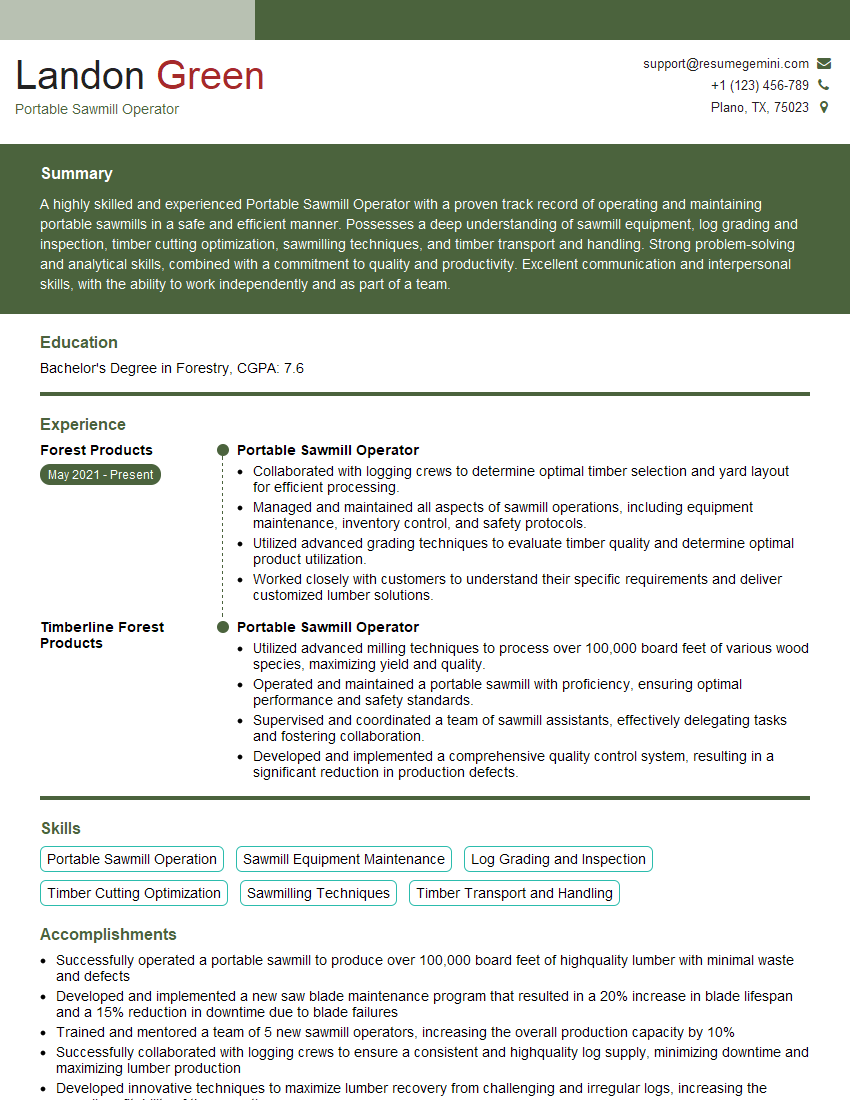
Are you gearing up for an interview for a Portable Sawmill Operator position? Whether you’re a seasoned professional or just stepping into the role, understanding what’s expected can make all the difference. In this blog, we dive deep into the essential interview questions for Portable Sawmill Operator and break down the key responsibilities of the role. By exploring these insights, you’ll gain a clearer picture of what employers are looking for and how you can stand out. Read on to equip yourself with the knowledge and confidence needed to ace your next interview and land your dream job!
Acing the interview is crucial, but landing one requires a compelling resume that gets you noticed. Crafting a professional document that highlights your skills and experience is the first step toward interview success. ResumeGemini can help you build a standout resume that gets you called in for that dream job.






Essential Interview Questions For Portable Sawmill Operator
1. Explain the process of setting up a portable sawmill on a job site.
Here is the step by step process involved in setting up a portable sawmill on a job site:
- Determine the location where the sawmill wll be setup
- Prepare the site by leveling the ground and removing any debris
- Assemble the sawmill and secure it on the ground using stakes or other anchors
- Connect the sawmill to a power source and water supply
- Check the blades and other components of the sawmill to ensure proper operation
- Calibrate the sawmill to the desired settings
- Load the logs onto the sawmill and secure them
- Start the sawing process and monitor it closely
2. What are the different types of blades that can be used in a portable sawmill and what are their applications?
- Circular blades: Circular blades come in variety of sizes and tooth configurations. They are used for a wide range of sawing applications, including ripping, cross-cutting, and specialty cuts.
- Band blades: Band blades are continuous loops of thin metal with teeth cut into them. They are used for resawing and cutting curves.
- Chainsaw blades: Chainsaw blades are similar to circular blades, but they are smaller and have a continuous chain of cutting teeth. They are used for cutting small logs and branches.
3. How do you maintain and troubleshoot a portable sawmill?
Maintaining and troubleshooting a portable sawmill involves performing regular maintenance tasks and addressing any issues that may arise. Here are some key steps:
- Regular maintenance: Regularly clean and inspect the sawmill, lubricate moving parts, change or sharpen blades, and check the tension of belts and chains.
- Troubleshooting: If the sawmill is not operating properly, troubleshoot the issue by checking the power supply, water supply, blade sharpness, and other components. If the issue persists, consult the manufacturer’s manual or seek professional assistance.
4. What safety precautions should be taken when operating a portable sawmill?
- Wear appropriate safety gear, including eye protection, ear protection, and gloves
- Secure the logs properly before sawing
- Keep hands and feet away from moving parts
- Never operate the sawmill when it is unattended
- Follow all manufacturer’s instructions and safety guidelines
5. How do you calculate the yield of lumber from a given log?
- Measure the diameter and length of the log
- Determine the log’s taper by measuring the diameter at both ends and calculating the difference
- Use a log scale or formula to estimate the board feet of lumber that can be produced from the log
- Consider factors such as the blade width, kerf, and sawing pattern when calculating the yield
6. What are the different grades of lumber and how are they determined?
- Select: The highest grade of lumber, with few or no defects
- No. 1 Common: A high-quality grade with some minor defects
- No. 2 Common: A medium-quality grade with more defects
- No. 3 Common: A lower-quality grade with significant defects
- Utility: The lowest grade of lumber, with many defects
7. How do you handle and store lumber to prevent warping and damage?
- Stack lumber flat and evenly on a level surface
- Use stickers between layers of lumber to allow for air circulation
- Cover the stack with a tarp or plastic wrap to protect it from moisture and sunlight
- Store lumber in a dry, well-ventilated area
- Regularly check the lumber for signs of warping or damage
8. What are the environmental considerations when operating a portable sawmill?
- Minimize noise pollution by using mufflers and other noise-reducing measures
- Control dust by using dust collectors or water spray systems
- Dispose of sawdust and other waste materials properly
- Operate the sawmill in a manner that minimizes soil disturbance and erosion
- Follow all applicable environmental regulations and best practices
9. How do you ensure the quality of lumber produced by a portable sawmill?
- Use sharp and properly set blades
- Calibrate the sawmill regularly
- Inspect logs carefully before sawing
- Saw lumber to the correct thickness and width
- Stack and store lumber properly to prevent warping and damage
10. What are the advantages and disadvantages of using a portable sawmill compared to a stationary sawmill?
Advantages
- Portability and flexibility
- Lower cost and investment
- Can be used on uneven terrain
- Suitable for small-scale and remote operations
Disadvantages
- Lower production capacity
- May be limited in terms of cutting capabilities
- Requires more setup time on each job site
- May be more prone to breakdowns and maintenance issues
Interviewers often ask about specific skills and experiences. With ResumeGemini‘s customizable templates, you can tailor your resume to showcase the skills most relevant to the position, making a powerful first impression. Also check out Resume Template specially tailored for Portable Sawmill Operator.
Career Expert Tips:
- Ace those interviews! Prepare effectively by reviewing the Top 50 Most Common Interview Questions on ResumeGemini.
- Navigate your job search with confidence! Explore a wide range of Career Tips on ResumeGemini. Learn about common challenges and recommendations to overcome them.
- Craft the perfect resume! Master the Art of Resume Writing with ResumeGemini’s guide. Showcase your unique qualifications and achievements effectively.
- Great Savings With New Year Deals and Discounts! In 2025, boost your job search and build your dream resume with ResumeGemini’s ATS optimized templates.
Researching the company and tailoring your answers is essential. Once you have a clear understanding of the Portable Sawmill Operator‘s requirements, you can use ResumeGemini to adjust your resume to perfectly match the job description.
Key Job Responsibilities
A Portable Sawmill Operator is responsible for the safe and efficient operation of a portable sawmill, which is used to convert logs into lumber. The primary responsibilities of this role include:
1. Machine Operation
Operate and maintain the portable sawmill, including setup, calibration, and troubleshooting.
- Set up and position the sawmill on the job site.
- Load logs onto the sawmill and secure them for cutting.
- Operate the sawmill controls to cut logs into lumber.
2. Lumber Quality Control
Monitor the sawing process to ensure that the lumber meets specifications.
- Inspect lumber for defects and grade it accordingly.
- Adjust the sawmill settings to optimize lumber quality and minimize waste.
3. Log Handling
Handle logs safely and efficiently, using proper techniques.
- Unload logs from the delivery truck.
- Debark logs to remove bark and debris.
4. Safety Compliance
Follow all safety protocols and regulations related to sawmill operation.
- Wear appropriate safety gear, including earplugs, safety glasses, and hard hat.
- Inspect the sawmill regularly for potential hazards.
Interview Tips
To prepare for an interview for a Portable Sawmill Operator position, follow these tips:
1. Research the Company and Position
Gather information about the company, its industry, and the specific role you are applying for. This will help you understand the company’s culture, values, and expectations.
- Visit the company’s website and social media pages.
- Read industry news and articles to stay up-to-date on trends and best practices.
2. Practice Your Answers
Prepare for common interview questions by practicing your answers. This will help you feel more confident and articulate during the interview.
- Review the job description and identify key skills and experiences.
- Use the STAR method to structure your answers: Situation, Task, Action, Result.
3. Showcase Your Skills and Experience
Highlight your relevant skills and experience in your resume and during the interview. Quantify your accomplishments whenever possible.
- Emphasize your experience operating and maintaining portable sawmills.
- Quantify your results in terms of lumber production, efficiency, and quality.
4. Prepare Questions for the Interviewer
Asking thoughtful questions shows that you are engaged and interested in the position. It also gives you an opportunity to learn more about the company and the role.
- Ask about the company’s safety protocols and training programs.
- Inquire about the company’s growth plans and opportunities for advancement.
- Ask about the specific requirements and expectations for the Portable Sawmill Operator position.
Next Step:
Now that you’re armed with a solid understanding of what it takes to succeed as a Portable Sawmill Operator, it’s time to turn that knowledge into action. Take a moment to revisit your resume, ensuring it highlights your relevant skills and experiences. Tailor it to reflect the insights you’ve gained from this blog and make it shine with your unique qualifications. Don’t wait for opportunities to come to you—start applying for Portable Sawmill Operator positions today and take the first step towards your next career milestone. Your dream job is within reach, and with a polished resume and targeted applications, you’ll be well on your way to achieving your career goals! Build your resume now with ResumeGemini.